


AI Product Photos Optimized For Google Shopping Feed 2026 Guide
Leveraging AI product photos optimized for Google Shopping feed is becoming crucial for e-commerce businesses aiming for higher visibility and conversion rates. This advanced approach uses artificial intelligence to generate and refine product images, ensuring they meet Google’s stringent requirements while captivating potential customers. By embracing AI, merchants can streamline their visual content creation, enhance image quality, and ultimately improve their performance across Google Shopping and broader image search results. This guide will explore how AI transforms product imagery for optimal online retail success.
Understanding Google Shopping Image Requirements and AI Compliance
Meeting Google Shopping’s image requirements is paramount for product listings to appear and perform well, and AI tools can significantly assist in ensuring compliance. Google mandates high-quality, relevant images that accurately represent the product, free from watermarks, promotional text, or excessive borders. AI compliance means using artificial intelligence to automatically check, generate, and modify images to adhere to these specific guidelines, preventing disapprovals and improving listing quality.
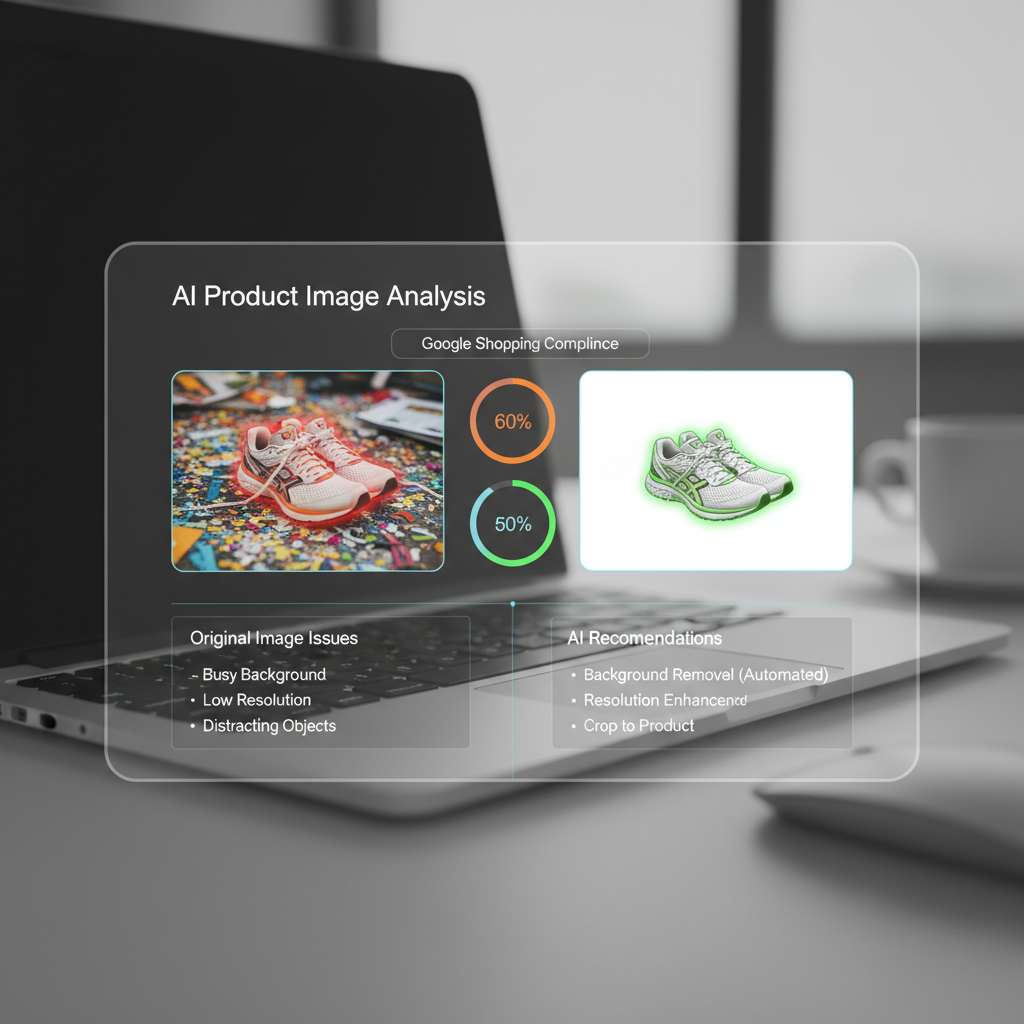
What are the core Google Shopping image guidelines?
The core Google Shopping image guidelines focus on clarity, accuracy, and professionalism to provide a consistent user experience. Products must be clearly visible, occupying at least 75% but not more than 90% of the total image area. The background should be solid white or transparent, especially for the main product image. Images must also be of sufficient resolution, with a minimum of 100×100 pixels for apparel and 50×50 pixels for all other products, though higher resolutions are always recommended for better visual appeal and zoom functionality.
Ensuring AI-generated images meet Google’s standards
Ensuring AI-generated images meet Google’s standards involves configuring AI tools to produce outputs that align with all specified criteria. Modern AI image generators can be trained on Google’s guidelines, allowing them to automatically remove backgrounds, adjust lighting, crop images to optimal ratios, and even upscale resolution without quality loss. This proactive approach ensures that the output is “Google Shopping image requirements and AI compliance guide”-ready from the moment of creation, reducing manual review time and potential errors. AI can also detect and flag non-compliant elements like logos or text overlays before submission.
Common pitfalls to avoid with AI product visuals
While powerful, AI product visuals can still encounter pitfalls if not managed correctly. Over-reliance on AI without human oversight can lead to uncanny valley effects, where products look artificial or unrealistic, potentially harming customer trust. Another common issue is generating images that, while technically compliant, lack the aesthetic appeal or brand consistency that resonates with target audiences. It is crucial to use AI as an enhancement tool, not a complete replacement for creative direction. Additionally, ensure the AI models are regularly updated to reflect any changes in Google’s evolving image policies.
Leveraging AI for Creating Google Shopping Product Images at Scale
AI for creating Google Shopping product images at scale offers an unprecedented advantage for e-commerce businesses managing large inventories, enabling rapid generation and customization of high-quality visuals. This involves using AI-powered platforms to automate repetitive tasks like background removal, image optimization, and even generating entirely new product variations from existing data, drastically cutting down on production time and costs. By automating these processes, businesses can maintain a consistent visual brand identity across thousands of products without extensive manual effort.

Automating background removal and image clean-up
Automating background removal and image clean-up is one of the most immediate benefits of using AI for product imagery. AI algorithms can precisely identify product outlines and separate them from busy or inconsistent backgrounds, replacing them with the required solid white or transparent options. This capability is essential for adhering to Google’s strict guidelines and ensures a clean, professional look for every listing. Beyond backgrounds, AI can also perform minor touch-ups, remove dust or imperfections, and correct color imbalances, all at a speed impossible for human editors.
Generating product variations and lifestyle shots with AI
AI for creating Google Shopping product images at scale extends to generating product variations and compelling lifestyle shots. Instead of costly photoshoots for every color, size, or material variant, AI can render these variations digitally based on a single original image and product data. Furthermore, AI can place products into realistic, context-rich lifestyle scenes, helping customers visualize how they might use the item. This capability is invaluable for enhancing product appeal and providing a richer shopping experience without the logistical challenges of traditional photography.
Cost and time efficiencies of AI image creation
The cost and time efficiencies of AI image creation are transformative for e-commerce operations. Traditional product photography involves significant expenses for studios, photographers, models, and post-production. AI significantly reduces or eliminates many of these costs. What might take days or weeks for a large catalog can be accomplished in hours with AI, allowing businesses to bring products to market faster and respond more agilely to trends. This efficiency directly impacts profitability and competitive advantage, freeing up resources for other marketing efforts.
How AI Product Images Affect Google Shopping Performance Scores
How AI product images affect Google Shopping performance scores is a critical consideration, as high-quality, compliant, and engaging visuals directly influence click-through rates (CTR), conversion rates, and ultimately, ad relevance. Google’s algorithms favor listings with excellent image quality because they enhance user experience and lead to more successful transactions. AI-generated images, when done correctly, can significantly boost these metrics by ensuring visual consistency, appeal, and adherence to technical specifications.
Impact on click-through rates and conversions
The impact of AI-enhanced images on click-through rates (CTR) and conversions is substantial. Visually appealing and accurate product images are often the first point of contact for potential customers on Google Shopping. AI ensures these images are optimized for maximum impact, making products stand out in a crowded marketplace. Higher-quality images instill greater confidence in shoppers, leading to more clicks and a higher likelihood of purchase. This direct correlation means that investing in AI for superior imagery can yield a significant return on investment through improved sales performance.
Google’s image quality signals and AI alignment
Google’s image quality signals are integral to how product listings are ranked and displayed. These signals include factors like image resolution, clarity, background consistency, and the absence of watermarks or promotional text. AI tools are perfectly aligned with these signals, as they can be programmed to automatically optimize images against these specific criteria. By consistently providing images that meet or exceed Google’s quality expectations, businesses can improve their ad relevance and visibility, leading to better overall Google Shopping performance scores.
Avoiding image disapprovals and account suspensions
Avoiding image disapprovals and account suspensions is a primary benefit of using AI for Google Shopping images. Disapprovals often occur due to non-compliant images, such as those with text overlays, incorrect aspect ratios, or low resolution. AI systems can act as a pre-submission filter, automatically detecting and rectifying these issues before they reach Google’s review process. This proactive compliance significantly reduces the risk of individual product disapprovals and, more critically, prevents account-level suspensions that can severely disrupt business operations.
AI Product Photo SEO Optimization for Google Image Search
AI product photo SEO optimization for Google image search involves using artificial intelligence to enhance the discoverability and ranking of product images beyond the Google Shopping platform. This goes beyond mere compliance, focusing on optimizing image metadata, file sizes, and visual content to appeal to Google’s broader image search algorithms. By leveraging AI, businesses can ensure their product visuals contribute meaningfully to their overall SEO strategy, driving organic traffic and brand visibility.
Optimizing image file names and alt text with AI
Optimizing image file names and alt text with AI is a crucial step for SEO. AI can analyze product descriptions and keywords to suggest highly relevant and descriptive file names and alt text, which are vital for search engines to understand image content. Instead of generic names like “image123.jpg,” AI can generate “blue-silk-dress-womens-fashion.jpg” and alt text like “Elegant blue silk dress for women, perfect for evening wear.” This detailed, keyword-rich metadata helps Google index images more effectively, improving their chances of appearing in relevant image search results.
Structured data and image sitemaps for AI-generated visuals
Structured data and image sitemaps are essential for AI-generated visuals to achieve maximum SEO impact. AI tools can assist in automatically embedding schema markup (structured data) directly into image files or product pages, providing search engines with explicit information about the product, price, and availability associated with the image. Furthermore, AI can help generate and maintain comprehensive image sitemaps, ensuring that all AI-created product images are discoverable and crawlable by Google, thereby boosting their visibility in image search results.
Improving image loading speed and user experience
Improving image loading speed and user experience is a direct outcome of AI optimization. Large image files can significantly slow down website loading times, negatively impacting SEO rankings and user retention. AI can compress images to optimal file sizes without compromising visual quality, ensuring fast loading across all devices. This optimization enhances the overall user experience, reduces bounce rates, and signals to Google that the website provides a high-quality experience, further benefiting search rankings for AI product photo SEO optimization for Google image search.
Best Practices for Implementing AI in Your Google Shopping Strategy
Implementing AI effectively in your Google Shopping strategy requires a thoughtful approach that balances automation with quality control. The goal is to leverage AI’s power to enhance efficiency and performance without sacrificing brand integrity or customer trust. This involves choosing the right AI tools, establishing clear guidelines for AI-generated content, and continuously monitoring performance.
Choosing the right AI tools for product image generation
Choosing the right AI tools for product image generation is fundamental to success. Evaluate platforms based on their ability to meet Google’s specific image requirements, their ease of integration with your existing e-commerce setup, and the quality of their output. Look for tools that offer features like automated background removal, intelligent cropping, color correction, and the ability to generate lifestyle scenes. Consider solutions that provide flexibility for human oversight and fine-tuning, ensuring the AI output aligns perfectly with your brand’s aesthetic and product accuracy needs.
Integrating AI workflows into existing e-commerce operations
Integrating AI workflows into existing e-commerce operations should be a seamless process. Start by identifying bottlenecks in your current image creation pipeline where AI can provide the most value, such as mass background removal or variation generation. Implement AI tools incrementally, training your team on their use and establishing clear protocols for review and approval of AI-generated content. This phased approach allows for smooth adoption, minimizes disruption, and ensures that AI becomes a valuable, integrated component of your overall product content strategy.
Monitoring and analyzing AI image performance metrics
Monitoring and analyzing AI image performance metrics is crucial for continuous improvement. Track key indicators such as click-through rates, conversion rates, image disapproval rates, and engagement metrics for products featuring AI-generated visuals. Use A/B testing to compare the performance of AI-enhanced images against traditionally created ones. This data-driven approach allows you to refine your AI strategies, adjust parameters, and ensure that your AI product photos optimized for Google Shopping feed are consistently delivering optimal results and contributing positively to your bottom line.
| Feature/Aspect | Traditional Product Photography | AI Product Image Generation |
|---|---|---|
| Cost per Image | High (studio, photographer, models, post-production) | Low (subscription/usage fees for AI platform) |
| Time to Produce | Days to weeks for large catalogs | Hours to days for large catalogs |
| Scalability | Limited by resources and logistics | Highly scalable, virtually unlimited output |
| Consistency | Can vary between photographers/sessions | High, automated adherence to guidelines |
| Compliance | Manual review, prone to human error | Automated checks, higher compliance rate |
| Variations/Lifestyle | Expensive and time-consuming | Efficient and cost-effective digital rendering |
Future Trends: The Evolution of AI in E-commerce Visuals
The evolution of AI in e-commerce visuals is rapid, promising even more sophisticated capabilities for online merchants. As AI technology advances, we can expect increasingly realistic, personalized, and interactive product imagery that further blurs the lines between digital and physical shopping experiences. Staying abreast of these trends will be vital for maintaining a competitive edge in the digital marketplace.
Personalized product imagery and dynamic content
Personalized product imagery and dynamic content represent a significant future trend. Imagine an AI that can dynamically alter a product image on a Google Shopping ad based on the individual shopper’s preferences, location, or past browsing history. For example, a coat might be shown on a model matching the shopper’s demographic, or in a setting relevant to their local climate. This level of personalization, driven by AI, will create highly engaging and relevant shopping experiences, significantly boosting conversion rates.
AI-powered virtual try-on and augmented reality integration
AI-powered virtual try-on and augmented reality (AR) integration are poised to revolutionize how customers interact with product visuals. AI can facilitate realistic virtual try-on experiences for apparel, eyewear, or even furniture, allowing shoppers to see how products look on them or in their own homes before purchasing. Integrating these AR capabilities directly into Google Shopping listings or product pages, powered by AI-generated models and environments, will provide an immersive experience that builds confidence and reduces returns.
Ethical considerations and transparency in AI image generation
Ethical considerations and transparency in AI image generation will become increasingly important. As AI-generated images become indistinguishable from real photographs, questions around authenticity, potential for manipulation, and consumer trust will arise. Future trends will likely involve clear labeling of AI-generated content, robust ethical guidelines for AI development, and mechanisms to ensure that AI-created visuals are used responsibly and truthfully. Maintaining transparency will be key to fostering consumer confidence in the evolving landscape of e-commerce visuals.
What is AI compliance for Google Shopping images?
AI compliance for Google Shopping images refers to using artificial intelligence tools to automatically ensure that all product visuals adhere to Google’s specific guidelines, such as background requirements, resolution, and content restrictions. This helps prevent disapprovals and improves listing quality.
Can AI create lifestyle product images?
Yes, AI can create highly realistic lifestyle product images. By leveraging advanced generative AI models, businesses can place products into various virtual environments and scenarios, eliminating the need for expensive and time-consuming physical photoshoots for every product variation or setting.
How does AI improve Google Shopping performance?
AI improves Google Shopping performance by optimizing product images for higher quality, compliance, and aesthetic appeal. This leads to increased click-through rates, better conversion rates, and improved ad relevance scores, as Google favors listings with excellent visual content.
Is AI product photo SEO optimization important for image search?
Yes, AI product photo SEO optimization is very important for Google image search. AI helps by generating descriptive file names and alt text, facilitating structured data implementation, and optimizing image file sizes for faster loading, all of which enhance discoverability and ranking in organic image results.
Are AI-generated images allowed on Google Shopping?
Yes, AI-generated images are generally allowed on Google Shopping, provided they meet all of Google’s standard image requirements. The key is that the images must accurately represent the product, be of high quality, and adhere to all content policies, regardless of how they were created.
What are the main benefits of using AI for product images at scale?
The main benefits of using AI for product images at scale include significant cost savings, drastically reduced production times, enhanced consistency across large catalogs, and improved compliance with platform guidelines. This enables businesses to quickly generate vast quantities of high-quality visuals.
The integration of AI product photos optimized for Google Shopping feed is no longer a futuristic concept but a present-day necessity for competitive e-commerce. Businesses that embrace this technology stand to gain significant advantages in efficiency, cost savings, and market performance. By leveraging AI to meet stringent image requirements, scale content creation, and boost SEO, merchants can dramatically enhance their online presence and drive sales.
Key takeaways for your e-commerce strategy:
* Prioritize AI tools that ensure Google Shopping image requirements and AI compliance guide adherence.
* Utilize AI for creating Google Shopping product images at scale to manage large inventories efficiently.
* Understand how AI product images affect Google Shopping performance scores to optimize for higher CTR and conversions.
* Implement AI product photo SEO optimization for Google image search to expand organic visibility.
* Stay informed on future AI trends to keep your visual content cutting-edge.
Start exploring AI solutions today to transform your product imagery and unlock new levels of success on Google Shopping and beyond.