


AI Product Photo Audit Checklist 2026 Strategy Guide
In the competitive landscape of online retail, compelling product imagery is no longer a luxury but a necessity. High-quality visuals are paramount, with up to 94% of shoppers stating that product image quality impacts their purchase decisions. As artificial intelligence (AI) revolutionizes content creation, understanding how to audit ecommerce product images with AI has become critical for maintaining visual excellence and driving conversions. This comprehensive AI product photo audit checklist provides online sellers with a systematic approach to evaluating and optimizing their AI-generated or AI-enhanced product visuals, ensuring they meet the highest standards for quality, compliance, and performance. By leveraging AI in your auditing process, you can identify areas for improvement, boost your search engine optimization (SEO), and ultimately enhance your sales.
Why is an AI Product Photo Audit Essential for Online Sellers?
An AI product photo audit is crucial for maintaining visual quality, ensuring compliance with marketplace standards, and maximizing conversion rates in the dynamic e-commerce environment. While AI tools offer unprecedented speed and cost efficiency in generating product visuals, they also introduce new challenges that necessitate systematic review.
Understanding the Impact of Visuals on Conversion Rates
Product images are the most influential factor in a Shopify store’s conversion rate, acting as the primary sales driver when shoppers cannot physically interact with products. Studies indicate that visual content accounts for up to 93% of purchasing decisions, making high-quality, engaging imagery non-negotiable for online success. AI-generated images, when optimized, can significantly increase conversion rates, with some brands reporting boosts of up to 42%. Conversely, poor visuals can lead to increased cart abandonment and reduced customer trust. An effective AI product photo audit checklist helps ensure every image contributes positively to the customer journey.

Mitigating Risks: Compliance and Brand Consistency with AI
The rapid adoption of AI photography tools has created a gap between production speed and visual quality standards, leading to potential inconsistencies and compliance issues. Marketplace enforcement actions against non-compliant imagery can result in listing removals and account penalties. AI product photography auditing systematically evaluates synthetic or AI-enhanced images to ensure they meet quality thresholds, technical specifications, and legal compliance. This includes verifying accurate color representation, realistic lighting, and appropriate depth of field. Maintaining a consistent visual identity across product listings builds customer recognition and trust, which is often compromised by unvetted AI-generated content.
The Role of AI in Modern Product Photography Workflows
AI is redefining how brands create and enhance product visuals, automating tasks like background removal, image enhancement, and even generating entire lifestyle scenes. This automation significantly reduces costs and accelerates time-to-market, allowing businesses to scale their product visuals effortlessly. However, this efficiency gain comes with new accountability requirements. A modern product photography workflow often involves capturing clean product images, enhancing them with AI, generating new variations, adapting visuals for different platforms, and scaling output across campaigns. An ecommerce image audit template for online sellers is essential to integrate quality control seamlessly into this fast-paced process, ensuring that AI-generated visuals align with brand standards and platform requirements before publication.
How Can AI Analyze Product Image Quality and Accuracy?
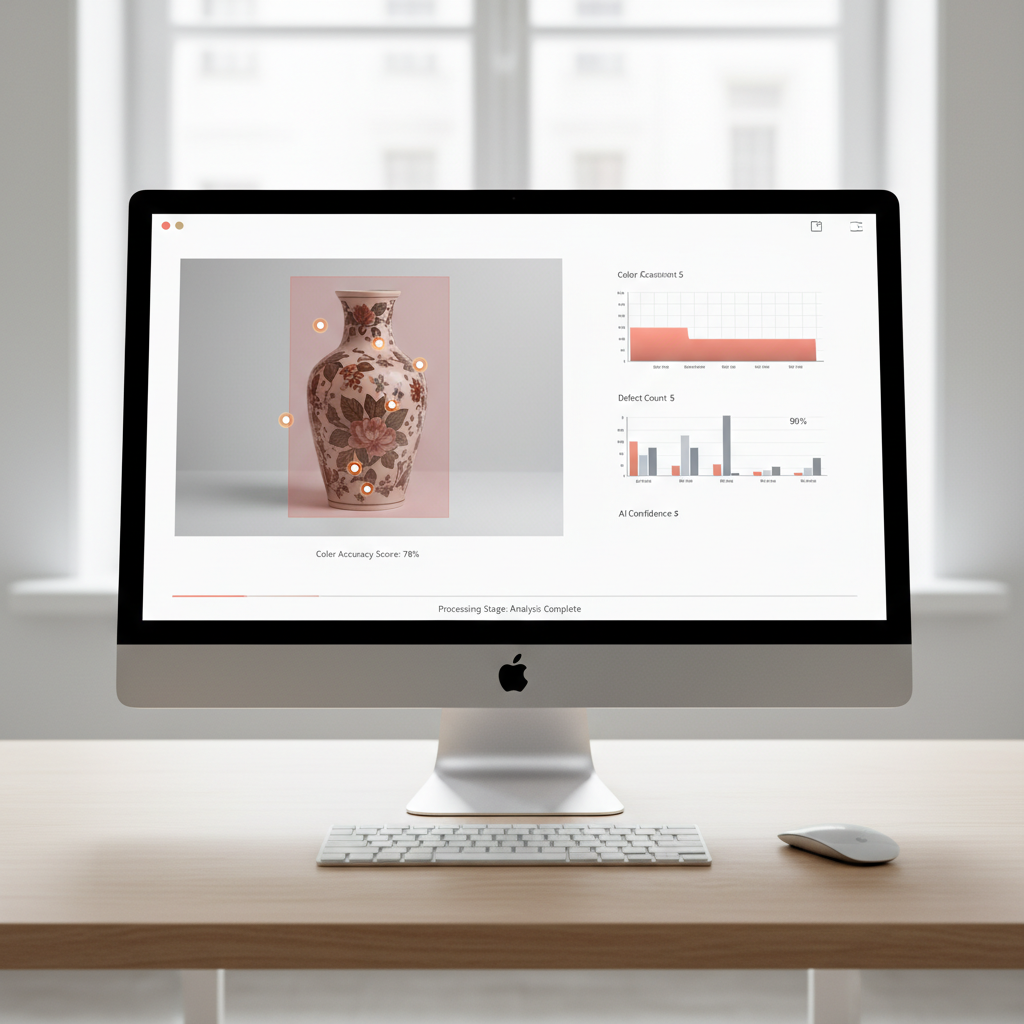
AI can analyze product image quality by meticulously evaluating resolution, color accuracy, lighting consistency, and detecting common visual artifacts, thereby ensuring the faithful representation of products in e-commerce. AI image analyzers leverage computer vision to interpret and analyze visual data, identifying patterns and inconsistencies that might be missed by the human eye.
Leveraging AI for Visual Accuracy Assessment
Visual accuracy assessment checks whether the AI faithfully reproduces the actual product’s features, colors, and proportions. AI-powered tools can automatically correct image imperfections, adjust lighting and colors, and even add missing details, resulting in high-quality and appealing product images. For instance, AI can be prompted to relight a product with soft, even studio lighting, adding gentle highlights and natural shadows to enhance depth while keeping colors accurate and realistic. This is especially useful for improving low-quality supplier photos or user-generated images.
Detecting AI-Generated Artifacts and Inconsistencies
Despite advancements, AI image generation can still produce inconsistencies, often referred to as “hallucinations,” that trained eyes can identify. These artifacts can manifest as unnatural fabric textures, distorted product proportions, unrealistic lighting conditions, or background elements that clash with the subject. Common “hallucination zones” to inspect include hands and fingers, text and signage, ears/jewelry, hair at background edges, background crowds and architecture, and lighting and shadows. For example, AI might generate plausible-looking text that doesn’t form real words, or shadows that don’t fall in the same direction. An AI checklist for improving low-converting product photos must include rigorous checks for these AI-specific flaws.
Establishing Quality Benchmarks for AI-Enhanced Visuals
Quality auditing begins with establishing measurable criteria that align with both customer expectations and platform technical requirements. Sellers should evaluate AI-generated images against a checklist that includes resolution adequacy for all target platform requirements (aiming for at least 2000 pixels on the longest side for zoom features), accurate color representation (using sRGB color space), and realistic lighting consistency. Creating a reference portfolio of your best professional photographs and comparing AI outputs side-by-side can help identify discrepancies in shadow direction, reflection patterns, or fabric texture rendering. For critical items, maintaining physical samples for spot-check comparison during audit processes is recommended.
Optimizing Product Image SEO and Conversion with AI Audits
AI-powered audits can significantly enhance product image SEO and conversion rates by identifying opportunities for optimized alt text, appropriate file formats, and responsive design, while also suggesting visual improvements that drive engagement and sales. Image optimization is a technical discipline that affects page speed, SEO rankings, accessibility, and conversion rates simultaneously.
AI-Driven Strategies for Image SEO Enhancement
Image SEO is the process of helping search engines find, understand, and display your images for relevant queries. AI tools can play a pivotal role in this. For optimal SEO, every product image should have descriptive alt text. AI can automate the generation of keyword-rich alt text and filenames across your catalog, ensuring images are ready for both search and AI discovery. Using HTML `` tags, implementing image sitemaps, and choosing the right file formats (like JPEG for photos, WebP for better performance) are also crucial. AI search engines favor content that loads fast, answers questions quickly, and works well on mobile.
Improving Conversion Rates Through Visual Optimization
High-quality and optimized product images can significantly increase conversion rates. AI has revolutionized how e-commerce businesses optimize their product images, directly impacting these rates. By using AI, businesses can enhance, resize, and format images to meet audience preferences, ensuring a personalized and engaging shopping experience. Clear, high-quality visuals help customers understand what they’re purchasing, reducing cart abandonment caused by uncertainty. AI can also generate multiple image sizes and formats optimized for various channels, increasing visibility and engagement.
Automating Alt Text and Metadata Generation
Manually writing alt text and optimizing metadata for thousands of product images is a time-consuming task. AI tools can automate this process, generating descriptive image alt text, titles, captions, and descriptions in seconds. This automation not only saves hours but also ensures consistency and keyword relevance across your entire product catalog, improving Google indexing and accessibility scores. Some AI platforms can even customize prompts for niche-specific optimization, like for e-commerce products, integrating SEO keywords effectively.
Implementing an AI-Driven Product Image Audit Workflow
Implementing an AI-driven product image audit workflow transforms quality control into an efficient, systematic process by defining clear objectives, leveraging automated tools for initial scans, conducting human reviews for nuanced issues, and continuously monitoring performance. This approach ensures visual assets consistently meet brand and platform standards.
Key Steps in Building Your AI Image Audit Process
A systematic audit workflow integrates quality control seamlessly into your product imagery pipeline. The key steps include:
- Define Scope and Objectives: Clearly identify what aspects of the images will be audited (e.g., quality, compliance, SEO) and set specific goals.
- Source Image Validation: Verify that reference photos meet minimum resolution and lighting requirements before AI generation begins, as AI outputs are only as accurate as their inputs.
- Automated Preliminary Scan: Use AI detection tools to flag obvious artifacts, technical issues, and compliance problems automatically. This can include checks for resolution, file size, and basic content.
- Human Visual Review: Conduct a human review of flagged items and a random sampling of non-flagged images to catch subtle inconsistencies or creative nuances AI might miss. Human oversight ensures AI-generated visuals don’t drift off-brand or introduce unintended distortions.
- Comparative Analysis: Compare AI-generated images against reference images and established brand standards documentation to ensure visual accuracy, technical quality, and brand consistency.
- Platform-Specific Validation: Confirm each image meets the technical requirements of specific marketplaces (e.g., Amazon, Shopify) using automated dimension and format verification.
- Legal Review: Assess generated content for disclosure requirements and advertising standard compliance, as misleading product representations can lead to penalties.
- Customer Preview Test: View images on various mobile devices and across different browsers to identify any display inconsistencies before publishing.
- Continuous Monitoring: Regularly audit AI-generated visuals to ensure ongoing quality and alignment with evolving brand aesthetics and market trends.
Integrating AI Tools into Your Existing E-commerce Operations
Integrating AI into your e-commerce operations streamlines the auditing process. Many AI tools offer API integrations, allowing them to be built into existing workflows for automated image processing. For instance, AI can automatically tag and organize image libraries, detect objects, and identify visual similarities, making large-scale audits more manageable. Building templates that include branding, alt-text prompts, and metadata slots can standardize the process.
Creating an Ecommerce Image Audit Template for Online Sellers
An ecommerce image audit template for online sellers provides a structured framework to identify and fix image issues that silently cost sales and search rankings. This template should cover both technical and creative aspects.
| Audit Category | Checklist Item | AI Audit Capability | Impact |
|---|---|---|---|
| Visual Quality | Resolution & Sharpness | Detects blur, low resolution, upscales | Customer trust, zoom functionality |
| Color Accuracy | Compares to reference, identifies shifts | Reduces returns, builds trust | |
| Lighting & Shadows | Ensures consistency, realism | Professionalism, product depth | |
| Product Proportions | Flags distortions, anatomical errors | Accurate representation, customer satisfaction | |
| Brand Consistency | Background Consistency | Standardizes backgrounds across sets | Visual harmony, brand recognition |
| Style Alignment | Compares to brand guidelines (lighting, angles, mood) | Cohesive brand voice, trust | |
| Technical SEO | Alt Text Coverage | Identifies missing, generates descriptive text | SEO ranking, accessibility |
| File Naming | Flags generic names, suggests keyword-rich | SEO discoverability | |
| File Size & Format | Compresses, recommends optimal format | Page load speed, user experience | |
| Responsive Images | Checks for mobile optimization | Mobile user experience, SEO | |
| Conversion & Compliance | Image Count per Product | Recommends optimal number (3-5 minimum) | Customer engagement, informed decisions |
| Variant Images | Ensures each variant has assigned images | Reduces confusion, improves clarity | |
| Marketplace Guidelines | Verifies compliance (e.g., Amazon, Shopify) | Avoids penalties, listing removals |
Advanced AI Techniques for Improving Low-Converting Product Photos
Advanced AI techniques can dramatically improve low-converting product photos by generating realistic lifestyle scenes, optimizing lighting and shadows, enhancing textures, and creating diverse visual variations for A/B testing, all aimed at boosting engagement and sales. These capabilities move beyond basic editing to truly transform product presentation.
Generating High-Impact Lifestyle Scenes with AI
One of the most powerful applications of AI is its ability to generate photorealistic lifestyle scenes from basic product photos. This means a product photographed on a plain white background can be convincingly placed in a kitchen, a forest, or a luxury setting, providing context and aspirational appeal. AI background generators create photorealistic settings, helping products feel relatable and aspirational, which is crucial for influencing consumer behavior. This significantly reduces the need for expensive and time-consuming physical photoshoots. Some tools can even add virtual models or props, further enriching the scene.
AI-Powered Lighting, Shadow, and Texture Enhancements
AI tools excel at refining the technical aspects of product imagery. They can automatically adjust lighting and colors, correct imperfections, and even add missing details to create high-quality, appealing product images. Advanced AI can relight products with soft, even studio lighting, adding realistic shadows that enhance depth and make products pop on white backgrounds. This is vital because lighting is often what separates amateur photos from professional ones. AI can also improve image sharpness, color accuracy, and overall visual appeal, ensuring textures and materials are rendered realistically. This comprehensive AI checklist for improving low-converting product photos includes verifying these subtle yet impactful details.
A/B Testing Visual Variations for Optimal Performance
AI-powered tools enable marketers to generate multiple variations of product images, making A/B testing visual elements significantly faster and more agile than traditional methods. You can create different backgrounds, lighting styles, compositions, or even product angles and test which resonate best with specific audience segments. This iterative process allows brands to statistically validate which visuals drive the highest engagement, click-through rates, and ultimately, conversions. By continuously generating and testing new assets, brands can keep their visuals fresh and optimized for ongoing campaigns and seasonal updates.
Selecting the Right AI Tools for Your Product Image Audit
Selecting the right AI tools for your product image audit involves carefully evaluating features such as automated quality checks, SEO optimization capabilities, compliance verification, and seamless integration to ensure they align with your specific e-commerce needs and workflow. The market for AI product photography tools is rapidly expanding, offering diverse solutions.
Comparing Leading AI Image Audit and Enhancement Platforms
Various AI tools specialize in different aspects of product image auditing and enhancement. Some focus on background removal and scene generation, while others excel in automated editing and optimization for large catalogs. For instance, tools like Photoroom, PixelPanda, and Claid.ai offer features like background removal, upscaling, and lifestyle scene creation, often with batch processing capabilities. Platforms like Nightjar prioritize consistency across entire catalogs by learning and applying a brand’s aesthetic. For SEO, tools can automate alt-text and metadata generation, as seen with some WordPress plugins.
Here’s a comparison of common AI tool categories and their typical features:
| AI Tool Category | Key Features for Audit/Enhancement | Best Use Case | Example Tools (Illustrative) |
|---|---|---|---|
| Generative AI for Scenes | Background replacement, lifestyle scene creation, virtual models, prop generation | Creating aspirational lifestyle imagery without photoshoots | Photoroom, Flair.ai, Pebblely, Midjourney |
| Image Enhancement & Optimization | Upscaling, sharpening, color correction, lighting adjustment, smart compression | Improving existing low-quality images, ensuring consistency | Claid.ai, Deep-image.ai, Let’s Enhance |
| AI Image Analyzers | Object detection, scene recognition, content tagging, anomaly flagging, visual similarity | Automated quality checks, content moderation, organizing large libraries | Google Cloud Vision API |
| SEO & Metadata Automation | Alt text generation, descriptive filenames, structured data integration | Optimizing images for search engine visibility and accessibility | Hypotenuse AI, WP Media Folder (with AI) |
| Brand Consistency Tools | Applying consistent styles (lighting, angles, colors) across catalogs, template-based generation | Maintaining a cohesive brand aesthetic at scale | Nightjar |
Criteria for Choosing AI Tools for Ecommerce Visuals
When choosing AI tools for your product image audit, consider the following:
- Accuracy and Realism: How well does the AI preserve product details, colors, and textures without introducing artifacts or distortions? Some generators might hallucinate buttons or warp logos.
- Scalability and Automation: Can the tool handle your product catalog volume efficiently, offering batch processing and API integrations for automated workflows?
- Ease of Use and Workflow Integration: Is the interface intuitive? Can it seamlessly integrate with your existing e-commerce platforms (e.g., Shopify, Amazon) and design tools (e.g., Photoshop)?
- Customization and Control: Does the tool allow for specific prompts, style guides, and human intervention to ensure brand alignment?
- Compliance Features: Does it help verify images against marketplace guidelines and legal requirements?
- Cost-Effectiveness: Evaluate pricing models (subscription, credit-based) against your budget and anticipated usage.
Future Trends in AI Product Photography and Auditing
The future of AI in e-commerce product photography is bright, with continuous advancements. Emerging trends include:
- Interactive 3D Models and AR/VR Integration: AI will facilitate the creation of interactive 3D models, allowing customers to view products from various perspectives and virtually “try on” items.
- Hyper-Personalized Visuals: AI will produce images tailored to individual customer preferences, further enhancing the online buying experience.
- Advanced Predictive Analytics: AI will offer more sophisticated insights into how consumers react to content, helping brands select images with the highest performance potential.
- Continuous, Real-time Auditing: AI auditing frameworks will become more integrated and automated, offering real-time performance monitoring and anomaly flagging.
Embracing these tools and trends will be essential for staying competitive and delivering exceptional visual experiences.
Frequently Asked Questions About AI Product Photo Audits
What is AI product photography?
AI product photography refers to digitally enhanced or entirely synthetic product images created using artificial intelligence algorithms. These algorithms can generate, edit, or improve product imagery without traditional photography equipment, offering efficiency and scalability for e-commerce sellers.
How often should I audit my product images with AI?
Regular audits are crucial. It’s recommended to perform a comprehensive audit before publishing new products, after major website updates, or when launching new campaigns. For high-traffic or top-selling products, more frequent spot-checks or automated continuous monitoring with AI tools can help maintain optimal performance.
Can AI detect misleading product images?
Yes, AI can be trained to detect inconsistencies that might lead to misleading product representations. This includes identifying incorrect color shifts, distorted proportions, or lifestyle images showing products in settings they don’t actually ship with. Human oversight remains vital for nuanced ethical and legal compliance checks.
Is AI product photography ethical?
AI product photography is ethical when used responsibly and transparently. Brands should prioritize accuracy, ensuring AI-generated images faithfully represent the real-world item. Disclosing AI usage when necessary and avoiding deceptive modifications helps maintain consumer trust and adheres to advertising standards.
What are the main benefits of using AI for image auditing?
The main benefits include increased efficiency, reduced costs, improved consistency, and enhanced accuracy in identifying image issues. AI can process large volumes of images quickly, automate repetitive checks, and provide data-driven insights to optimize visuals for better SEO and conversion rates.
How does AI impact image SEO?
AI significantly impacts image SEO by automating the generation of descriptive alt text and filenames, optimizing image compression for faster page loads, and helping ensure images are responsive. This improves discoverability, indexing, and ranking in search results, including
visual search results. By ensuring images meet technical SEO requirements and are highly relevant to search queries, AI helps drive more organic traffic to product pages.
The Future is Visual: Mastering Your AI Product Photo Audit Checklist 2026
The landscape of e-commerce is constantly evolving, with visual content playing an increasingly critical role in consumer decision-making. As we move towards 2026, the integration of artificial intelligence into every facet of product photography and auditing will no longer be an option, but a necessity for competitive brands. The comprehensive AI product photo audit checklist 2026 isn’t just a guide; it’s your strategic blueprint for ensuring your visual assets are not only stunning but also optimized for performance, compliance, and conversion.
By diligently applying the principles and tools outlined in this guide, you empower your brand to leverage the full potential of AI. From automating mundane checks to gaining predictive insights into customer preferences, AI-driven audits ensure your product images are always at their peak. Embrace these advanced methodologies to enhance user experience, improve search engine visibility, and ultimately, drive greater sales in a visually-driven market. Stay ahead of the curve, continuously refine your visual strategy, and let AI be your partner in achieving unparalleled e-commerce success.