

How AI Product Photography Reduces Time-to-Market for New Products
AI product photography fundamentally transforms the launch process for new items, significantly reducing the time-to-market. By automating and streamlining image creation, businesses can accelerate their product introduction cycles, gaining a crucial competitive edge. This innovative approach allows brands to generate high-quality visuals rapidly, bypassing the traditional bottlenecks associated with conventional photography methods. Ultimately, it means products can move from concept to consumer much faster.
AI Product Photo Generation Speed vs. Traditional Photography Workflow: A Comparison
AI product photography dramatically outpaces traditional methods in terms of image generation speed, allowing businesses to launch products faster. Traditional photography involves numerous time-consuming steps, from booking studios and models to lengthy post-production editing. In contrast, AI platforms can create photorealistic images from 3D models or even simple product descriptions in minutes or hours. This rapid turnaround directly translates into a reduced time-to-market for new products.
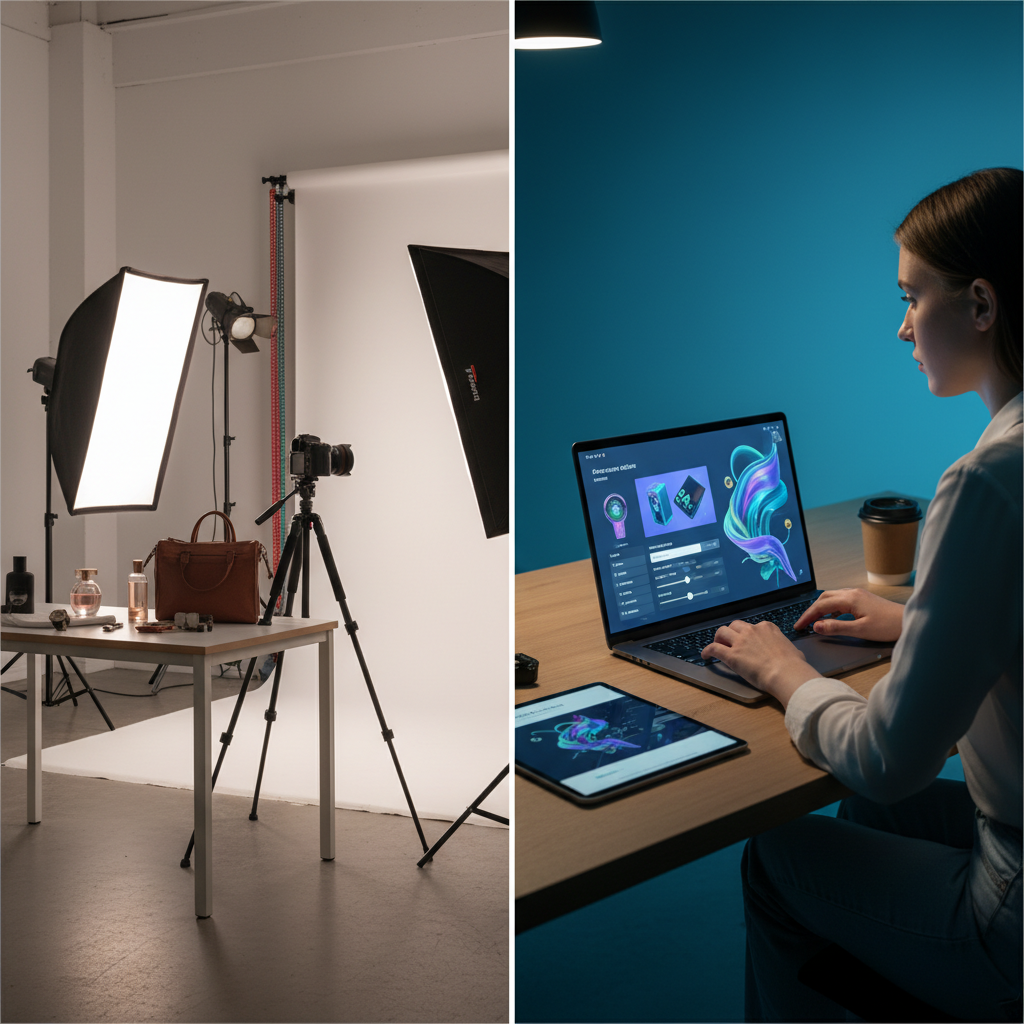
The AI product photo generation speed vs traditional photography workflow highlights a stark difference in operational efficiency. A conventional photoshoot often requires days or weeks of planning, execution, and editing. This includes logistical arrangements, setup, shooting, and extensive retouching. Each of these stages can introduce delays, particularly when dealing with multiple products or variations. AI, however, eliminates most of these physical constraints, providing an on-demand solution for visual content.
How AI Product Photography Accelerates Image Creation Timelines
AI tools leverage advanced algorithms to produce high-quality product visuals almost instantly. Users can upload existing product designs or specifications, and the AI generates various scenes, angles, and lighting conditions. This process bypasses the need for physical prototypes, studio rentals, or human photographers. The ability to iterate quickly on visual concepts further speeds up the approval process.
Eliminating Delays in the Traditional Product Photography Process
Traditional photography workflows are prone to several bottlenecks. Weather conditions, model availability, equipment failures, and extensive manual editing can all cause significant delays. AI product photography removes these dependencies. It offers a controlled, digital environment where images can be created and refined without external factors impacting the timeline. This predictability is invaluable for tight launch schedules.
Enterprise AI Product Photography Cost Analysis and Savings: Maximizing ROI
Enterprise AI product photography cost analysis and savings reveal substantial financial benefits compared to traditional methods, leading to a higher return on investment (ROI). While initial investment in AI tools or subscriptions exists, the long-term operational savings in equipment, studio rental, personnel, and post-production are significant. This cost reduction directly contributes to a more efficient product launch budget.
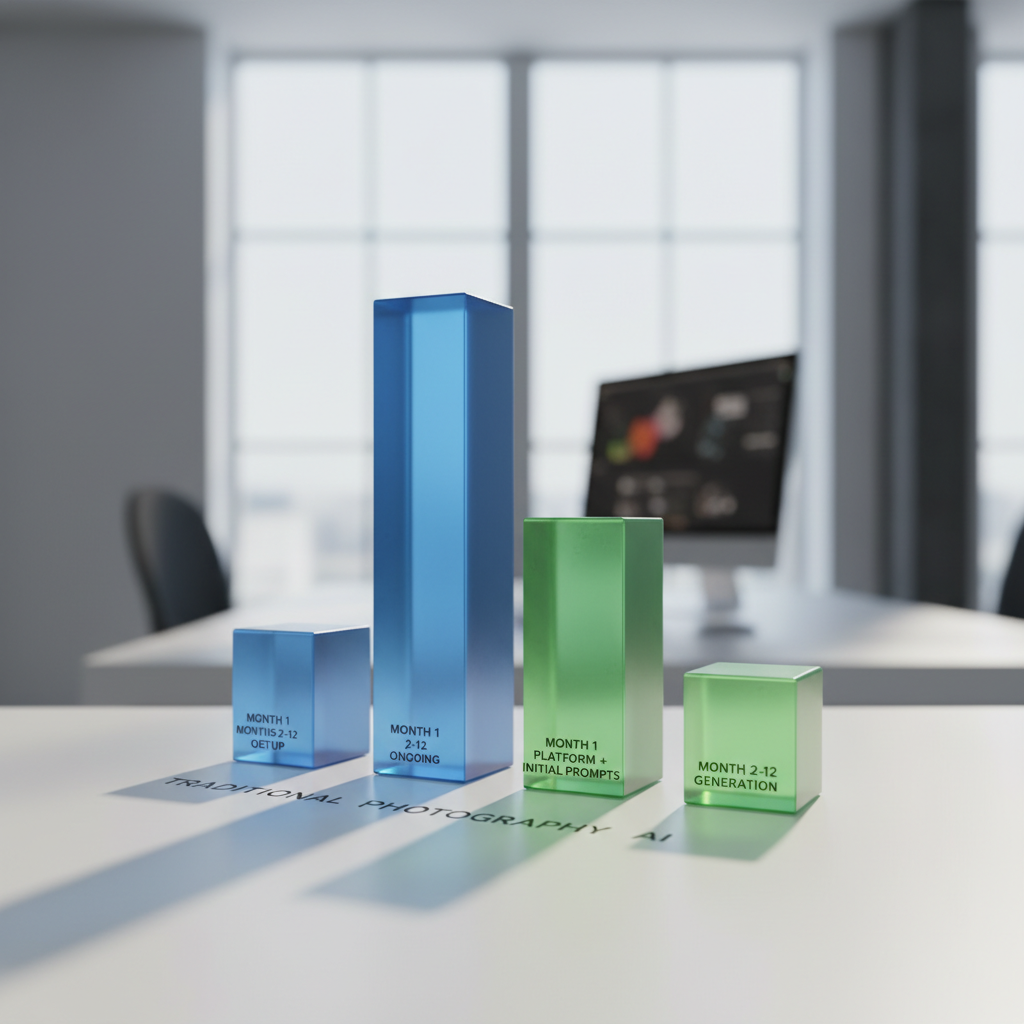
The financial advantages of AI product photography extend beyond just direct cost cutting. Reduced time-to-market means products start generating revenue sooner, improving cash flow and profitability. Furthermore, the ability to produce a higher volume of diverse visuals for A/B testing or personalized marketing campaigns can lead to increased conversion rates, further boosting ROI. Understanding these savings is crucial for businesses evaluating their visual content strategies.
Reducing Overhead Costs in Product Visual Production
AI product photography drastically cuts down on the overhead associated with traditional photoshoots. Companies no longer need to invest in expensive cameras, lighting equipment, or studio spaces. The costs of hiring photographers, stylists, and retouchers are also significantly reduced or eliminated. This shift transforms a variable, high-cost expense into a more predictable and often lower subscription-based or usage-based cost.
Long-Term Financial Benefits of Implementing AI for Product Visuals
The long-term savings from AI product photography accumulate over time, especially for businesses with large and frequently updated product catalogs. Companies can scale their visual content production without proportionally increasing their budget. This scalability is particularly beneficial for global brands needing localized visuals. The efficiency gains free up resources that can be reallocated to other critical business areas, such as marketing or product development.
AI for Reducing Product Photography Bottlenecks in Ecommerce Operations
AI is instrumental in reducing product photography bottlenecks in ecommerce operations, ensuring a smooth and rapid flow of new products to online storefronts. Traditional photography often creates a significant choke point in the product launch pipeline, as visual assets are typically among the last items to be finalized. AI circumvents these delays by generating high-quality images much earlier and faster in the development cycle.
Ecommerce businesses thrive on speed and variety, making efficient content creation critical. When new products arrive, the race is on to get them listed with appealing visuals. Manual photography workflows can quickly become overwhelmed, leading to backlogs and missed sales opportunities. AI provides an agile solution, allowing brands to keep pace with demand and maintain a constant stream of fresh inventory online.
Streamlining the Visual Content Pipeline for Online Retailers
AI tools integrate seamlessly into existing ecommerce workflows, streamlining the entire visual content pipeline. From initial product design to final website upload, AI can generate visuals at various stages. This means marketing teams can start creating campaigns even before physical products are manufactured. The ability to produce consistent, high-quality images across an entire catalog also enhances brand perception and customer trust.
Overcoming Challenges of Scale and Variety in Ecommerce Photography
Ecommerce platforms often deal with thousands of products, each requiring multiple images from different angles and contexts. Manually photographing such a vast inventory is a monumental task. AI excels at handling scale, capable of generating an unlimited number of images for an unlimited number of products. It also allows for easy variations, such as different colors, materials, or settings, without needing additional photoshoots. This flexibility is crucial for dynamic online stores.
How Fast-Fashion Brands Use AI to Photograph Hundreds of New Items Daily
Fast-fashion brands leverage AI to photograph 100 new items daily, a feat impossible with traditional photography, enabling them to maintain their rapid inventory turnover. The core business model of fast fashion relies on quickly bringing trending styles to market. AI product photography is a critical enabler, allowing these brands to generate the necessary visual assets at an unprecedented pace to match their production cycles.
The speed at which new collections are introduced demands an equally rapid content creation process. AI allows these brands to upload designs or basic product information and instantly generate a range of images. This includes product shots, lifestyle imagery, and even virtual try-ons. The ability to produce such a high volume of diverse visuals daily is a game-changer for staying competitive in a highly dynamic market.
Accelerating Product Launches in the Apparel Industry with AI
The apparel industry, particularly fast fashion, operates on extremely tight timelines. From concept to store, the entire process can take just a few weeks. AI product photography fits perfectly into this accelerated model by providing visual content almost immediately. This means marketing can begin simultaneously with manufacturing, dramatically shortening the lead time for online listings and promotional campaigns.
Maintaining High Volume and Consistency in Rapid Product Cycles
Producing hundreds of images daily while maintaining brand consistency and quality is a significant challenge. AI solutions are programmed with brand guidelines, ensuring every generated image adheres to specific aesthetic standards. This eliminates the variability often seen with multiple photographers or studios. The consistent output reinforces brand identity and provides a seamless shopping experience for customers, even with a constantly refreshing catalog.
Streamlining Product Visuals from Design to Digital Shelf
How AI product photography reduces time-to-market for new products is evident in its ability to streamline the entire visual content creation process, from initial design concepts to final digital deployment. AI bridges the gap between product development and marketing, allowing for simultaneous progress rather than sequential bottlenecks. This integration ensures that high-quality visuals are ready as soon as the product is.
The traditional linear workflow often means product visuals are the last piece of the puzzle, delaying launches. AI allows for a parallel workflow where product designs can be fed into an AI system to generate images even before a physical prototype exists. This proactive approach significantly cuts down on overall launch times, ensuring that marketing materials are ready well in advance of product availability.
Integrating AI into Product Development Workflows for Early Visuals
By integrating AI into the early stages of product development, designers can generate photorealistic renders directly from CAD files or 3D models. This means marketing teams can begin crafting campaigns and populating product pages with visuals much earlier. This early access to high-fidelity images allows for iterative feedback and refinement of both the product and its marketing presentation, ensuring alignment.
Automating Content Delivery for Faster Digital Shelf Placement
Once AI generates the product images, many platforms offer automated delivery and integration with ecommerce systems. This means images can be automatically formatted, tagged, and uploaded to product information management (PIM) systems or directly to online stores. This automation further reduces manual effort and potential errors, ensuring that products appear on the digital shelf as quickly as possible with all necessary visual assets.
Enhancing Brand Consistency and Scalability with AI-Generated Images
AI-generated images play a crucial role in enhancing brand consistency and scalability, directly contributing to a faster time-to-market for new products. By ensuring uniform visual standards across all product lines and marketing channels, AI reinforces brand identity and builds customer trust. This consistent output is difficult to achieve with diverse traditional photography teams.
The ability to scale visual content production effortlessly is a major advantage. As businesses grow and expand their product offerings, AI can generate images at volume without compromising quality or consistency. This scalability means brands can launch new products or enter new markets without being limited by their visual content capabilities, ensuring a smooth and rapid expansion.
Ensuring Uniform Visual Standards Across All Product Launches
AI platforms can be trained on specific brand guidelines, including lighting, background, styling, and product presentation. This ensures that every image generated, regardless of the product or collection, adheres to these predefined standards. This level of consistency creates a cohesive brand experience for customers and strengthens brand recognition across all touchpoints.
Scaling Product Visuals On-Demand for Global Market Expansion
When expanding into new markets, localizing content is often essential. AI allows businesses to generate culturally relevant visuals without the need for new photoshoots in different regions. This on-demand scalability means brands can quickly adapt their visual marketing to various demographics and preferences, accelerating their entry and success in new global territories.
What is AI product photography?
AI product photography uses artificial intelligence algorithms to generate photorealistic images of products without the need for physical prototypes, studios, or traditional cameras. It often utilizes 3D models or product data to create diverse visual assets in various settings and styles. This technology significantly speeds up content creation.
How does AI photography reduce time-to-market?
AI photography reduces time-to-market by eliminating numerous steps in the traditional workflow, such as physical photoshoots, logistical planning, and extensive manual editing. Images can be generated rapidly from design files, allowing marketing and sales teams to prepare launch materials much earlier in the product development cycle.
Is AI product photography cost-effective for enterprises?
Yes, AI product photography is highly cost-effective for enterprises, especially in the long run. It reduces expenses related to studio rentals, equipment, models, photographers, and post-production. While there might be an initial investment in software or subscriptions, the operational savings and faster revenue generation from quicker launches lead to significant ROI.
Can AI generate lifestyle product images?
Absolutely. Modern AI product photography tools are capable of generating highly realistic lifestyle images. They can place products in various virtual environments, with different lighting, shadows, and props, to create compelling scenes that resonate with target audiences. This eliminates the need for expensive and time-consuming lifestyle photoshoots.
How do fast-fashion brands benefit from AI product photography?
Fast-fashion brands benefit immensely from AI product photography by being able to generate visuals for hundreds of new items daily. This speed matches their rapid inventory turnover, allowing them to list new products online almost instantly after design completion. It ensures they stay competitive by quickly bringing trending styles to market.
What are the main bottlenecks AI helps solve in ecommerce photography?
AI helps solve several key bottlenecks in ecommerce photography, including the slow turnaround times of traditional photoshoots, the high costs of scaling visual content, and the challenges of maintaining consistency across large product catalogs. It also addresses issues related to model availability, studio logistics, and manual retouching.
Is the quality of AI-generated product photos comparable to traditional photography?
With advancements in AI technology, the quality of AI-generated product photos is now often indistinguishable from, and sometimes even surpasses, traditional photography. AI can produce images with perfect lighting, sharp details, and consistent styling, meeting the high standards required for professional ecommerce and marketing.
AI product photography is rapidly becoming an indispensable tool for businesses aiming to accelerate their product launches and dominate their respective markets. The shift from a laborious, sequential visual creation process to a rapid, parallel one offers unparalleled advantages. Brands can now bring their innovations to consumers at unprecedented speeds, significantly boosting their competitive edge.
Key takeaways from embracing AI in product photography include:
* Drastically reduced timelines: AI slashes the time required for visual asset creation, directly impacting time-to-market.
* Significant cost efficiencies: Long-term savings on studio, equipment, and personnel translate into higher profitability.
* Elimination of operational bottlenecks: AI removes common delays in traditional photography workflows, especially for ecommerce.
* Enhanced scalability and consistency: Businesses can generate high volumes of consistent, on-brand images effortlessly.
* Empowered fast-fashion cycles: Brands can keep pace with rapid inventory changes, photographing hundreds of items daily.
Embrace the future of product visualization to unlock faster launches and greater market agility. Explore how AI can revolutionize your product photography workflow today.