


Consumer Attitudes Toward AI-generated Product Photos Survey 2026
The landscape of e-commerce is rapidly evolving, with artificial intelligence (AI) increasingly shaping how products are presented online. A consumer attitudes toward AI-generated product photos survey for 2026 reveals a complex interplay between the efficiency AI offers brands and the trust consumers place in visual authenticity. While AI-generated images offer numerous benefits like cost reduction and faster production, understanding shopper perceptions is crucial for maintaining brand integrity and driving sales in a competitive digital marketplace. This article explores current consumer sentiment, disclosure best practices, and strategic considerations for brands leveraging AI in their product photography.
Do Shoppers Care If Product Photos Are AI-Generated? A Deep Dive into Consumer Attitudes
Yes, shoppers generally care if product photos are AI-generated, with recent studies indicating a significant level of skepticism and a preference for authentic imagery. Research in 2026 shows that consumer attitudes toward AI-generated content have become increasingly wary, especially concerning product images which hold a critical trust position in purchasing decisions. Customers rely on visual representations to be accurate and express concerns about potential misrepresentation.
Consumer trust remains fragile, particularly without transparency regarding AI usage. A 2026 study by Salsify found that only 14% of shoppers trust AI recommendations alone to make a purchase, though 27% trust them for some purchases if verified with other sources. This highlights a “critical trust gap” in advertising, with 61% of consumers distrusting all advertising due to concerns about misleading AI-generated or manipulated imagery. When consumers discover an image is AI-generated, their acceptance often drops, even if they initially found it realistic.
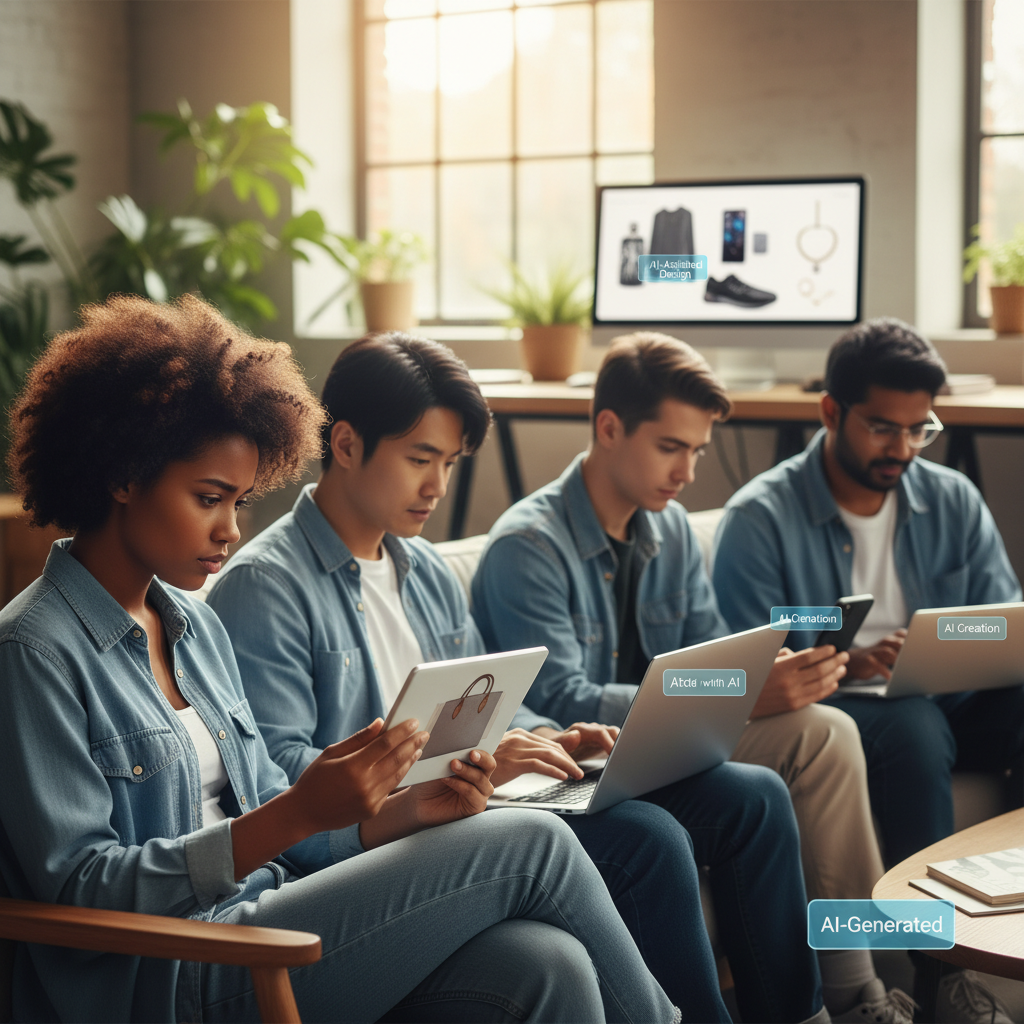
Understanding the Authenticity Problem Facing AI Imagery
The authenticity problem with AI imagery stems from consumers’ fundamental expectation that product visuals accurately reflect reality. According to Getty Images research from 2022-2024, 98% of consumers consider authentic imagery essential for trust, and 78% believe an AI-generated image cannot be considered “authentic” due to its origin. This perception holds even if AI-generated images are just as realistic as camera-taken photographs. Consumers consistently express concerns about the accuracy of product representation, including hidden defects, misleading material textures, colors, and size distortions. When users recognize content as AI-generated, they often doubt the product’s real appearance, quality, and how it will perform.
Consumer Perception of AI-Generated Images in E-commerce
In e-commerce, the perception of AI-generated images is heavily influenced by the product category and the level of disclosure. While AI offers compelling efficiency and cost benefits, risks to authenticity and customer trust require careful consideration. For products where visual quality and realism are paramount, such as high-end or luxury items, traditional photography may still be preferred. However, for certain applications like background variations or lifestyle contexts where the product itself is professionally photographed, AI performs well without compromising accuracy. The key is to balance AI’s scalability with the need for credibility, often through hybrid approaches that combine professional photography with AI enhancements.
What Are the AI Product Photo Disclosure Best Practices for Brands?
Transparency is paramount when brands decide to use AI product images, with ethical concerns emphasizing the importance of honest disclosure to maintain consumer trust. Best practices for AI product photo disclosure in 2026 include clear labeling, prominent placement of information, specific descriptions of AI involvement, and consistent application across all channels. This approach helps brands navigate the “ethics-efficiency paradox,” where maximizing sales efficiency with AI must be balanced with maintaining ethical standards.

Ethical Use of AI in Product Photography for E-commerce
The ethical use of AI in product photography extends beyond simple disclosure, touching upon fundamental questions about the brand-customer relationship. It requires a commitment to truthfulness and avoiding misrepresentation. Brands should establish internal guidelines to determine acceptable levels of AI enhancement, ensuring that AI is used for tasks like background removal or color correction rather than altering core product aspects. Human oversight in the image creation process is crucial to ensure quality, accuracy, and adherence to brand guidelines, preventing issues like subtle distortions or “hallucinated” product details that can erode confidence.
The Transparency Imperative: Building Trust with AI
The transparency imperative is about proactively communicating AI usage to consumers to build and maintain trust. A significant majority of consumers, nearly 90%, want transparency when an image has been AI-modified or generated. This is driven by the understanding that consumers want to avoid feeling misled. The European AI Act, effective August 2, 2026, mandates disclosure for content significantly generated by AI, especially if it could be perceived as real or human-made. Similarly, the IAB U.S. AI Transparency and Disclosure Framework, released in Q1 2026, advises disclosure when AI involvement risks misleading consumers. Brands that prioritize ethical AI use are more likely to see increased customer satisfaction and revenue growth.
How to Label AI-Generated Product Images on Your Ecommerce Store Effectively
Effectively labeling AI-generated product images on your e-commerce store involves clear, concise, and prominent disclosures to ensure transparency and maintain customer trust. The goal is to inform shoppers without deterring them, adhering to both emerging regulations and consumer expectations. This typically means placing labels directly on or near the image and within product descriptions.
Clear Disclosure for AI Product Photos
Clear disclosure for AI product photos means using plain language that is easily understandable by the average consumer. Avoid technical jargon and instead opt for straightforward phrases. The IAB U.S. framework, for instance, recommends simple labels like “AI-generated image”. These labels should be visible from the first interaction with the image and remain so throughout the viewing experience. For instance, on platforms like Instagram, creators are advised to use the “AI-generated” label for realistic AI imagery, particularly for content depicting real-looking people or events.
Key elements for clear disclosure include:
* Direct labeling: A small badge or text overlay directly on the image.
* Alt text inclusion: Adding “AI-generated image” to the image alt text field.
* Product description notes: A clear statement in the product description, such as “Product images were generated using AI technology”.
Examples of AI Image Disclaimers in E-commerce
Several effective strategies and examples exist for implementing AI image disclaimers in e-commerce:
1. Simple Text Overlay: A subtle, yet visible text overlay on the image itself, for example, “AI Enhanced” or “AI Generated.” This is particularly useful for lifestyle shots where only the background or context is AI-generated, while the product itself is real.
2. Product Page Banner: A small banner or notification at the top of the product page stating, “Some product visuals on this page may be AI-generated to showcase diverse contexts and styles.” This provides a general disclosure without cluttering individual images.
3. Dedicated “About Our Imagery” Section: A link near the product images or in the footer leading to a page explaining the brand’s approach to AI in photography. This can detail when and how AI is used, emphasizing accuracy and ethical considerations.
4. Interactive Elements: For more advanced implementations, a small ‘i’ icon near the image could reveal a pop-up with detailed AI disclosure when hovered over or clicked.
For example, for a product with an AI-generated background, the alt text could read: “Blue ceramic vase on a minimalist AI-generated living room background.” In the product description, a note could be added: “Please note: Lifestyle images feature AI-generated backgrounds to illustrate product versatility. The product itself is accurately represented.” This level of detail helps manage customer expectations and builds trust by being upfront about the use of synthetic media.
AI Product Photos vs. UGC: Which Builds More Customer Trust?
User-Generated Content (UGC) generally builds more customer trust than AI-generated product photos, primarily due to its perceived authenticity and real-world validation. Consumers highly value authentic imagery, with 98% considering it essential for trust. UGC, such as customer reviews with photos or social media posts, directly demonstrates real people using and experiencing a product, offering a level of social proof and relatability that AI-generated images currently struggle to replicate.
The Authenticity Advantage of User-Generated Content
UGC holds a significant authenticity advantage because it originates from genuine customer experiences. Shoppers often view UGC as unbiased and more credible than brand-produced content, whether traditional or AI-generated. This content provides tangible evidence of a product’s appearance and performance in real-life scenarios, which is crucial for building confidence, especially for products that directly affect human health or experience, like skincare or food. When consumers see AI-generated content, they often question the credibility of the brand and may feel disappointed if the actual product doesn’t match the AI-enhanced image. This can lead to a loss of long-term trust and even negative reviews.
A comparison of AI product photos and UGC reveals distinct strengths and weaknesses regarding customer trust:
| Feature | AI-Generated Product Photos | User-Generated Content (UGC) |
|---|---|---|
| Cost & Speed | Very high efficiency, low cost, fast production of variations | Variable, can be slow to collect, often free or low cost per piece |
| Authenticity Perception | Often perceived as less authentic; concerns about misrepresentation | Highly authentic; real-world validation, high trust |
| Control & Consistency | High control over aesthetics, consistent branding possible with effort | Low control, inconsistent quality and style, reflects diverse user experiences |
| Trust Building | Requires explicit disclosure to build trust; trust can be fragile | Naturally builds trust through social proof and relatability |
| Scalability | Excellent for generating large volumes and variations | Scales organically with customer base, but collection can be challenging |
| Misleading Potential | Higher risk if not transparently used or if product details are “hallucinated” | Lower risk, as it reflects actual user experiences (though can be faked) |
Balancing AI Product Photos and UGC for Optimal Trust
The most effective strategy for brands is often a hybrid approach, combining the efficiency and creative flexibility of AI product photos with the authenticity and trust-building power of UGC. AI can be leveraged for tasks like background variations, seasonal campaigns, and creating diverse lifestyle contexts from a professionally shot product image, without compromising the core product’s accuracy. This allows brands to rapidly generate a high volume of visually appealing content for various marketing channels.
Meanwhile, UGC should be actively encouraged and prominently featured to provide the authentic social proof consumers crave. This can include showcasing customer reviews with photos, integrating social media feeds, and running campaigns that encourage user submissions. By clearly disclosing AI usage where appropriate and prioritizing UGC for real-world validation, brands can harness the benefits of both technologies, striking a balance that enhances visual marketing while safeguarding customer trust.
Future-Proofing Your Brand: Navigating Consumer Perceptions of AI Product Imagery
Future-proofing your brand in the era of AI product imagery involves a strategic blend of technological adoption, transparency, and a deep understanding of evolving consumer expectations. The goal is to leverage AI’s benefits—such as cost efficiency, speed, and creative flexibility—while actively mitigating risks to customer trust and brand authenticity. This requires a proactive approach to ethical AI use and continuous adaptation to new regulations and consumer sentiments.
Balancing AI Efficiency with Customer Trust
Striking the right balance between AI efficiency and customer trust is critical for long-term brand success. AI product photography offers significant advantages, reducing production costs by 80-95% and speeding up time-to-market. It enables brands to generate high-quality visuals at scale, create diverse variations for marketing campaigns, and even produce images before physical stock is available. However, this efficiency must not come at the expense of trust. Research shows that 75% of consumers are more likely to trust companies that prioritize ethical AI use.
To achieve this balance, brands should:
* Prioritize product accuracy: Ensure AI enhancements do not misrepresent the product, its textures, or colors. Hallucinated details can quickly erode trust.
* Implement human oversight: While AI accelerates production, human review is essential for quality control, creative direction, and ensuring brand alignment.
* Adopt hybrid workflows: Combine the credibility of professional photography for hero images and luxury products with AI’s scalability for secondary images, lifestyle backgrounds, and social media variants.
Innovative Uses of AI Product Imagery in E-commerce
Beyond basic image generation, AI is unlocking innovative use cases that can enhance customer experience and drive engagement, provided they are implemented thoughtfully. These advancements are transforming how shoppers interact with products online.
Here are some innovative applications of AI product imagery:
* 3D Product Rendering and Virtual Try-Ons: AI can create realistic 3D models for interactive online catalogs and power augmented reality (AR) experiences, allowing shoppers to virtually place products in their homes or try on items digitally. This improves decision-making and satisfaction.
* Dynamic Personalization: AI can generate custom product visuals based on individual user preferences, past behavior, or even geo-specific and cultural references, making products more relatable and appealing to diverse audiences.
* AI Model Photography: Brands can generate product photos with AI models of different body types, ethnicities, and poses, promoting inclusivity and saving costs associated with traditional photoshoots.
* AI-Powered Trend Predictions: AI can analyze data to predict what styles, backgrounds, and layouts sell best, informing visual content strategy even before creation.
* Automated Styling and Props: AI visual editors can design and stage virtual photoshoots, adding props and styling elements that align with brand aesthetics and campaign moods.
By embracing these innovations responsibly and transparently, brands can create more engaging, personalized, and efficient visual marketing strategies, ultimately strengthening their position in the competitive e-commerce landscape.
Frequently Asked Questions About AI Product Photos
What are AI-generated product photos?
AI-generated product photos are images created or enhanced using artificial intelligence algorithms. These tools can produce realistic visuals from text descriptions or existing images, simulating studio lighting, generating backgrounds, and even placing products on virtual models without traditional photoshohoots.
Why are brands using AI for product photography?
Brands use AI for product photography primarily for cost efficiency, speed, and creative flexibility. AI drastically reduces production costs by 80-95% and accelerates time-to-market, allowing for rapid generation of high-quality images, variations, and personalized content at scale.
Do consumers trust AI-generated product images?
Consumer trust in AI-generated product images is complex and often skeptical. While many find AI images realistic, trust can erode if consumers discover content is AI-generated, especially without disclosure. Concerns include misrepresentation and lack of authenticity, making transparency crucial.
What is “AI product photo disclosure”?
AI product photo disclosure refers to the practice of clearly informing consumers when product images have been generated or significantly altered by artificial intelligence. This transparency is essential for maintaining trust and complying with emerging ethical guidelines and regulations.
How should brands label AI-generated images on their e-commerce store?
Brands should label AI-generated images clearly and prominently. Best practices include adding “AI-generated image” in the image alt text and product description, or using a visible text overlay on the image itself. The disclosure should be in plain language and consistently applied.
Is there a legal requirement to disclose AI-generated content?
Yes, legal requirements for disclosing AI-generated content are emerging. The EU AI Act, effective August 2, 2026, mandates disclosure for content significantly generated by AI that could be perceived as real. Other frameworks, like the IAB U.S. AI Transparency and Disclosure Framework, also recommend disclosure when there’s a risk of misleading consumers.
How do AI product photos compare to user-generated content (UGC) for trust?
UGC generally builds more customer trust than AI product photos due to its inherent authenticity and real-world validation from other consumers. While AI offers efficiency, UGC provides genuine social proof, which is highly valued by shoppers for making purchase decisions.
The integration of AI into product photography presents both immense opportunities and significant challenges for brands in 2026. Understanding consumer attitudes toward AI-generated product photos is no longer optional; it’s a strategic imperative.
Key takeaways for brands navigating this evolving landscape include:
* Transparency is non-negotiable: Proactive and clear disclosure of AI usage builds trust, as consumers are increasingly wary of unlabelled AI content.
* Authenticity remains supreme: While AI can create realistic visuals, it struggles to replicate the inherent authenticity of human-created or user-generated content.
* Hybrid approaches are optimal: Combining the efficiency of AI for scalable content with the credibility of traditional photography and user-generated content offers the best balance for trust and engagement.
* Accuracy is paramount: Ensure AI-generated images accurately represent products to avoid misleading consumers and eroding confidence.
* Stay informed on regulations: Keep abreast of evolving disclosure requirements, such as the EU AI Act and IAB U.S. framework, to ensure compliance.
By embracing responsible AI practices, prioritizing transparency, and strategically integrating AI with authentic content, brands can harness the power of this technology to enhance their visual marketing, build stronger customer relationships, and drive sustained growth in the digital age. Explore how a balanced AI content strategy can elevate your brand’s presence and foster deeper consumer connections today.