


State Of AI Product Photography Industry Report 2026 Guide
The AI product photography industry report for 2026 reveals a sector undergoing rapid transformation, driven by advancements in artificial intelligence and its increasing integration into commercial workflows. This report defines the current state of AI in product visuals, exploring its impact on creation, efficiency, and market dynamics. AI product photography encompasses the use of artificial intelligence algorithms and machine learning models to generate, enhance, or automate the creation of product images for e-commerce, marketing, and advertising purposes. It leverages technologies like generative AI, image recognition, and computational photography to produce high-quality visuals with reduced time and cost.
How AI is Disrupting the Commercial Photography Industry
AI is profoundly disrupting the commercial photography industry by automating labor-intensive tasks, reducing production costs, and democratizing access to high-quality visual content. This disruption manifests through faster turnaround times, consistent brand aesthetics, and the ability to generate diverse product variations without physical shoots. The integration of AI tools allows businesses to scale their visual content creation significantly.
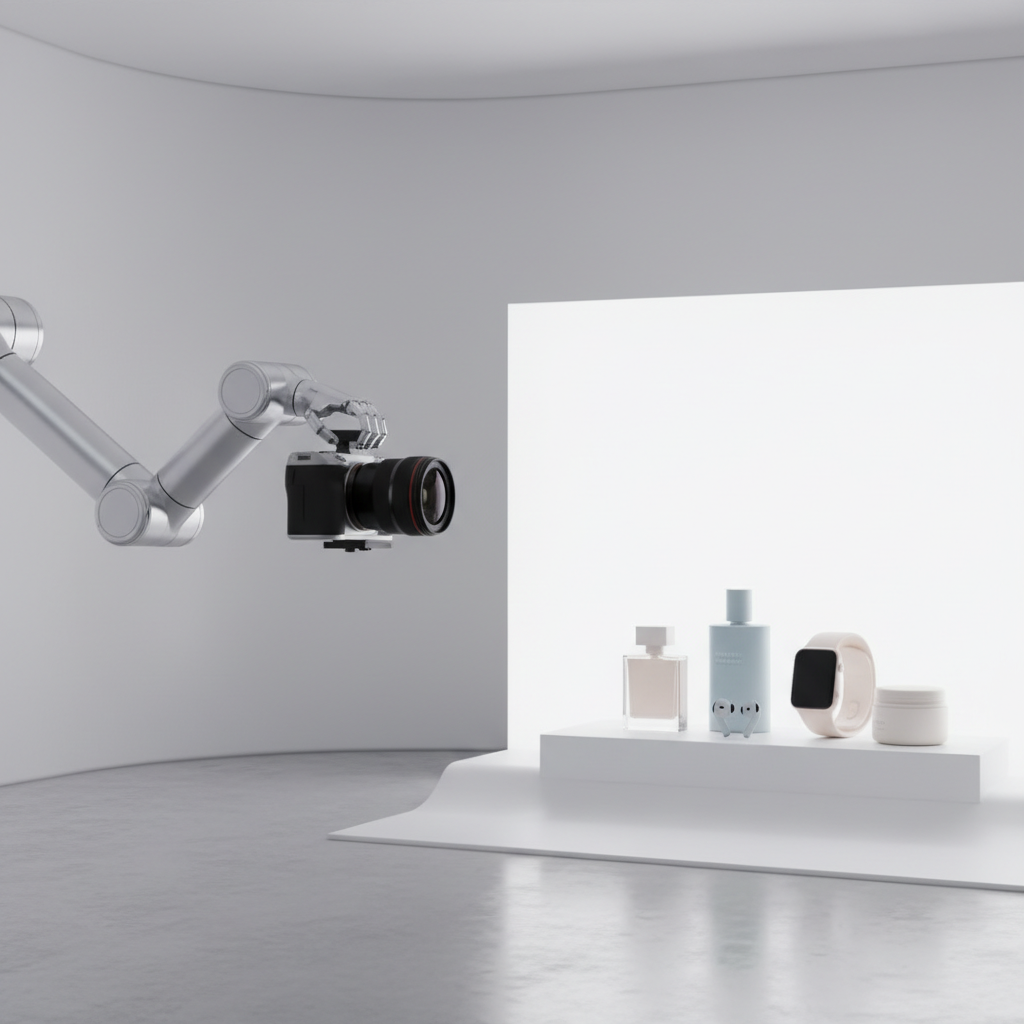
Traditional commercial photography often involves significant logistical challenges. These include studio rentals, model fees, extensive equipment, and post-production editing. AI streamlines these processes, allowing for virtual studios and instant image generation. This shift is enabling smaller businesses to compete with larger enterprises in visual marketing. The entire workflow, from concept to final image, is becoming more efficient.
Automating Workflow Efficiencies in Product Photography
AI-powered platforms are automating numerous aspects of the product photography workflow. This includes background removal, image retouching, and even creating entirely new scenes. Such automation frees up human photographers to focus on more creative and strategic tasks. It also ensures a high level of consistency across large product catalogs.
* Background Generation: AI can instantly generate diverse backgrounds, from minimalist white studios to elaborate lifestyle scenes.
* Image Enhancement: Tools automatically correct lighting, color balance, and sharpness, ensuring professional-grade quality.
* Virtual Staging: Products can be placed into realistic virtual environments, eliminating the need for physical props and sets.
Cost Reduction and Scalability with AI Photography
The financial implications of how AI is disrupting the commercial photography industry 2026 are substantial. Businesses can drastically cut costs associated with traditional photoshoots. This includes travel, equipment, and personnel expenses. AI also offers unparalleled scalability, allowing companies to generate thousands of unique product images in a fraction of the time. This capability is crucial for e-commerce platforms with rapidly expanding inventories.
The cost-effectiveness of AI solutions makes professional-grade imagery accessible to a wider range of businesses. Startups and small to medium-sized enterprises (SMEs) can now produce visuals that were previously out of reach. This levels the playing field in competitive online marketplaces. The ability to quickly adapt and scale visual content is a major competitive advantage.
AI Product Photography Adoption Rate Among Ecommerce Sellers
The AI product photography adoption rate among ecommerce sellers 2026 shows a significant upward trend, particularly among small to medium-sized businesses (SMBs) seeking cost-effective and scalable solutions for their online stores. While larger enterprises are also investing heavily, SMBs are leveraging AI to bridge the gap in visual content quality and quantity. The convenience and efficiency offered by AI tools are key drivers for this widespread adoption.

E-commerce platforms thrive on compelling visuals, and AI provides an accessible way to meet this demand. Many sellers, especially those with extensive product catalogs, find traditional photography methods too slow and expensive. AI offers an agile alternative, enabling rapid content updates and consistent branding across all product listings. This is critical for maintaining customer engagement and driving sales.
SMBs Leading the Charge in AI Visuals
Small and medium-sized businesses are at the forefront of AI product photography adoption. These businesses often operate with limited budgets and resources. AI tools provide an affordable entry point into high-quality visual marketing. They can generate professional-grade images without the need for expensive equipment or specialized photography skills.
The ease of use of many AI platforms also contributes to their popularity among SMBs. User-friendly interfaces allow even non-technical users to create stunning product visuals. This empowers small business owners to manage their visual content in-house. It reduces reliance on external agencies or freelancers, further cutting costs.
Enterprise Strategies for AI Product Photography Integration
While SMBs lead in adoption rate, larger enterprises are strategically integrating AI product photography into their existing workflows. Their focus is often on optimizing large-scale operations and maintaining brand consistency across diverse product lines and global markets. Enterprises are exploring custom AI solutions and integrating them with their existing digital asset management (DAM) systems.
Enterprise adoption often involves a hybrid approach, combining AI generation with traditional photography for hero shots or complex product features. This ensures that the brand maintains its unique aesthetic while benefiting from AI’s efficiency. The goal is to streamline the entire content pipeline, from initial product launch to ongoing marketing campaigns.
* Custom AI Models: Developing proprietary AI models tailored to specific brand guidelines.
* API Integration: Connecting AI photography tools directly into e-commerce platforms and DAM systems.
* Quality Control: Implementing robust human oversight to ensure AI-generated images meet brand standards.
Enterprise AI Product Photography Investment Trends
Enterprise AI product photography investment trends 2026 indicate a significant increase in capital allocation towards advanced AI solutions, driven by the desire for greater efficiency, personalization at scale, and competitive differentiation. Large corporations are moving beyond basic AI tools, focusing on integrating sophisticated generative AI capabilities and establishing dedicated in-house AI visual content teams. This strategic investment reflects a long-term commitment to leveraging AI for visual content creation.
Businesses are recognizing the strategic importance of high-quality, abundant visual content in today’s digital marketplace. Investing in AI product photography is no longer just about cost savings; it’s about gaining a competitive edge. Enterprises are looking for solutions that can not only automate but also innovate, creating unique and engaging visual experiences for their customers. This includes exploring AI for personalized product visuals tailored to individual consumer preferences.
Strategic Allocations in Generative AI for Visuals
A major portion of enterprise investment is directed towards generative AI technologies. These advanced AI models can create entirely new images, backgrounds, and even product variations from text prompts or existing data. This capability allows enterprises to produce an unprecedented volume and variety of visual content. It supports diverse marketing campaigns and A/B testing efforts.
Generative AI also enables rapid prototyping of new product concepts. Designers can visualize products in different settings or with varying features before physical production. This reduces development costs and speeds up time-to-market. The ability to iterate quickly on visual concepts is a powerful tool for innovation.
Building In-House AI Visual Content Capabilities
Many large enterprises are shifting from relying solely on third-party AI solutions to building their own in-house AI visual content capabilities. This involves hiring AI engineers, data scientists, and specialized content creators. The goal is to develop proprietary AI models and workflows that are deeply integrated with their brand identity and operational needs. This allows for greater control over data, security, and customization.
This trend highlights a move towards treating AI visual content creation as a core competency rather than an outsourced service. In-house teams can continuously refine AI models based on specific brand requirements and customer feedback. This ensures that the AI-generated content remains authentic and aligned with the company’s overall marketing strategy.
| Investment Area | Description | Primary Benefit |
|---|---|---|
| Generative AI Platforms | Solutions for creating new images and scenes from scratch. | Unprecedented content volume and variety. |
| AI-powered Editing Tools | Automated retouching, background removal, and enhancement. | Workflow efficiency and consistency. |
| Data Infrastructure | Systems for managing and training AI models with proprietary data. | Improved accuracy and brand alignment. |
| Talent Acquisition | Hiring AI specialists, prompt engineers, and visual artists. | In-house expertise and innovation. |
AI Photography Market Size and Growth Forecast
The AI photography market size and growth forecast 2026 to 2030 predicts substantial expansion, driven by the increasing demand for visual content across all industries and the continuous maturation of AI technologies. The market is projected to experience a compound annual growth rate (CAGR) significantly higher than traditional photography sectors. This rapid growth is fueled by the pervasive need for digital visuals in e-commerce, social media, and advertising.
The market for AI photography is defined by the revenue generated from AI-powered software, platforms, and services that assist in or fully automate the creation and enhancement of photographic content. This includes solutions for product photography, portraiture, landscape, and other commercial applications. The underlying technology, such as deep learning and computer vision, is continually improving, leading to more sophisticated and realistic outputs. This fuels broader adoption across diverse user bases.
Projected Market Valuation and Key Drivers
Industry analysts project the AI photography market to reach multi-billion dollar valuations by 2030. Key growth drivers include the explosion of e-commerce, which necessitates vast quantities of product images, and the increasing sophistication of generative AI models capable of producing photorealistic results. The global shift towards digital-first marketing strategies further amplifies this demand.
* E-commerce Expansion: The continuous growth of online retail drives the need for scalable and affordable product visual solutions.
* Social Media Content: Businesses and individuals require a constant stream of high-quality images for social platforms.
* Technological Advancements: Improvements in AI algorithms, processing power, and data availability enhance AI photography capabilities.
* Cost Efficiency: AI offers a more economical alternative to traditional photography methods for many applications.
Regional Growth and Emerging Market Opportunities
Geographically, North America and Europe currently represent the largest shares of the AI photography market. However, significant growth is anticipated in emerging markets, particularly in Asia-Pacific. Countries like China and India, with their booming e-commerce sectors and large tech-savvy populations, are poised for rapid adoption. These regions present substantial opportunities for AI photography solution providers.
The accessibility of cloud-based AI platforms means that businesses globally can leverage these tools. This democratizes access to advanced visual content creation. Localized AI solutions, tailored to specific cultural aesthetics and market demands, are also emerging. This further accelerates adoption in diverse regional markets.
Navigating Challenges and Unlocking Opportunities in AI Product Photography
Navigating the landscape of AI product photography presents both significant challenges and vast opportunities for businesses and creative professionals alike. While the technology offers unprecedented efficiency and scalability, concerns regarding authenticity, ethical use, and the evolving role of human creativity must be addressed. Successfully overcoming these hurdles will unlock the full potential of AI in visual content creation.
One of the primary challenges lies in maintaining authenticity and preventing the spread of misleading visuals. As AI becomes more adept at generating photorealistic images, the line between real and synthetic content blurs. This necessitates robust ethical guidelines and transparency in AI image creation. Businesses must ensure their use of AI aligns with consumer trust and regulatory standards.
Addressing Ethical Concerns and Authenticity
The ethical implications of AI-generated product photography are a critical consideration. Questions arise about intellectual property for AI-generated images, potential biases in AI models, and the transparency required when content is not “real.” Companies must develop clear policies on disclosing AI usage, especially in advertising where authenticity is paramount.
* Transparency: Clearly labeling AI-generated content when necessary to maintain consumer trust.
* Bias Mitigation: Actively working to prevent AI models from perpetuating or amplifying existing biases in visual representation.
* Copyright and Ownership: Establishing clear guidelines for ownership and usage rights of AI-created imagery.
The Evolving Role of Human Creativity and Expertise
Rather than replacing human creativity, AI product photography is redefining its role. Photographers and designers are transitioning from manual execution to becoming “prompt engineers” and creative directors of AI. Their expertise in aesthetics, composition, and brand storytelling remains invaluable. Humans guide the AI, refine its outputs, and ensure the final visuals resonate with target audiences. This shift creates new opportunities for professionals to leverage AI as a powerful creative assistant.
The demand for professionals skilled in AI tools and prompt engineering is growing. These individuals can bridge the gap between technological capabilities and creative vision. They help businesses harness AI to produce innovative and impactful visual content. This collaborative approach, where AI augments human talent, is key to unlocking the industry’s future.
Key Innovations Driving AI Product Photography Forward
Key innovations are consistently driving AI product photography forward, with advancements in generative AI, 3D rendering integration, and hyper-personalization leading the charge. These technological leaps are making AI-generated visuals more realistic, versatile, and tailored to individual consumer preferences. The pace of innovation ensures that the capabilities of AI product photography continue to expand rapidly.
The core of these innovations lies in sophisticated machine learning algorithms. These algorithms learn from vast datasets of images to understand visual patterns, textures, lighting, and composition. This deep understanding allows AI to generate new images that are indistinguishable from traditionally captured photographs. The continuous feedback loops within these systems lead to constant improvement in output quality and realism.
Generative AI and Hyper-Realistic Image Synthesis
Generative AI, particularly models like Generative Adversarial Networks (GANs) and diffusion models, is at the forefront of creating hyper-realistic product images. These models can synthesize entirely new visuals, from product variations to complex lifestyle scenes, with remarkable fidelity. This capability allows businesses to create a virtually unlimited array of product shots without physical production.
The ability to control specific attributes like material, color, lighting, and environment through simple text prompts is revolutionizing the creative process. This empowers marketers and designers to rapidly iterate on visual concepts. It also allows for the production of highly specific imagery for niche markets or personalized advertising campaigns.
Integrating 3D Rendering with AI for Enhanced Visuals
The seamless integration of 3D rendering technologies with AI is another significant innovation. Products modeled in 3D can be easily manipulated and placed into AI-generated environments. This combines the precision and flexibility of 3D assets with the creative power of AI. The result is photorealistic images that offer unparalleled control over perspective, lighting, and texture.
This hybrid approach allows for dynamic content creation. Businesses can generate interactive 360-degree views, augmented reality (AR) experiences, and consistent visuals across all marketing channels. It also reduces the need for multiple physical prototypes, as design changes can be instantly rendered and visualized in various settings.
What is AI product photography?
AI product photography uses artificial intelligence to create, enhance, or automate product images. It leverages machine learning algorithms for tasks like background removal, image generation, and virtual staging, significantly streamlining the visual content creation process for businesses. This technology helps produce high-quality, consistent images efficiently.
How is AI disrupting the commercial photography industry?
AI is disrupting the commercial photography industry by automating labor-intensive tasks, reducing costs, and enabling rapid scalability of visual content. It allows for virtual studios and instant image generation, making professional-grade visuals accessible to more businesses and shifting human photographers’ roles to creative direction.
What is the AI product photography adoption rate among ecommerce sellers?
The AI product photography adoption rate among e-commerce sellers is rapidly increasing, especially among SMBs seeking cost-effective and scalable solutions. Larger enterprises are also integrating AI strategically to optimize workflows and maintain brand consistency across vast product catalogs and global markets.
What are the enterprise AI product photography investment trends?
Enterprise AI product photography investment trends show a significant increase in capital towards advanced generative AI solutions and the establishment of in-house AI visual content teams. Businesses are investing to achieve greater efficiency, personalization at scale, and competitive differentiation in their visual marketing efforts.
What is the AI photography market size and growth forecast?
The AI photography market is projected for substantial growth from 2026 to 2030, driven by the increasing demand for visual content and continuous AI advancements. It is expected to achieve multi-billion dollar valuations with a high compound annual growth rate, fueled by e-commerce expansion and technological improvements.
What are the main benefits of using AI for product photography?
The main benefits include significant cost reduction, faster production times, enhanced scalability for large product catalogs, consistent brand aesthetics, and the ability to generate diverse and personalized visuals. AI democratizes access to high-quality imagery, empowering businesses of all sizes.
Are there ethical concerns with AI product photography?
Yes, ethical concerns include maintaining authenticity, preventing the spread of misleading visuals, intellectual property rights for AI-generated content, and potential biases in AI models. Businesses must establish transparent practices and robust guidelines to ensure responsible and trustworthy AI usage.
The AI product photography industry report for 2026 underscores a pivotal moment for visual content creation. The industry is experiencing unprecedented growth and innovation, fundamentally altering how businesses approach product visuals.
Key takeaways from this report include:
* AI is a powerful disruptor, driving efficiency and cost savings across the commercial photography sector.
* Adoption rates are soaring, particularly among e-commerce SMBs, who leverage AI for competitive advantage.
* Enterprise investment is shifting towards advanced generative AI and in-house capabilities for strategic control.
* The market is set for substantial growth through 2030, fueled by e-commerce demand and technological leaps.
* Navigating ethical considerations and embracing the evolving role of human creativity are crucial for long-term success.
As AI technologies continue to mature, the possibilities for creating compelling, personalized, and scalable visual content will only expand. Businesses that strategically integrate AI into their product photography workflows will be best positioned to thrive in the increasingly visual-centric digital economy. Explore how AI can transform your visual content strategy today.