


AI Video Generator Comparison For Ecommerce Sellers 2026 Guide
The landscape of digital marketing for online stores is constantly evolving, with video content now a non-negotiable element for capturing customer attention. In 2026, AI video generator comparison for ecommerce sellers reveals a competitive arena, offering powerful tools to transform product marketing. These advanced platforms leverage artificial intelligence to create compelling product videos, engaging advertisements, and dynamic social media content with unprecedented speed and efficiency. Ecommerce brands are increasingly relying on AI to produce high-quality visuals at scale, moving beyond traditional video production methods that are often time-consuming and expensive. This guide delves into the leading AI video generators, evaluating their features, pricing, and suitability for various e-commerce needs.
Understanding the Landscape of AI Video Generators for Ecommerce
AI video generators are software tools that utilize artificial intelligence to create video content from various inputs, such as text prompts, images, or existing video clips. These innovative platforms automate many aspects of video production, from script generation and voiceovers to visual asset selection and editing, making professional-quality video accessible to ecommerce businesses of all sizes. The market for these tools has rapidly matured, with offerings ranging from general-purpose video creation suites to highly specialized solutions tailored for specific marketing objectives. In 2026, the demand for dynamic product showcases and engaging advertisements has propelled AI video tools into the spotlight for online sellers.
What defines the best AI video tools for product marketing today?
The best AI video tools for product marketing are characterized by their ability to produce high-quality, realistic, and brand-consistent video content with minimal manual effort. Key features include strong prompt adherence, which ensures the generated video accurately reflects the input descriptions, and temporal coherence, meaning objects and characters maintain consistency across frames without flickering or morphing. Photorealism, physics simulation, and the capacity for synchronized native audio are also critical for creating compelling product demonstrations and advertisements. Furthermore, the best tools offer robust customization options, allowing brands to align videos with their unique aesthetic and messaging. The speed of generation and the ability to scale content production are paramount for ecommerce brands needing to update product visuals frequently or launch extensive marketing campaigns.
Why are AI video tools essential for online stores?
AI video tools have become essential for online stores due to their capacity to significantly enhance marketing efforts and drive conversions. Video content generates significantly more shares than text and images combined, with 87% of marketers reporting a positive ROI from video marketing. For ecommerce, dynamic product videos can increase conversion rates by as much as 80%. These tools allow businesses to create scroll-stopping videos from static product images in minutes, addressing the challenge of traditional video production which requires expensive equipment, professional videographers, and extensive editing time. With AI, online stores can produce a high volume of diverse content, from social media ads and product page videos to user-generated content (UGC)-style testimonials, all while maintaining brand consistency and reducing costs. This scalability is particularly valuable for brands with large catalogs or those frequently launching new products.
Sora, Veo, Runway, Kling: A Feature Deep Dive for Product Videos
When evaluating Sora vs Veo vs Runway vs Kling for product videos, it’s crucial to understand their distinct capabilities and how they cater to the specific needs of ecommerce content creation. While OpenAI’s Sora project was officially discontinued in late March 2026, its technical prowess and influence on the AI video generation landscape were significant. Before its shutdown, Sora was known for its ability to generate high-definition, realistic videos from text prompts, excelling in narrative coherence and physics simulation, which made it a gold standard for temporal consistency and visual fidelity. Its underlying architecture has inspired a new generation of video synthesis tools.
Comparing visual fidelity and creative control for product videos
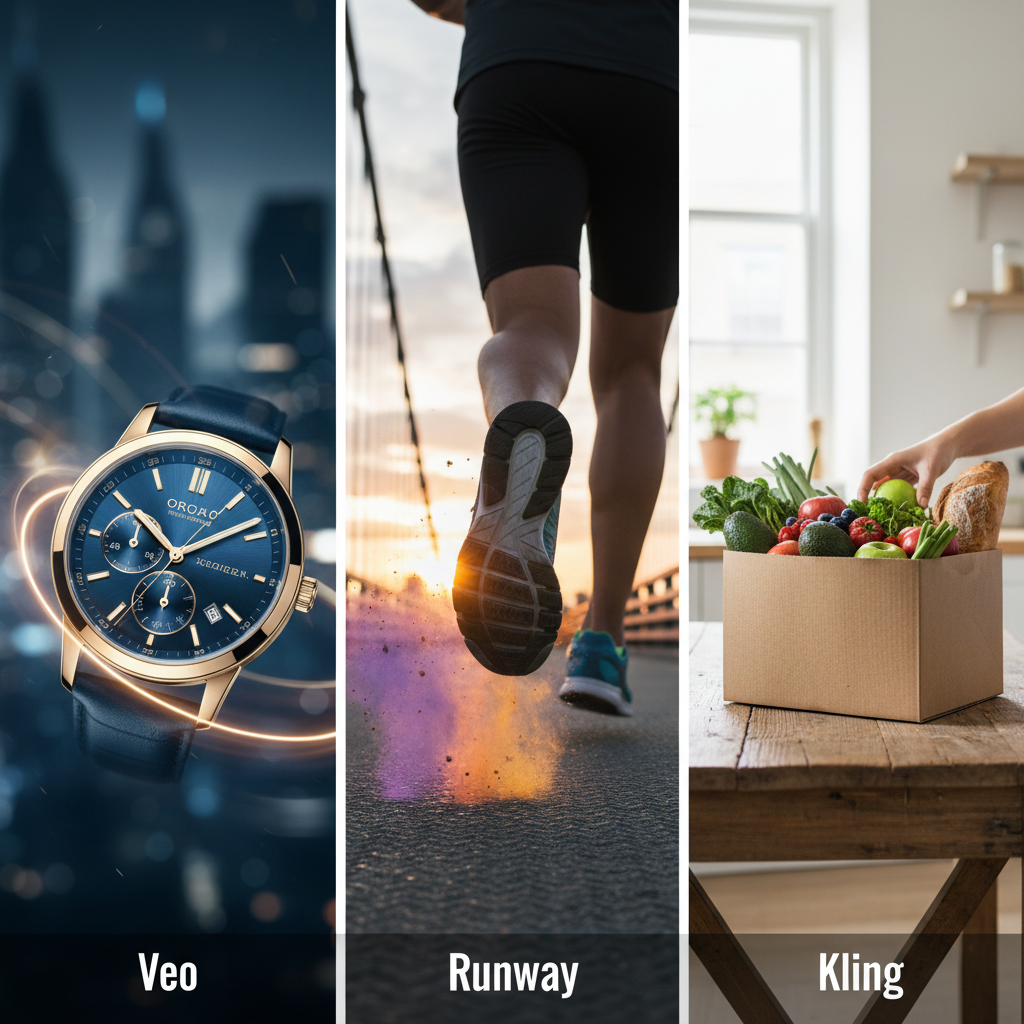
Google Veo 3.1 stands out for its exceptional photorealism and cinematic quality, producing videos that closely resemble real footage. It offers strong prompt adherence and robust creative tools, making it a reliable choice for high-fidelity product showcases. Runway ML, with its Gen-4.5 model, provides extensive creative control, making it a favorite for cinematic quality and visual effects artists. Runway allows for precise camera controls, motion brushes to animate specific elements, and green screen removal, which are invaluable for stylized product marketing. Kling AI (Kling 3.0 or O3) has made significant strides, now supporting native 4K output and offering motion transfer from reference clips, which is ideal for detailed product demonstrations that need to hold up on large screens. Its “AI Director” feature enables multi-shot storyboarding, allowing for more complex narratives within a single generation.
Evaluating native audio and cinematic capabilities for ecommerce brands
For ecommerce brands seeking comprehensive audiovisual content, Google Veo 3.1 is a leader in native audio generation, producing synchronized sound effects, ambient audio, and even dialogue alongside the video. This eliminates the need for separate audio post-production, streamlining the workflow for product explainers and ads. Kling AI also offers native audio support, allowing for dynamic scenes with synchronized music and dialogues without manual editing, and even multilingual lip-sync. Runway ML focuses more on visual fidelity and creative control, often requiring external audio integration for complete productions. The ability to generate vertical video outputs (9:16) is also a crucial cinematic capability for these tools, as 85% of video consumption occurs on mobile devices, making vertical formats indispensable for platforms like TikTok, Instagram Reels, and YouTube Shorts. Veo 3.1 and Kling AI both support vertical video, catering directly to the mobile-first consumption habits of online shoppers.
Beyond the Big Four: Other Top AI Video Tools for Online Store Ads
While Sora, Veo, Runway, and Kling represent the cutting edge of generative AI video, the market offers a diverse range of other powerful best AI video tools for product marketing specifically designed for ecommerce sellers. These platforms often provide specialized features, streamlined workflows, or unique output styles that can be highly advantageous for creating impactful online store ads. From AI avatars to content repurposing, these tools address various marketing needs, helping brands scale their video content efficiently and effectively.
Specialized AI video tools for online store ads and conversions
Several AI video generators are built with a strong focus on driving conversions for ecommerce. Adstellar, for instance, is an AI-powered ad creative platform that generates performance-focused video ads specifically designed for ecommerce brands. It analyzes product catalogs and generates video ads optimized for platform-specific algorithms like Meta and TikTok, even predicting creative performance before ad spend. This makes Adstellar invaluable for data-driven marketers focused on paid campaigns. Similarly, Creatify generates product videos with AI-written scripts optimized for conversions, often using UGC-style avatar options to create authentic-feeling customer testimonials. Synthesia excels in creating professional product presentations and brand storytelling using highly realistic AI avatars. Its ability to generate videos in over 160 languages with proper lip-sync makes it ideal for global ecommerce brands aiming for polished, credible content. HeyGen also stands out for its AI avatar videos, translation, and personalized video capabilities, hitting a sweet spot between ease of use and quality for avatar-led content.
Here’s a quick look at some specialized tools:
* Adstellar: Performance-focused video ads, optimized for Meta and TikTok, with creative scoring and batch generation.
* Synthesia: Realistic AI avatars for professional product explainers, training, and multilingual content.
* HeyGen: AI avatar videos with strong lip-sync, translation, and personalized video marketing content.
* DeeVid AI: An all-in-one solution providing access to top models (like Veo 3.1, Kling) with an ad-oriented workflow specifically for ecommerce.
Leveraging AI avatars and content repurposing for product marketing
AI avatars offer a compelling way for ecommerce brands to create engaging video content without needing real actors or extensive filming. Synthesia and HeyGen are prime examples, allowing users to generate videos featuring digital human avatars that speak provided scripts with natural expressions and gestures. This is particularly useful for explainer videos, product demos, or personalized marketing messages that require a human touch without the logistical complexities of live-action shoots. For brands with extensive written content, tools like Pictory are invaluable for content repurposing. Pictory can transform product descriptions, blog posts, or scripts into engaging videos with automatic scene selection, stock footage, and voiceovers. This feature is critical for maximizing existing content assets and scaling video production efficiently across multiple platforms. InVideo AI also offers prompt-based video generation, creating complete videos from text descriptions and providing over 5,000 templates for various industries and use cases, making professional video creation accessible to anyone on a team. These tools collectively empower ecommerce sellers to diversify their video marketing strategies, reaching audiences through various formats and channels.
Demystifying AI Video Generator Pricing for Ecommerce Brands
Understanding AI video generator pricing for ecommerce brands can be complex, as platforms often employ varied credit systems, subscription tiers, and usage-based models. Prices can range from free tiers with limited functionality to hundreds of dollars per month for professional, high-volume access. For most active creators and ecommerce businesses, the sweet spot for regular content creation typically falls within the $10-$50 per month range, with enterprise solutions costing significantly more. It is essential for brands to carefully evaluate what each plan delivers in terms of video minutes or credits, resolution, and commercial licensing to ensure it aligns with their specific marketing needs and budget.
Analyzing subscription tiers and credit systems for AI video generator pricing
Most AI video generators operate on a credit system, where users purchase credits that are then consumed based on video length, resolution, and complexity of generation. For example, entry-level paid plans for tools like Kling AI and Pika can start around $10 per month, offering enough credits for occasional use (e.g., 10-30 standard videos) and removing watermarks. Mid-range options, often priced between $20-$50 per month, cater to active creators. Kling AI Pro, for instance, provides 3,000 monthly credits for around 50 videos at 1080p, making it highly efficient for a daily short-form video schedule. Google Veo 3.1 is accessible through Google AI Pro at approximately $20/month for 1,000 credits at 720p, or Google AI Ultra at around $250/month for 12,500+ credits at 1080p. Runway ML offers a free plan with 125 one-time credits, with paid plans starting at about $15/month annually. Synthesia’s Starter plan is $29 per month for 120 minutes of video per year. It is critical to note that “credits” can translate differently across platforms, so comparing the actual output (e.g., minutes of video) per dollar spent is key.
Here’s a comparison of typical pricing structures:
| AI Video Generator | Typical Starting Price (Monthly) | Key Offerings at Entry/Mid-Tier | Resolution | Notes |
|---|---|---|---|---|
| Google Veo 3.1 (Google AI Pro) | ~$20 | 1,000 credits (~12 videos) | 720p | Focus on photorealism, native audio. |
| Runway ML | ~$15 (annual) | 125 one-time free credits, then monthly credits for standard use | Variable (up to 1080p) | Creative control, cinematic quality. |
| Kling AI (Standard/Pro) | ~$10 / ~$37 | 660 credits (Standard) / 3,000 credits (Pro) | 1080p / Native 4K (Pro) | Long-form video, motion control, native audio. |
| Synthesia (Starter) | ~$29 | 120 minutes of video per year | 1080p | Realistic AI avatars, multilingual support. |
| DeeVid AI (Lite) | ~$14 | 200 credits | 720p | Aggregates top models, ecommerce workflow. |
Maximizing ROI with budget-friendly AI video tools for ecommerce brands
To maximize ROI, ecommerce brands should look for AI video tools for ecommerce brands that offer commercial licensing even at lower price points, ensuring their generated content can be used for marketing and advertising without legal issues. Free tiers are excellent for testing capabilities and user interfaces before committing to a paid plan. For businesses with large product catalogs, platforms offering batch processing or automated video generation from product URLs, like Adstellar or Creatify, can provide immense value by drastically reducing production time and cost per video. Furthermore, considering tools that aggregate access to multiple advanced AI models, such as DeeVid AI, can be a cost-effective strategy, allowing access to diverse generation capabilities without juggling multiple subscriptions. Focusing on tools that excel in specific, high-impact areas like performance-optimized ads or rapid content repurposing can yield better returns than generic, all-in-one solutions that may not specialize in ecommerce needs.
Choosing the Right AI Video Tool for Your Online Store Ads and Marketing
Selecting the ideal AI video generator for your ecommerce business involves a strategic assessment of your specific marketing objectives, desired output quality, and operational workflow. With a plethora of options available, identifying which AI video tool is best for online store ads requires a clear understanding of what you aim to achieve. The right tool will not only produce compelling visuals but also integrate seamlessly into your existing marketing efforts, helping you scale video content efficiently and effectively.
Identifying which AI video tool is best for online store ads based on campaign goals
The best AI video tool for your online store ads depends heavily on your campaign goals. If your primary objective is direct response advertising and maximizing conversions on platforms like Meta and TikTok, specialized tools such as Adstellar or Creatify are highly recommended. These platforms are engineered to generate ads optimized for performance, often incorporating AI-written scripts and UGC-style avatars that resonate with social media audiences. For brands prioritizing high-fidelity, cinematic product showcases and atmospheric brand videos, Google Veo 3.1 and Runway ML offer superior visual quality and creative control. Veo’s photorealism and native audio are excellent for immersive product experiences, while Runway’s advanced controls suit highly stylized or experimental campaigns. If your strategy involves consistent, high-volume short-form content for social media, Kling AI provides efficient generation with native 4K output and strong motion control, making it suitable for dynamic, engaging clips. For educational content or product explainers requiring realistic presenters, Synthesia and HeyGen excel with their AI avatar capabilities and multilingual support.
Consider these campaign goals:
* Conversion-focused ads: Adstellar, Creatify (UGC-style, optimized scripts).
* Cinematic product showcases: Google Veo 3.1, Runway ML (high photorealism, creative control).
* High-volume social media content: Kling AI, InVideo AI (efficient, dynamic clips, templates).
* Product explainers with avatars: Synthesia, HeyGen (realistic AI presenters, multilingual).
Integrating AI video generation into your existing product marketing workflow
Seamless integration into your existing product marketing workflow is crucial for maximizing the benefits of AI video tools. Look for platforms that offer intuitive user interfaces and compatibility with other marketing technologies you currently use. Many tools support generating videos directly from product URLs, simplifying the process for businesses with large catalogs. Platforms like DeeVid AI are designed with an ad-oriented workflow specifically for ecommerce operators, providing access to multiple top-tier AI models from a single platform. This reduces context-switching and streamlines the entire creative process. For content repurposing, tools like Pictory can convert existing blog posts or product descriptions into video, extending the life and reach of your written content. The ability to batch process videos, generate multiple variations for A/B testing, and export in various formats optimized for different platforms (e.g., vertical for TikTok, horizontal for YouTube) will significantly enhance your workflow efficiency. Ultimately, the best tool is one that not only produces high-quality video but also empowers your team to create, manage, and distribute content with greater speed and less friction.
What is an AI video generator?
An AI video generator is a software application that uses artificial intelligence to create video content from various inputs, such as text, images, or audio. These tools automate elements of video production like scriptwriting, visual generation, and editing.
How do AI video tools benefit ecommerce sellers?
AI video tools enable ecommerce sellers to produce high-quality product videos and ads quickly and cost-effectively. They help increase engagement, drive conversions, and scale content creation for large product catalogs or frequent marketing campaigns.
Is OpenAI Sora still available for use?
As of late March 2026, OpenAI officially discontinued the Sora project, citing strategic shifts and complex copyright challenges. While its architecture influenced other tools, direct access to Sora is no longer available from OpenAI.
Which AI video generator is best for creating realistic product demonstrations?
Google Veo 3.1 is highly regarded for its photorealism, cinematic quality, and native audio generation, making it excellent for realistic product demonstrations. Kling AI also offers native 4K output and strong motion control for detailed visuals.
Can AI video generators create vertical videos for social media?
Yes, many leading AI video generators, including Google Veo 3.1 and Kling AI, support native vertical (9:16) video output. This is crucial for platforms like TikTok, Instagram Reels, and YouTube Shorts, where vertical content dominates.
How much do AI video generators
cost?
The cost of AI video generators varies widely based on features, usage limits, and subscription models. Many offer free trials or freemium versions with basic functionalities. Paid plans can range from $20-$50 per month for individual users or small businesses, up to several hundred dollars for enterprise solutions that include advanced features, higher video generation limits, and team collaboration tools. Factors like video length, resolution, access to premium assets, and API integrations often influence pricing.
What are the key considerations when choosing an AI video generator for an ecommerce business?
When selecting an AI video generator, ecommerce sellers should prioritize photorealism for product visuals, ease of integration with existing marketing workflows, scalability for large product catalogs, cost-effectiveness, and the ability to generate diverse video formats (e.g., vertical for social media, horizontal for product pages). Also, consider the availability of templates, voiceover options, and multilingual support to reach a broader audience.
The Future is Visual: Making Your Choice for 2026
The landscape of AI video generator comparison for ecommerce sellers 2026 reveals a dynamic and rapidly evolving toolkit. From hyper-realistic product demos to engaging social media snippets and personalized explainer videos, the capabilities of these platforms are transforming how online businesses connect with their customers. The key to success isn’t just adopting AI, but strategically integrating the right tools that align with your brand’s specific needs, budget, and workflow.
As you navigate the options, remember to prioritize tools that offer robust creative control, seamless integration, and scalability. Whether you’re aiming for cinematic quality with Google Veo 3.1, high-volume content with Kling AI, or avatar-led explainers with Synthesia, the perfect AI video partner will empower you to create compelling visual narratives that drive engagement and conversions. Embrace these innovations, and position your ecommerce brand at the forefront of digital marketing in 2026 and beyond.