

AI Search Optimization for Ecommerce Product Images
Optimizing product images for AI search optimization for ecommerce product images is crucial for online visibility. As search engines evolve with artificial intelligence, how product visuals are processed and presented has fundamentally changed. Understanding these shifts helps ecommerce businesses ensure their products stand out in new search environments. This guide will explore the strategies and tactics needed to prepare your product images for the future of AI-powered search.
Understanding How Product Images Appear in AI Overviews and AI Mode
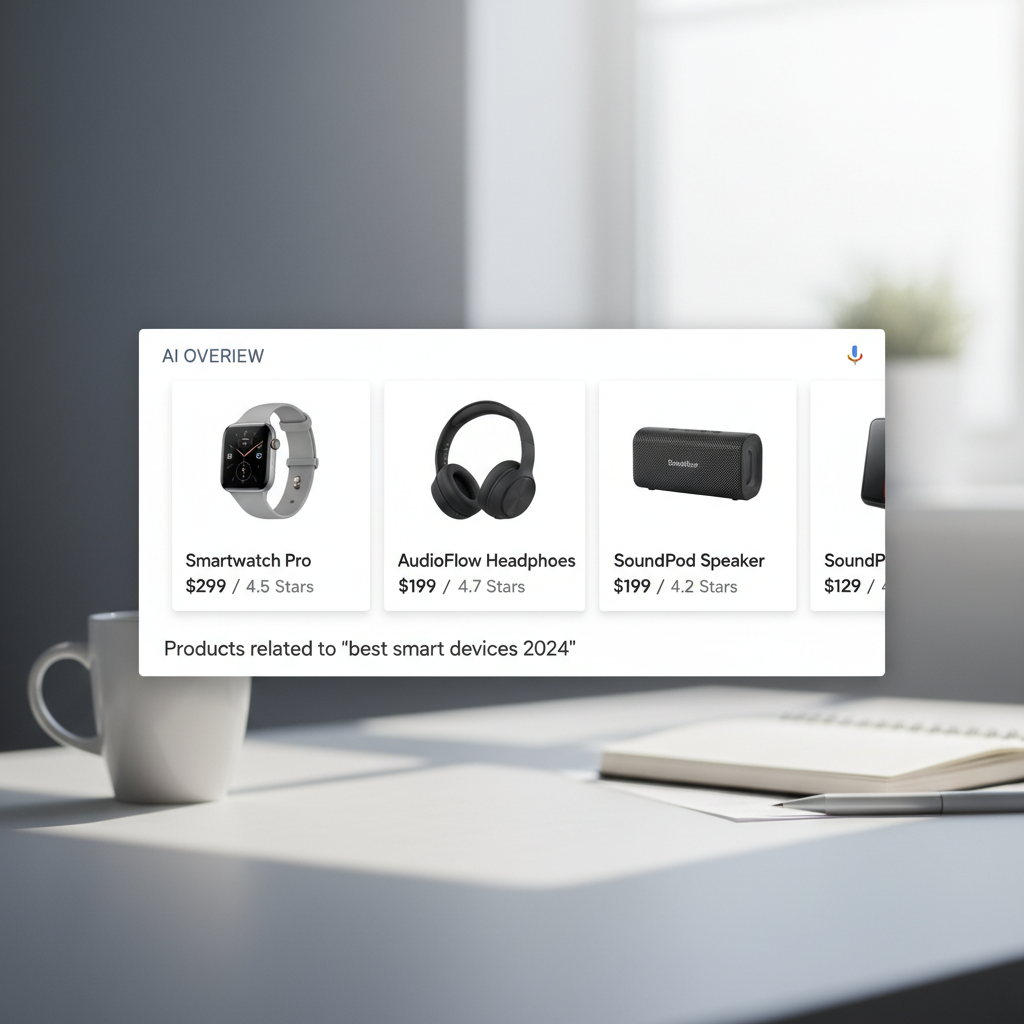
Product images appear in AI Overviews and AI Mode as visual summaries or direct answers, often integrated seamlessly with textual information. These new search interfaces prioritize rich, relevant media that directly addresses user queries. AI Overviews are generated by AI models to provide concise, comprehensive answers at the top of search results, frequently incorporating images that visually represent the information. AI Mode, on the other hand, often refers to more interactive and conversational search experiences where visuals play a dynamic role in guiding users through product discovery and comparison.
What are AI Overviews and AI Mode in modern search?
AI Overviews are AI-generated summaries that appear at the top of search results, offering direct answers to queries. They often include images, videos, and links to relevant sources. AI Mode refers to a more conversational and interactive search experience, where AI assists users in exploring topics, comparing products, and finding information, often with a strong visual component. These features represent a significant shift from traditional ten-blue-link search results. They aim to provide immediate, context-rich information, making visual content more critical than ever for capturing user attention.
How do visual elements impact AI-driven search results?
Visual elements significantly impact AI-driven search results by providing immediate context and enhancing user understanding. AI models analyze images for content, quality, and relevance to a query. High-quality, contextually appropriate product images can directly influence whether a product is featured in an AI Overview or recommended in AI Mode. Search engines use advanced computer vision to understand what an image depicts, not just what its alt text says. This means the actual visual content of your product photos must be clear, relevant, and compelling.
Why is image quality essential for AI search visibility?
Image quality is essential for AI search visibility because AI algorithms prioritize clear, high-resolution, and well-composed visuals. Blurry, pixelated, or poorly lit images are less likely to be selected by AI for display in prominent search features. AI models are trained on vast datasets of images, learning to identify and prefer visuals that offer the most informative and appealing representation of a product. Superior image quality ensures that AI can accurately interpret the product, enhancing its chances of appearing in relevant AI-powered search results.
Developing an Effective AEO Strategy for Ecommerce Product Visuals
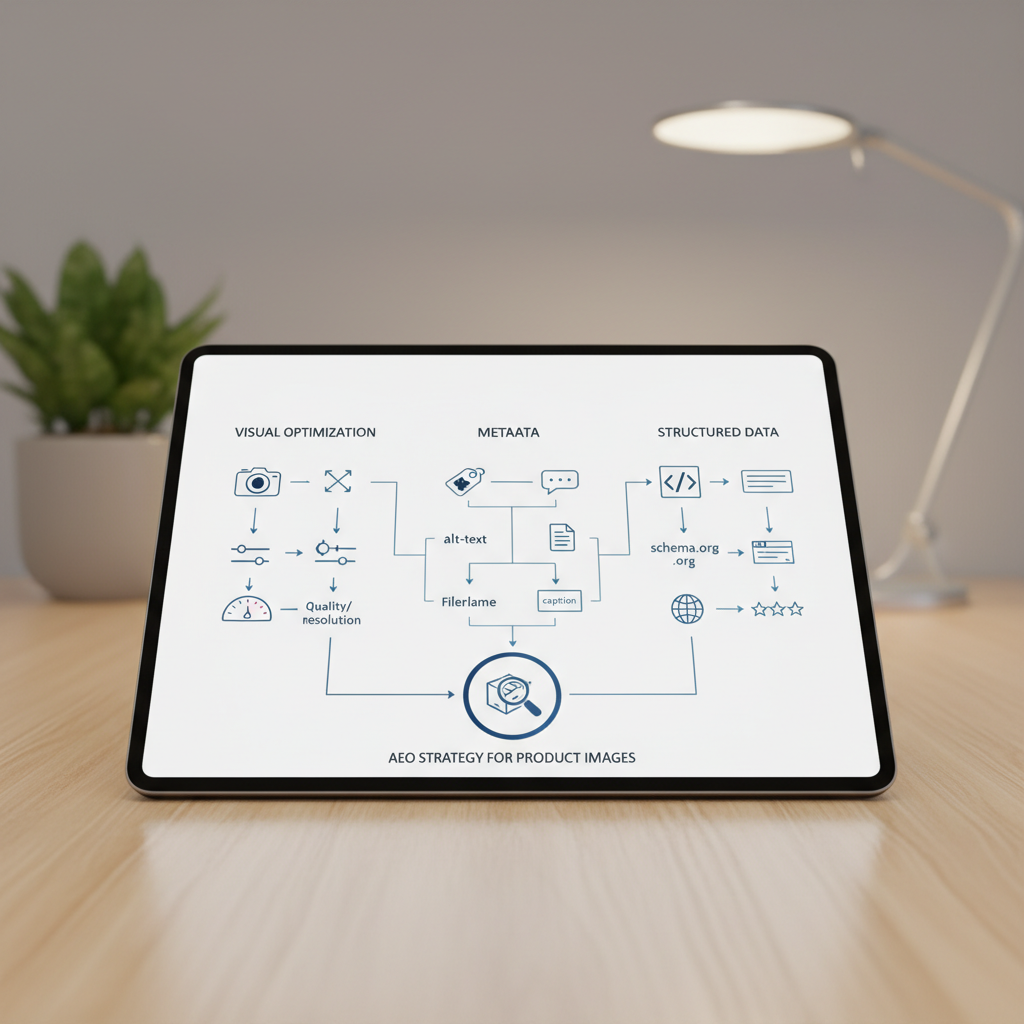
Developing an effective AEO (AI Engine Optimization) strategy for ecommerce product visuals involves a holistic approach that goes beyond traditional image SEO. It focuses on making your images not just discoverable but also understandable and highly relevant to AI algorithms. This strategy ensures your product images are primed for display in AI Overviews, AI Mode, and other emerging AI-powered search features. It considers factors like visual clarity, contextual relevance, and structured data implementation.
What is AEO and how does it differ from traditional image SEO?
AEO, or AI Engine Optimization, is the process of optimizing content, including images, specifically for artificial intelligence-powered search engines and interfaces. It differs from traditional image SEO by focusing not just on keywords and technical aspects (like alt text and file size) but also on the semantic understanding of images by AI. AEO emphasizes visual quality, contextual relevance, and the use of structured data to help AI interpret the content and purpose of an image accurately. It’s about making images “AI-readable” and “AI-preferable.”
Key components of an AEO strategy for product images
A robust AEO strategy for product images includes several key components designed to enhance AI understanding and visibility. These components encompass technical optimization, content quality, and semantic enrichment.
* High-Quality Visuals: Ensure images are high-resolution, professionally shot, and clearly display the product from multiple angles.
* Contextual Relevance: Images should accurately represent the product and be relevant to the surrounding text on the product page.
* Descriptive Filenames: Use clear, keyword-rich filenames (e.g., `red-leather-womens-handbag.jpg`).
* Comprehensive Alt Text: Write detailed, descriptive alt text that explains the image content for both accessibility and AI interpretation.
* Structured Data Markup: Implement Schema.org markup (e.g., `Product`, `ImageObject`) to provide explicit signals to AI about the image’s content and context.
* Image Sitemaps: Submit image sitemaps to help search engines discover and index all product images.
* User Experience: Optimize images for fast loading speeds to improve overall page experience, a factor AI considers.
How to align product visual content with AI search intent?
Aligning product visual content with AI search intent means understanding what users are looking for visually when they perform a search. This involves analyzing common queries related to your products and ensuring your images directly address those visual needs. For example, if users frequently search for “red dress party,” your images for a red dress should clearly show it in a party setting or on a model. Consider different angles, close-ups of features, and lifestyle shots that answer potential visual questions. AI aims to provide the most helpful and relevant answer, and a visually comprehensive product image collection directly supports this goal.
Best Practices to Optimize Product Photos for AI Search Engines
To optimize product photos for AI search engines, focus on creating high-quality, contextually rich, and technically sound images that AI can easily interpret. This means going beyond basic SEO to ensure visual clarity, relevance, and proper semantic markup. AI algorithms prioritize images that offer the most value to users, so every aspect from resolution to surrounding text plays a role. Effective optimization ensures your product visuals contribute positively to your overall AI search visibility.
What are the critical image attributes for AI readability?
Critical image attributes for AI readability include high resolution, clear focus, good lighting, and minimal distractions. AI algorithms use computer vision to analyze the content of an image. They look for distinct objects, colors, textures, and patterns. Therefore, images should be:
* Sharp and Clear: Avoid blurriness or pixelation.
* Well-Lit: Ensure the product is evenly lit without harsh shadows.
* High Resolution: Provide sufficient detail for AI to understand the product’s features.
* Relevant Background: Use clean, uncluttered backgrounds that highlight the product.
* Multiple Angles: Offer various perspectives to give a complete visual representation.
* Consistency: Maintain a consistent style across all product images.
How to optimize image file formats and sizes for AI search?
Optimizing image file formats and sizes for AI search involves balancing quality with performance. While AI appreciates high-quality images, slow loading times can negatively impact user experience and search rankings.
* Choose Efficient Formats: Use modern formats like WebP where possible, as they offer superior compression without significant quality loss. JPEG is suitable for photographs, while PNG is better for images with transparency.
* Compress Images: Compress images without sacrificing visual quality. Tools and plugins can automate this process.
* Responsive Images: Implement responsive image techniques (e.g., `
* Lazy Loading: Implement lazy loading for images that are not immediately visible on page load. This prioritizes critical content and improves initial page load times.
| Optimization Aspect | Traditional Image SEO Focus | AI Search Optimization (AEO) Focus |
|---|---|---|
| Alt Text | Keyword stuffing, basic description | Detailed, natural language description for accessibility and AI understanding of content |
| Image Quality | Good enough to display | High-resolution, professional, contextually relevant, visually appealing for AI interpretation |
| File Name | Keywords, short | Descriptive, natural language, accurately reflecting image content |
| Structured Data | Limited or none | Extensive Schema.org markup (Product, ImageObject) to provide explicit AI signals |
| Context | Image on a relevant page | Visual content directly aligns with surrounding text, user intent, and potential AI Overviews |
| User Experience | Load speed | Load speed, visual appeal, relevance to query, overall contribution to user journey |
Leveraging visual search and reverse image search for product discovery
Leveraging visual search and reverse image search capabilities is crucial for modern product discovery. Visual search allows users to find products by uploading an image rather than typing text. To optimize for this, ensure your product images are unique, clearly depict the product, and are associated with comprehensive metadata. Reverse image search, often used by AI, helps identify similar products or verify product authenticity. By having distinct and well-labeled images, you increase the likelihood of your products appearing in these advanced search methods, driving more targeted traffic to your ecommerce site.
Implementing the AI Search Visibility Checklist for Product Pages
Implementing an AI search visibility checklist for product pages is a proactive approach to ensuring your ecommerce visuals are ready for the evolving search landscape. This checklist goes beyond standard SEO practices, focusing on elements that specifically enhance how product images are perceived and utilized by AI algorithms. By systematically addressing each point, you can significantly improve your product’s chances of appearing prominently in AI-powered search results and AI Overviews.
What is the AI search visibility checklist for product pages?
The AI search visibility checklist for product pages is a comprehensive set of guidelines designed to optimize product images and their surrounding content for AI search engines. It includes technical, content, and semantic elements that contribute to an image’s discoverability and interpretability by AI. This checklist helps ensure that your product visuals meet the current and anticipated demands of advanced AI search algorithms. It’s an essential tool for any ecommerce business aiming to maintain a competitive edge. An effective AI search visibility checklist for product pages 2026 would include:
1. High-Resolution Images: All product images are crisp, clear, and high-resolution.
2. Multiple Angles & Contextual Shots: Provide diverse images, including close-ups, lifestyle shots, and images showing scale.
3. Descriptive Alt Text: Alt text accurately describes the image content for AI and accessibility.
4. Keyword-Rich Filenames: Image filenames include relevant keywords.
5. Schema.org Markup: Product images are marked up with `ImageObject` and `Product` schema.
6. Fast Loading Times: Images are optimized for speed using efficient formats and compression.
7. Mobile Responsiveness: Images display correctly and load quickly on all devices.
8. Unique Images: Avoid using stock photos; use original product photography.
9. Consistent Branding: Maintain consistent visual branding across all images.
10. Surrounding Text Context: Product descriptions and titles are highly relevant to the images.
Steps to audit and improve existing product image optimization
Auditing and improving existing product image optimization involves a systematic review of your current image assets against the AI search visibility checklist.
* Step 1: Inventory Current Images: Compile a list of all product images and their associated metadata.
* Step 2: Assess Image Quality: Review each image for resolution, clarity, lighting, and composition. Identify any images that are blurry, low-resolution, or poorly lit.
* Step 3: Evaluate Alt Text and Filenames: Check if alt text is descriptive and keyword-rich, and if filenames are optimized. Use tools to identify missing or generic alt text.
* Step 4: Verify Structured Data Implementation: Use Google’s Rich Results Test to ensure your `Product` and `ImageObject` schema are correctly implemented and free of errors.
* Step 5: Test Page Speed and Responsiveness: Use Google PageSpeed Insights and mobile-friendly tests to identify performance bottlenecks related to images.
* Step 6: Analyze AI Search Performance (if data available): Monitor how your images appear in AI Overviews or similar features, if your analytics provide this data.
* Step 7: Prioritize and Implement Changes: Based on the audit, prioritize the most impactful changes (e.g., re-shooting low-quality images, updating missing alt text, adding schema markup).
Ensuring product images are ready for AI Overviews and AI Mode
Ensuring product images are ready for AI Overviews and AI Mode requires a proactive and detailed approach. This means not only optimizing for current AI capabilities but also anticipating future trends. Focus on creating images that are inherently “understandable” by AI. This includes using clean, isolated product shots, along with lifestyle images that provide context. Ensure your images are free from distracting watermarks or overlays that could confuse AI. Furthermore, consistently update your image metadata and structured data to reflect any product changes or new features. The goal is to make your images as informative and unambiguous as possible for AI interpretation.
Leveraging Structured Data and Metadata for AI Image Recognition
Leveraging structured data and metadata is paramount for AI image recognition, as it provides explicit signals to AI algorithms about the content, context, and purpose of your product images. While AI can interpret visuals, structured data offers a layer of semantic information that enhances understanding and reduces ambiguity. This direct communication with AI helps ensure your images are correctly categorized, indexed, and presented in relevant search results, including AI Overviews and visual search functionalities.
The role of Schema.org markup in enhancing AI image understanding
Schema.org markup plays a crucial role in enhancing AI image understanding by providing structured data in a format that search engines readily comprehend. For product images, implementing `ImageObject` and `Product` schema allows you to explicitly define attributes such as the image URL, width, height, caption, and most importantly, its relationship to a specific product. This semantic information helps AI connect the visual content of an image with its textual description and product details, making it easier for algorithms to accurately identify, categorize, and present your products in AI-powered search results. It acts as a guide for AI, ensuring correct interpretation.
Best practices for writing effective alt text and captions for AI
Writing effective alt text and captions for AI involves being descriptive, concise, and contextually relevant, moving beyond simple keyword stuffing.
* Alt Text:
* Be Descriptive: Accurately describe what is visually present in the image. For example, instead of “shoe,” write “Men’s brown leather oxford dress shoe with laces.”
* Include Keywords Naturally: Integrate relevant keywords where appropriate, but prioritize natural language and accuracy.
* Consider User Intent: Think about what a user searching for this product might expect to see.
* Keep it Concise: Aim for 125 characters or less, but don’t sacrifice clarity.
* Captions:
* Provide Context: Use captions to add further information or context that isn’t immediately obvious from the image itself.
* Engage Users: Captions can be a place to highlight features, benefits, or use cases.
* Reinforce Keywords: Naturally weave in relevant keywords to reinforce the product’s purpose.
* Call to Action (Optional): Sometimes, a soft call to action can be included in a caption.
Using descriptive filenames and URLs for improved AI indexing
Using descriptive filenames and URLs for product images is a simple yet powerful way to improve AI indexing and understanding. Just like alt text, filenames provide early signals to search engines about the image’s content.
* Filenames:
* Be Specific: Use clear, hyphen-separated words that describe the product. For example, `womens-red-floral-summer-dress.jpg` is better than `IMG_001.jpg`.
* Include Keywords: Incorporate primary keywords relevant to the product.
* Avoid Special Characters: Stick to alphanumeric characters and hyphens.
* URLs:
* Logical Structure: Ensure your image URLs are part of a logical, crawlable site structure.
* Descriptive Paths: If possible, include keywords in the URL path (e.g., `yourstore.com/products/dresses/red-floral-summer-dress-image.jpg`).
* Consistency: Maintain a consistent URL structure for all your images.
By providing these clear signals, you assist AI in accurately categorizing and associating your images with relevant search queries.
Measuring and Iterating on AI Image Performance in Search
Measuring and iterating on AI image performance in search is crucial for continuous improvement and maintaining a competitive edge in the evolving digital landscape. This involves tracking how your product images perform in AI-powered search features, analyzing user engagement, and using these insights to refine your optimization strategies. Regular monitoring ensures that your visuals remain effective and relevant as AI search capabilities advance.
Key metrics for tracking product image performance in AI search
Tracking product image performance in AI search requires focusing on specific metrics that indicate visibility, engagement, and conversion.
* Impressions in AI Overviews/Visual Search: How often your images appear in AI-generated summaries or visual search results.
* Click-Through Rate (CTR) from Image Results: The percentage of users who click on your image from AI-powered search results.
* Engagement Metrics on Product Page: Time on page, bounce rate, and scroll depth after a user lands from an image click.
* Conversion Rate: The percentage of users who complete a purchase after interacting with your product images in search.
* Image Ranking for Specific Queries: While less direct, monitoring overall image ranking for key product queries can indicate AI relevance.
* User Feedback/Reviews: Indirectly, positive feedback on product visuals can suggest good AI interpretation.
Tools and techniques for analyzing AI-driven image traffic and engagement
Analyzing AI-driven image traffic and engagement requires leveraging various analytics tools and techniques.
* Google Search Console: Provides data on image search performance, including impressions, clicks, and average position. Look for queries that specifically trigger visual results.
* Google Analytics 4 (GA4): Can track user behavior on your product pages, including how users interact with images, scroll depth, and conversion paths from various traffic sources.
* Heatmap Tools (e.g., Hotjar, Crazy Egg): Visualize where users click, scroll, and spend time on your product pages, indicating engagement with images.
* A/B Testing Platforms: Test different image types, angles, or styles to see which ones perform better in terms of CTR and on-page engagement.
* AI-powered Analytics: As AI search evolves, dedicated AI-driven analytics platforms may emerge to provide more granular insights into image performance within AI Overviews.
* Manual Spot Checks: Regularly perform searches for your products and observe how your images appear in AI Overviews and AI Mode.
Iterative strategies for continuous AI image optimization
Iterative strategies for continuous AI image optimization involve a cycle of analysis, adjustment, and re-evaluation.
1. Analyze Performance Data: Regularly review the metrics mentioned above (impressions, CTR, conversions). Identify underperforming images or areas.
2. Identify Trends: Look for patterns in what types of images perform well in AI Overviews versus those that don’t. Are lifestyle shots preferred over plain product shots for certain queries?
3. A/B Test Variations: Experiment with different image styles, backgrounds, angles, and even alt text variations. Use A/B testing to determine which changes yield positive results.
4. Refine Metadata and Structured Data: Based on performance, update alt text, captions, filenames, and Schema.org markup to be more precise and AI-friendly.
5. Update Image Content: If certain images consistently underperform, consider re-shooting them or adding new visual assets that better align with AI search intent.
6. Stay Informed: Keep abreast of updates from search engines regarding AI capabilities and best practices for visual content.
This continuous loop ensures your product images remain optimized for the dynamic world of AI search.
What is AI search optimization (AEO)?
AI search optimization (AEO) is the process of tailoring content, including product images, to be easily understood and highly favored by artificial intelligence algorithms in search engines. It goes beyond traditional SEO by focusing on semantic understanding, visual quality, and contextual relevance to ensure content appears prominently in AI-generated search results and features like AI Overviews. AEO aims to make your digital assets “AI-readable” and “AI-preferable” for enhanced visibility.
Why are product images important for AI Overviews?
Product images are important for AI Overviews because these AI-generated summaries often include visual elements to provide a more comprehensive and engaging answer to user queries. High-quality, relevant product images can directly contribute to an AI Overview’s ability to quickly convey information and attract user attention. AI prioritizes visuals that clearly represent the product and add value to the summary, making them crucial for visibility in these new search features.
How does alt text help AI understand product images?
Alt text helps AI understand product images by providing a textual description of the image content. While AI has advanced computer vision, alt text offers explicit semantic information that reinforces what the image depicts. This text is crucial for accessibility and also serves as a direct signal to AI algorithms, helping them accurately categorize and match images to relevant search queries. Descriptive and keyword-rich alt text enhances an image’s discoverability.
Should I use multiple images for each product?
Yes, you should absolutely use multiple images for each product. Providing several high-quality images from different angles, including close-ups, lifestyle shots, and images showing scale, offers a comprehensive visual representation. This not only enhances the user experience but also provides more data points for AI algorithms to understand the product fully. Multiple images increase the likelihood of your product being featured in various visual search contexts and AI Overviews.
What is the ideal resolution for product images in AI search?
The ideal resolution for product images in AI search is generally high-resolution, ensuring clarity and detail, while also being optimized for web performance. There isn’t a single “perfect” number, but images should be large enough to be zoomed in without pixelation (e.g., 1000px on the longest side or more). However, they must also be compressed efficiently to maintain fast loading speeds. Balancing high visual quality with optimal file size is key for both user experience and AI preference.
How often should I review my image optimization strategy?
You should review your image optimization strategy regularly, ideally on a quarterly or bi-annual basis, and whenever there are significant updates to search engine algorithms or AI capabilities. The digital landscape is constantly evolving, and what works today might need adjustments tomorrow. Continuous monitoring of performance metrics, staying informed about industry best practices, and iterative testing are essential for maintaining optimal AI search visibility for your product images.
The evolution of search with artificial intelligence has fundamentally reshaped how ecommerce product images gain visibility. Embracing AI search optimization for ecommerce product images is no longer optional but a strategic imperative. By prioritizing high-quality visuals, rich metadata, and structured data, businesses can significantly enhance their presence in emerging AI-powered search environments.
Key takeaways for optimizing your product images:
* Focus on superior image quality and contextual relevance for AI interpretation.
* Implement a robust AEO strategy that goes beyond traditional SEO.
* Leverage Schema.org markup to provide explicit signals to AI.
* Regularly audit and refine your image optimization based on performance data.
* Prepare your visuals for seamless integration into AI Overviews and AI Mode.
Start implementing these strategies today to ensure your products capture attention and drive conversions in the AI-driven future of search.