


AI Image Alt Text Generator for Ecommerce Product Listings
An AI image alt text generator for ecommerce revolutionizes how online stores optimize their product listings for search engines and accessibility. This innovative technology uses artificial intelligence to automatically create descriptive and keyword-rich alternative text for product images. By automating this crucial SEO task, businesses can significantly improve their online visibility and enhance the user experience for all shoppers, including those using screen readers.
How AI Image Alt Text Generators Function for Ecommerce
An AI image alt text generator for ecommerce works by employing advanced computer vision and natural language processing (NLP) algorithms to analyze product images and generate relevant descriptive text automatically. These systems are trained on vast datasets of images and corresponding descriptions, allowing them to identify objects, colors, textures, and even brand-specific attributes within an image.
The process typically begins when an image is uploaded to the AI tool. The AI then “sees” and interprets the visual content. It extracts key features and combines this information with its understanding of language to construct a human-readable and SEO-friendly alt text. This automation streamlines a task that is often manual and time-consuming for online retailers.
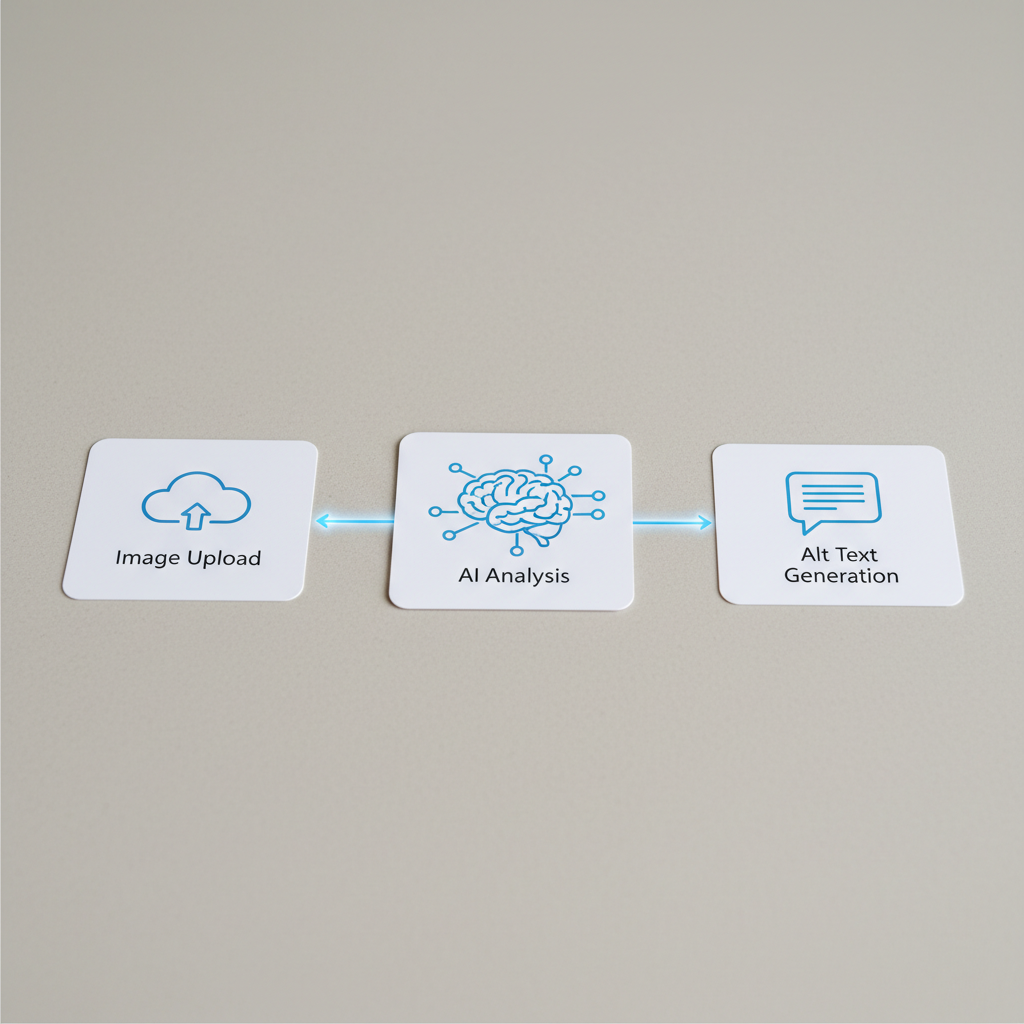
Understanding AI Vision Models for Image Analysis
AI vision models are the core technology behind these generators. These models, often based on deep learning neural networks, are trained to recognize and categorize visual elements within an image. For product photos, this means identifying specific product types, materials, colors, and even the context in which a product is presented. For instance, a model can differentiate between a “red leather handbag” and a “red canvas tote bag” by analyzing visual cues. The more sophisticated the model, the more accurate and detailed the alt text it can produce. This capability is crucial for generating high-quality descriptions.
Automated Alt Text Generation Process Explained
The automated alt text generation process involves several steps after the image analysis. First, the AI identifies the primary subject of the image, such as a “women’s running shoe.” Then, it adds relevant attributes like color (“blue”), material (“mesh”), and style (“lightweight”). Finally, it often incorporates common e-commerce keywords or brand names if provided in the product data. The goal is to create a concise yet comprehensive description that accurately represents the image. This text helps search engines understand the image content, improving its discoverability.
Why Leverage AI Tools for Product Image Alt Text at Scale?
Leveraging AI tools for product image alt text at scale offers significant advantages for e-commerce businesses, primarily by saving time, ensuring consistency, and improving SEO efficiency across large product catalogs. Manually writing alt text for thousands of product images is a monumental task that can be prone to errors and inconsistencies. AI eliminates these challenges, providing a scalable solution for optimization.
These tools allow businesses to process entire inventories quickly, ensuring every product image contributes to their SEO strategy. This efficiency is particularly valuable for retailers with frequently updated product lines or extensive collections. The ability to generate product image alt text from photos with AI transforms a bottleneck into a streamlined operation.

Saving Time and Resources with AI Automation
The most immediate benefit of an AI image alt text generator for ecommerce is the immense time and resource savings. Instead of dedicating hours of staff time to manual alt text creation, businesses can automate the process, freeing up employees for more strategic tasks. This automation reduces operational costs and accelerates the time-to-market for new products. For large-scale operations, the cost-effectiveness of AI-driven solutions is undeniable. It allows for rapid deployment of optimized content.
Ensuring SEO Consistency Across Product Catalogs
Consistency in alt text is vital for effective SEO. Manual efforts often lead to variations in keyword usage, descriptive style, and overall quality across different products or even within the same product line. AI tools, however, apply a uniform set of rules and algorithms to every image. This ensures that all alt text is consistently optimized, adheres to brand guidelines, and incorporates target keywords effectively. Consistent alt text signals clear relevance to search engines, boosting overall site authority. An AI can also help businesses create images that align with their brand’s visual identity, further enhancing consistency.
Best Practices: How to Write SEO Alt Text for Product Photos with AI
To effectively write SEO alt text for product photos with AI, it’s crucial to guide the AI with clear parameters and integrate human oversight for optimal results. While AI can generate descriptions rapidly, fine-tuning its output ensures that the alt text is not only descriptive but also highly relevant to search queries and user intent. The goal is to create alt text that both search engines and visually impaired users can understand.
This involves providing the AI with sufficient context and potentially refining its suggestions. Proper implementation of an AI image alt text generator for ecommerce requires a strategic approach. It’s not just about automation, but about intelligent automation that aligns with your SEO objectives.
Optimizing for Keywords and User Intent with AI
When using an AI alt text generator, ensure it has access to relevant product keywords and category information. This context helps the AI generate alt text that includes terms customers are likely to search for. For example, if a product is a “vintage leather messenger bag,” the AI should be prompted to include these terms. Consider the user’s intent when searching for such a product. Are they looking for material, style, or color? The AI should aim to capture these details. Regularly reviewing and updating keyword lists for your AI can significantly improve its output.
Balancing Detail and Conciseness in AI-Generated Alt Text
Effective alt text strikes a balance between being descriptive and concise. While you want to provide enough detail for search engines and screen readers, overly long or keyword-stuffed alt text can be detrimental. Aim for 5-15 words that clearly describe the image and its function.
Here’s a comparison of alt text examples:
| Poor Alt Text (Too Generic/Keyword Stuffing) | Good Alt Text (Descriptive & Concise) |
| :——————————————- | :———————————— |
| `shoe` | `Men’s black leather dress shoe with laces` |
| `red dress best dress party dress buy now` | `Women’s elegant red cocktail dress, knee-length` |
| `laptop computer tech device` | `Silver ultrabook laptop with backlit keyboard` |
Train your AI to prioritize key visual elements and relevant keywords without creating repetitive or overly verbose descriptions. Human review can help refine this balance.
Exploring Ecommerce Alt Text Examples for Product Images Generated by AI
Examining ecommerce alt text examples for product images generated by AI reveals the potential for consistent, high-quality descriptions across diverse product categories. These examples demonstrate how AI can accurately capture visual details and integrate relevant keywords, significantly enhancing SEO and accessibility. The strength of an AI image alt text generator for ecommerce lies in its ability to adapt to different product types and nuances.
Good examples showcase AI’s capacity to understand context and apply appropriate descriptive language. They highlight the importance of providing the AI with rich product data to produce the most effective alt text.
Fashion and Apparel Alt Text Examples
For fashion and apparel, AI-generated alt text should describe the item, color, material, style, and any unique features.
* Original Image: A model wearing a navy blue slim-fit blazer.
* AI-Generated Alt Text: “Men’s navy blue slim-fit blazer, single-breasted with two buttons.”
* Original Image: A pair of distressed light-wash denim jeans.
* AI-Generated Alt Text: “Women’s distressed light-wash denim jeans, high-waisted skinny fit.”
* Original Image: A child’s yellow rain jacket with a hood.
* AI-Generated Alt Text: “Kids’ bright yellow waterproof rain jacket with hood and front pockets.”
These examples demonstrate how AI can provide specific details that are helpful for both search engines and users.
Electronics and Gadgets Alt Text Examples
When it comes to electronics, AI-generated alt text needs to focus on the device type, brand, model, color, and key features.
* Original Image: A silver smartphone with a large display.
* AI-Generated Alt Text: “Silver smartphone with edge-to-edge display and dual camera system.”
* Original Image: Black over-ear noise-canceling headphones.
* AI-Generated Alt Text: “Black wireless over-ear noise-canceling headphones with cushioned earcups.”
* Original Image: A smart home speaker in white.
* AI-Generated Alt Text: “White smart home speaker with voice assistant and 360-degree sound.”
These descriptions are clear, concise, and include important identifying information that customers might use in their searches.
Comparing AI Solutions to Generate Product Image Alt Text from Photos
When looking to generate product image alt text from photos with AI, comparing various solutions is essential to find the best fit for your e-commerce needs. Different AI tools offer varying levels of accuracy, customization, and integration capabilities. Understanding these distinctions helps businesses make an informed decision that aligns with their budget and technical requirements.
The market for AI image alt text generators for ecommerce is growing, with solutions ranging from standalone applications to integrated platform features. Evaluating key features and pricing models is crucial for effective implementation.
Key Features to Look For in an AI Alt Text Generator
When evaluating AI alt text generators, consider the following features:
* Accuracy and Specificity: How well does the AI describe complex products? Does it include brand names, materials, and unique features?
* Customization Options: Can you provide specific keywords, brand guidelines, or product attributes to guide the AI’s output?
* Bulk Processing: Does the tool efficiently handle large volumes of images simultaneously?
* Integration Capabilities: Can it integrate with your existing e-commerce platform (e.g., Shopify, Magento) or PIM (Product Information Management) system?
* Multilingual Support: Is it capable of generating alt text in multiple languages for international markets?
* Human Review Workflow: Does it allow for easy human review and editing of AI-generated suggestions?
Pricing Models and Scalability Considerations
AI alt text generators typically come with different pricing models, including per-image fees, subscription plans based on usage tiers, or enterprise licenses.
* Per-Image Pricing: Good for businesses with fluctuating or smaller image volumes.
* Subscription Tiers: Ideal for consistent, medium-to-large scale operations, often offering better value at higher volumes.
* Enterprise Solutions: Tailored for very large businesses requiring extensive customization, dedicated support, and deep integration.
Consider your current and projected image volume when choosing a solution. A scalable option will grow with your business without incurring prohibitive costs. Always factor in the total cost of ownership, including potential integration expenses and training.
Implementing an AI Image Alt Text Generator into Your Ecommerce Workflow
Integrating an AI image alt text generator for ecommerce into your existing workflow requires careful planning and execution to maximize its benefits. A smooth implementation ensures that the automation enhances, rather than disrupts, your product management and SEO processes. This involves preparing your product data, choosing the right tool, and establishing a review process.
Effective integration can transform how you handle product imagery, making SEO optimization a seamless part of your daily operations. It’s about leveraging technology to improve efficiency and maintain high standards.
Preparing Product Data for AI Alt Text Generation
Before feeding images to an AI generator, ensure your product data is clean, consistent, and comprehensive. This includes accurate product titles, descriptions, categories, and any relevant attributes (e.g., color, material, size, brand). The AI uses this contextual information to generate more precise and keyword-rich alt text. Incomplete or inaccurate data can lead to generic or irrelevant descriptions. Standardizing your product data across your e-commerce platform is a critical first step for optimal AI performance.
Integrating AI Tools with Existing Ecommerce Platforms
Many AI alt text generators offer direct integrations with popular e-commerce platforms like Shopify, WooCommerce, or Magento. These integrations allow for automated syncing of product images and the seamless application of generated alt text back into your product listings. If a direct integration isn’t available, consider using APIs to connect the AI tool with your PIM or e-commerce system. This programmatic approach ensures that alt text is updated efficiently and consistently across your entire catalog. Test the integration thoroughly to ensure data flows correctly and alt text is applied as expected.
What is alt text and why is it important for ecommerce?
Alt text, or alternative text, is a written description of an image. It’s crucial for ecommerce because it improves accessibility for visually impaired users and helps search engines understand image content, boosting SEO and discoverability of product pages.
Can AI generate SEO-friendly alt text for all types of products?
Yes, AI can generate SEO-friendly alt text for a wide range of products. Its effectiveness depends on the quality of the AI model and the specificity of the product image and associated data. More complex or niche products may require some human refinement.
How accurate is an AI image alt text generator for ecommerce?
The accuracy of an AI image alt text generator for ecommerce has significantly improved with advancements in computer vision. While highly accurate for many products, human review is still recommended to ensure optimal SEO and descriptive quality, especially for unique items.
Is an AI alt text generator suitable for small businesses?
Yes, AI alt text generators are suitable for businesses of all sizes, including small businesses. Many tools offer affordable plans or even free tiers, making advanced SEO optimization accessible. They help small teams save time and compete more effectively.
Does AI alt text help with Google image search rankings?
Absolutely. AI-generated alt text, when optimized correctly, provides Google Image Search with valuable context about your product photos. This can significantly improve your images’ visibility and ranking in relevant search queries, driving more traffic to your store.
What is the difference between alt text and image captions?
Alt text describes an image for accessibility and SEO purposes, typically not visible on the page unless the image fails to load. Image captions are visible text displayed directly below or next to an image, providing additional context or information to all users.
Optimizing product images with an AI image alt text generator for ecommerce is no longer a luxury but a necessity for competitive online retailers. This technology offers a powerful solution to streamline SEO efforts and enhance accessibility across vast product catalogs.
Key takeaways for leveraging AI in alt text generation include:
* Efficiency: Automate a time-consuming task, freeing up valuable resources.
* Consistency: Ensure uniform, high-quality alt text across all product images.
* SEO Boost: Improve search engine visibility and drive more organic traffic.
* Accessibility: Make your product listings more inclusive for all users.
* Scalability: Effortlessly manage alt text for growing product inventories.
By integrating an AI image alt text generator into your e-commerce strategy, you can unlock significant advantages in search engine rankings and user experience. Start exploring AI solutions today to elevate your online store’s performance and reach a broader audience.