

AI For Creating Transparent Background PNG Product Photos 2026
The landscape of e-commerce and digital marketing is constantly evolving, with visual content at its core. In 2026, AI for creating transparent background PNG product photos has become an indispensable tool for businesses aiming for professional, versatile, and high-quality imagery. This advanced technology streamlines the often tedious process of background removal, allowing brands to present their products flawlessly across various platforms and marketing materials. AI not only enhances efficiency but also opens doors to generating product images optimized for specific uses, from lightning-fast web pages to high-fidelity print catalogs.
AI for Transparent Background PNG Product Photos
AI significantly simplifies the creation of transparent background PNG product photos by automatically identifying and isolating the product from its original background. This capability allows businesses to achieve studio-quality cutouts without manual editing, saving immense time and resources.
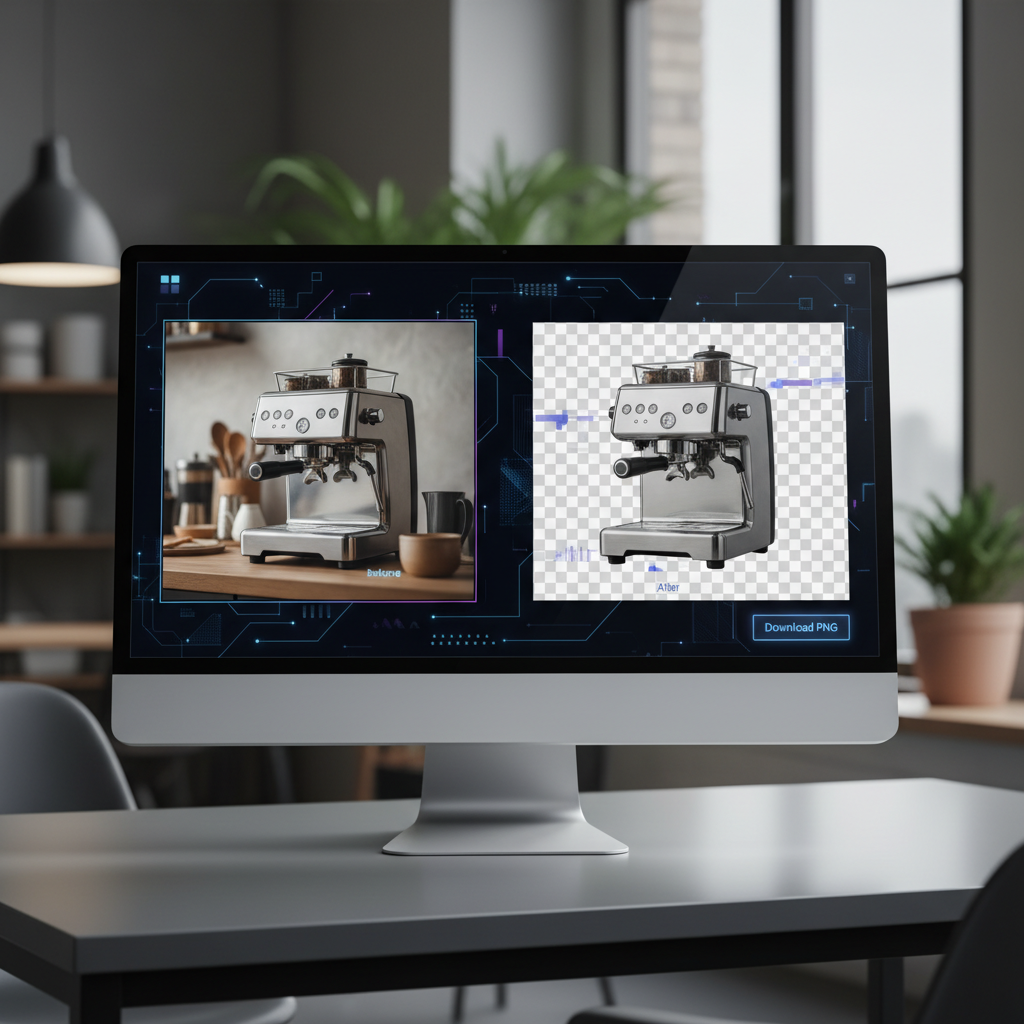
Artificial intelligence, in this context, refers to machine learning algorithms trained on vast datasets of images to recognize objects and distinguish them from their surroundings. These algorithms can accurately detect edges, even complex ones like hair or intricate product details, and then remove the background with precision. The result is a clean, professional product image ready for any digital application.
How AI Achieves Perfect Background Removal for Product Images
AI-powered background removal tools employ sophisticated deep learning models, often convolutional neural networks (CNNs), to analyze image pixels. They learn to differentiate foreground (the product) from background elements. This process involves segmentation, where the AI creates a mask around the product, effectively “cutting it out” from the original scene. Modern AI systems can handle challenging scenarios, including reflections, shadows, and similar color palettes between the product and background.
* Semantic Segmentation: AI identifies and classifies each pixel in an image as either belonging to the product or the background.
* Edge Detection: Advanced algorithms precisely outline the product, even with soft or complex edges.
* Automated Masking: A digital mask is created, allowing the product to be extracted and placed on a transparent canvas.
Benefits of AI-Generated Transparent PNGs for E-commerce
Transparent PNGs are invaluable for e-commerce because they offer unparalleled versatility. Products with transparent backgrounds can be seamlessly placed on any website background, in marketing banners, or integrated into composite images without visible edges or halos. This consistency enhances brand professionalism and provides flexibility for design teams. Using AI for creating transparent background PNG product photos ensures every image meets high standards.
* Design Flexibility: Easily place products on diverse backgrounds for different campaigns.
* Brand Consistency: Maintain a uniform, polished look across all product listings.
* Reduced Editing Time: Automate a process that traditionally took hours of manual labor.
* Improved User Experience: Clean product images contribute to a more professional and trustworthy online store.
AI for Generating WEBP Format Product Images for Page Speed
AI for generating WEBP format product images for page speed is crucial for modern e-commerce, as it automatically converts and optimizes images into the highly efficient WEBP format, significantly improving website loading times. Faster page speeds lead to better user experiences and higher search engine rankings.
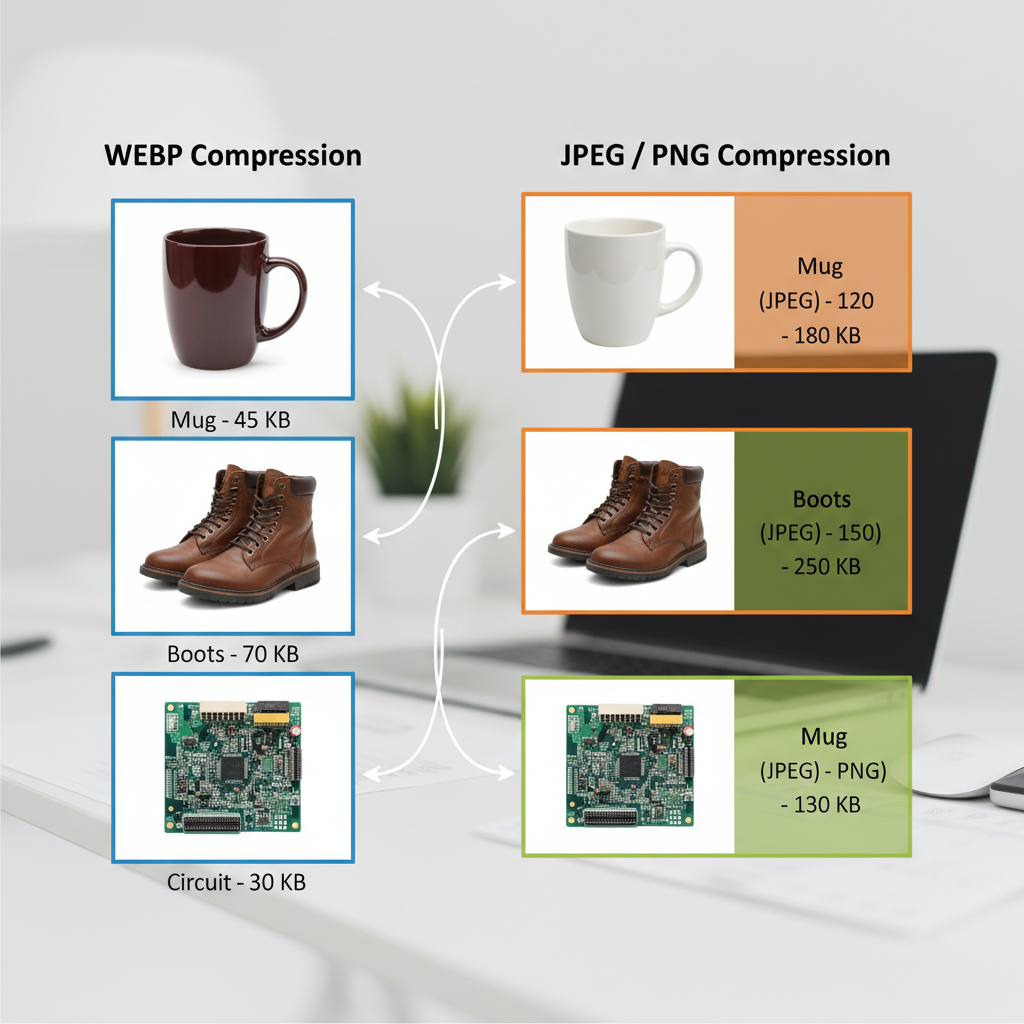
WEBP is an image format developed by Google that provides superior lossless and lossy compression for images on the web. It can reduce file sizes by 25-34% compared to JPEG and PNG, often without a noticeable loss in quality. AI tools go beyond simple conversion; they intelligently analyze each image to apply the optimal compression settings, ensuring the smallest possible file size while preserving visual fidelity. This automated optimization is essential for managing large product catalogs efficiently.
Why WEBP is Crucial for E-commerce Page Speed
In the competitive world of online retail, every second counts. Slow-loading websites frustrate users and increase bounce rates, directly impacting sales and conversions. Search engines like Google also prioritize fast-loading sites in their rankings. By using WEBP, e-commerce stores can deliver rich visual content without compromising performance. AI makes this optimization scalable and consistent across thousands of product images.
* Faster Loading Times: Smaller file sizes mean quicker image downloads and overall page loads.
* Improved SEO: Page speed is a critical ranking factor for search engines.
* Enhanced User Experience: Visitors are more likely to stay and browse on a fast website.
* Reduced Bandwidth Usage: Lower data transfer costs for both the website owner and the user.
AI Tools for WEBP Conversion and Optimization
Modern AI-powered image optimization platforms integrate WEBP conversion as a standard feature. These tools often use machine learning to determine the best compression level for each image dynamically, balancing quality and file size. Some even offer “smart cropping” or resizing features to further optimize images for different devices and screen sizes. The goal is to automate the entire image pipeline, from upload to optimized delivery.
| Feature | AI-Powered WEBP Optimization | Manual WEBP Conversion |
|---|---|---|
| Efficiency | Automated, batch processing, real-time optimization | Time-consuming, one-by-one conversion |
| Quality Control | Intelligent compression, maintains visual fidelity | Requires manual judgment, inconsistent results |
| Scalability | Handles thousands of images effortlessly | Impractical for large catalogs |
| Integration | Often integrates with CMS, CDN, and e-commerce platforms | Standalone tools, manual upload/download |
| Cost | Subscription-based, saves labor costs | Free tools available, high labor cost |
AI for Creating Product Photos in CMYK for Print Catalog
AI for creating product photos in CMYK for print catalog ensures that digital images are accurately converted to the correct color profile required for professional printing, eliminating color shifts and ensuring brand consistency. This is vital for producing high-quality physical marketing materials.
CMYK (Cyan, Magenta, Yellow, Key/Black) is a subtractive color model used in color printing. Unlike RGB (Red, Green, Blue), which is an additive model used for screens, CMYK colors are created by combining different proportions of inks. Converting RGB images to CMYK can often result in duller or inaccurate colors if not handled correctly. AI tools are trained to perform this conversion intelligently, predicting how colors will appear in print and adjusting them to maintain fidelity to the original digital image. This ensures that your print catalogs accurately reflect your brand’s visual identity.
Understanding CMYK for Professional Printing
When preparing images for print, understanding the CMYK color space is fundamental. Printers use CMYK inks to reproduce colors on paper, and the way these inks mix differs significantly from how light combines to create colors on a screen. Incorrect conversion can lead to colors that look vibrant online appearing flat or off-hue in print. AI-powered solutions take the guesswork out of this complex process, ensuring that the final printed product aligns with the digital representation.
* Color Gamut Differences: RGB has a wider color gamut than CMYK, meaning some vibrant RGB colors cannot be perfectly reproduced in CMYK.
* Ink Limitations: CMYK is limited by the physical properties of inks and paper.
* Print Consistency: Proper CMYK conversion is essential for consistent brand colors across all print materials.
AI-Powered CMYK Conversion for Catalogs
AI systems designed for print media conversion use advanced algorithms to map RGB colors to their closest CMYK equivalents. They can also apply sophisticated color management techniques, such as gamut mapping, to handle out-of-gamut colors gracefully. Some AI tools even allow for previewing the CMYK output, giving designers confidence before sending files to print. This automation is particularly beneficial for large product catalogs, where manual color correction for hundreds or thousands of images would be impractical. By leveraging AI for creating product photos in CMYK for print catalog, businesses can achieve professional print results with minimal effort.
1. Automated Color Profile Assignment: AI identifies the optimal CMYK profile for the target print medium.
2. Intelligent Gamut Mapping: Out-of-gamut RGB colors are adjusted to their closest CMYK representation, minimizing visual discrepancies.
3. Batch Processing: Convert entire folders of product images to CMYK simultaneously, saving significant time.
4. Print-Ready Output: Deliver files that meet the strict color requirements of commercial printers.
AI for Generating Product Photos at 300 DPI for Print Media
AI for generating product photos at 300 DPI for print media is essential for ensuring images retain sharpness and detail when reproduced in physical formats like magazines, brochures, and catalogs. AI can intelligently upscale lower-resolution images or ensure native high-resolution output.
DPI (Dots Per Inch) is a measure of spatial printing dot density, specifically the number of individual dots a printer can place in a linear inch. For high-quality print media, 300 DPI is the industry standard because it provides sufficient detail to prevent pixelation or blurriness when viewed up close. While digital screens typically display images at 72 DPI or 96 DPI, print requires a much higher density of information. AI-powered upscaling technologies use machine learning to add detail to images, rather than simply stretching pixels, resulting in sharper and more defined print-ready files.
The Importance of 300 DPI for High-Quality Prints
Using images with insufficient DPI for print can lead to fuzzy, blocky, or unprofessional results. A low-resolution image that looks acceptable on a screen will appear pixelated when printed at a larger size. Ensuring all product photos intended for print media are at 300 DPI is a fundamental requirement for maintaining brand image and product appeal. AI helps bridge the gap when original source images might not meet this stringent standard.
* Sharpness and Clarity: 300 DPI ensures fine details are crisp and legible.
* Professional Appearance: High-resolution images convey quality and attention to detail.
* Avoids Pixelation: Prevents images from looking blurry or “blocky” when printed.
* Meets Printer Requirements: Commercial printers typically require 300 DPI for optimal output.
AI Solutions for High-Resolution Product Imagery
AI upscaling, also known as super-resolution, utilizes deep learning models to predict and generate missing pixel information in an image. Instead of simple interpolation, which can lead to blurriness, AI analyzes patterns and textures within the image to intelligently reconstruct details. This means that even if a product photo was initially captured at a lower resolution, AI for generating product photos at 300 DPI for print media can transform it into a print-ready asset. This technology is a game-changer for businesses working with legacy images or those needing to repurpose web-optimized photos for print.
Here’s how AI enhances image resolution for print:
1. Pattern Recognition: AI models learn from vast datasets of high and low-resolution image pairs to understand how details are lost and can be restored.
2. Intelligent Pixel Generation: Instead of simply stretching pixels, AI generates new pixels that fit the existing patterns, adding genuine detail.
3. Noise Reduction: Many AI upscaling tools also incorporate noise reduction to clean up images during the process.
4. Batch Upscaling: Process multiple images efficiently, ensuring all print assets meet the 300 DPI standard.
AI for Creating Product Photography in HDR Format
AI for creating product photography in HDR format captures and enhances a wider range of light and shadow details, resulting in images with greater visual depth and realism. This format is particularly beneficial for showcasing products with intricate textures or reflective surfaces.
HDR (High Dynamic Range) photography involves combining multiple exposures of the same scene, taken at different brightness levels, into a single image. This process captures a much broader spectrum of light intensities than a standard dynamic range (SDR) image. The human eye can perceive a vast dynamic range, but traditional cameras and displays are limited. AI algorithms can intelligently merge these exposures, or even simulate HDR from a single image, to reveal details in both the brightest highlights and the darkest shadows. This makes products look more vibrant and true-to-life, especially for items like jewelry, electronics, or apparel with subtle fabric textures.
Unlocking Detail with HDR Product Photography
Standard photography often struggles to capture scenes with extreme contrast, resulting in either blown-out highlights or crushed shadows. HDR overcomes this limitation, providing a more faithful representation of the product. For e-commerce, this means customers get a clearer, more detailed view of what they are purchasing. The enhanced dynamic range can highlight material quality, intricate designs, and subtle color variations that might otherwise be lost.
* Expanded Tonal Range: Captures more detail in both bright and dark areas.
* Increased Realism: Images appear closer to how the human eye perceives a scene.
* Enhanced Visual Impact: Products stand out with greater depth and dimension.
* Reveals Fine Details: Crucial for showcasing textures, finishes, and intricate components.
AI for Enhancing Dynamic Range in Product Shots
AI plays a pivotal role in simplifying and improving the HDR process. Instead of complex manual bracketing and merging, AI tools can automate the creation of HDR images. Some advanced AI systems can even analyze a single image and intelligently “expand” its dynamic range by inferring missing light information. This is achieved by deep learning models trained on vast datasets of HDR and SDR images, allowing them to accurately predict and reconstruct details. AI for creating product photography in HDR format makes this formerly specialized technique accessible and efficient for all businesses.
AI-driven HDR enhancements include:
* Automated Exposure Blending: Seamlessly merges multiple exposures into a single, perfectly balanced HDR image.
* Single-Shot HDR Simulation: AI can analyze an SDR image and intelligently generate an HDR-like output, saving shooting time.
* Intelligent Tone Mapping: Optimizes the display of HDR content on SDR screens, ensuring the enhanced details are visible.
* Color and Contrast Optimization: AI fine-tunes colors and contrast to maximize the visual impact of the expanded dynamic range.
FAQ About AI Product Photography
What is AI in the context of product photography?
AI in product photography refers to the use of artificial intelligence and machine learning algorithms to automate and enhance various aspects of image creation and optimization. This includes tasks like background removal, color correction, image upscaling, and format conversion, making the process faster and more efficient.
How does AI create transparent backgrounds for product photos?
AI uses deep learning models, specifically semantic segmentation, to identify and isolate the product from its background. It creates a precise mask around the object, allowing the background to be removed automatically and replaced with transparency, resulting in a clean PNG file.
Can AI convert images to WEBP format without losing quality?
Yes, AI-powered tools are designed to convert images to WEBP while intelligently optimizing compression. They balance file size reduction with visual fidelity, often achieving significant file size savings (25-34% over JPEG/PNG) with minimal or no perceptible quality loss, crucial for page speed.
Is AI suitable for generating CMYK product photos for print?
Absolutely. AI tools can accurately convert RGB images to CMYK, the color space for print. These systems employ advanced color management and gamut mapping to ensure that colors remain consistent and accurate when printed, avoiding common color shifts and dullness.
How does AI help achieve 300 DPI for print media?
AI utilizes super-resolution techniques, where deep learning models intelligently generate new pixel information to upscale lower-resolution images. This process adds genuine detail rather than just stretching pixels, allowing images to meet the 300 DPI standard required for sharp, high-quality print output.
What are the benefits of using AI for HDR product photography?
AI enhances HDR product photography by automating exposure blending and even simulating HDR from single shots. This captures a wider dynamic range, revealing more detail in highlights and shadows, making products appear more realistic, vibrant, and visually impactful for customers.
What are the main advantages of using AI for product image creation overall?
The primary advantages include significant time and cost savings through automation, consistent high-quality output, scalability for large product catalogs, and the ability to optimize images for various platforms and uses (web, print, social media) with specialized formats and resolutions.
The integration of AI into product photography workflows has revolutionized how businesses create and manage their visual assets. From effortlessly generating transparent background PNG product photos to optimizing for lightning-fast web performance with AI for generating WEBP format product images for page speed, the benefits are undeniable. Furthermore, the ability of AI for creating product photos in CMYK for print catalog and AI for generating product photos at 300 DPI for print media ensures brand consistency across all physical marketing materials. Finally, AI for creating product photography in HDR format elevates visual appeal, capturing products with stunning realism.
Key takeaways for leveraging AI in product photography:
* Efficiency Boost: Automate repetitive tasks like background removal and image optimization.
* Versatility: Easily adapt images for web, print, and various digital platforms.
* Quality Assurance: Achieve professional-grade results with consistent color, resolution, and detail.
* Future-Proofing: Stay ahead with advanced formats and optimization techniques for evolving digital landscapes.
* Cost Savings: Reduce reliance on expensive manual editing and specialized photography equipment.
Embrace AI-powered solutions to streamline your product photography, enhance your brand’s visual presence, and deliver an exceptional experience to your customers. Explore the latest AI tools to transform your product imagery today.