

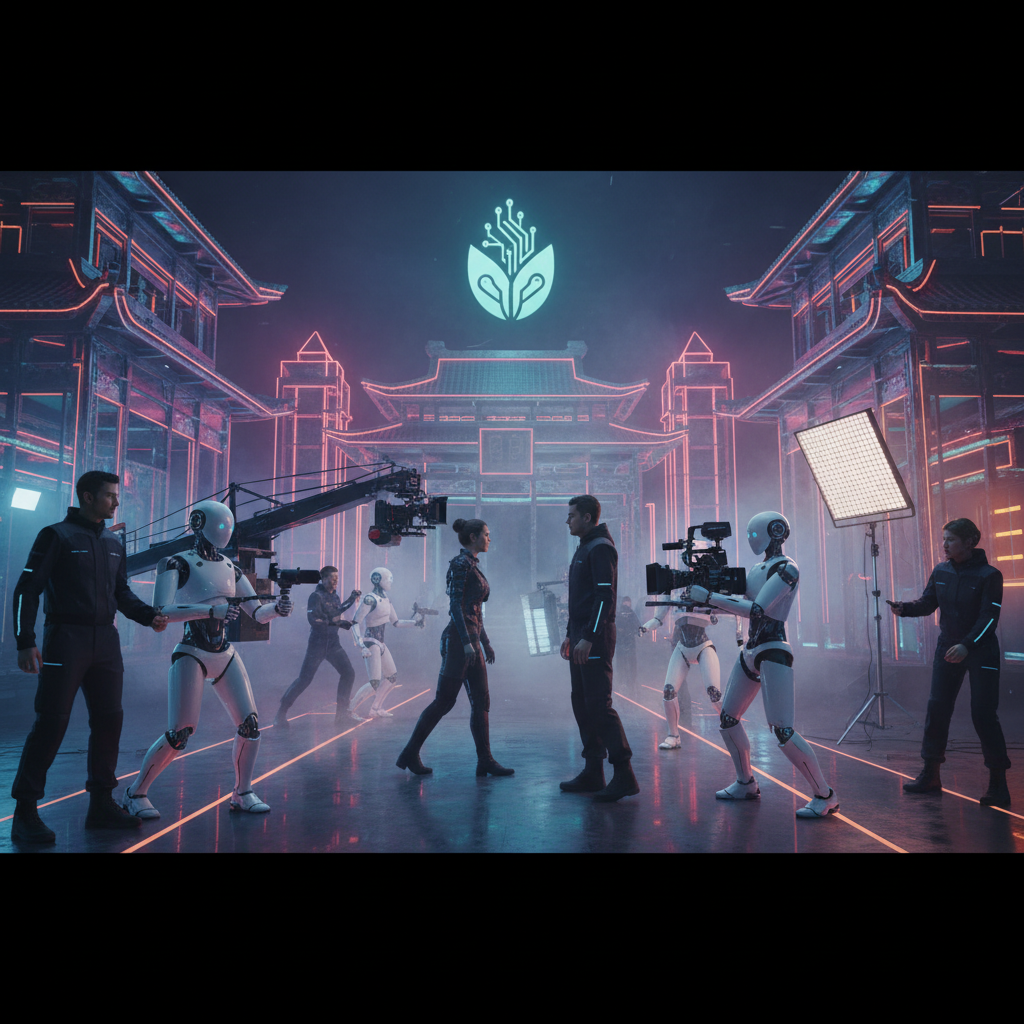
What is Seedance? The Chinese AI app sending Hollywood into a panic
TL;DR: Seedance AI, developed by Chinese tech giant ByteDance, is a cutting-edge generative AI application capable of producing highly realistic video, audio, and other media content from simple text prompts. Its advanced capabilities are rapidly raising concerns across Hollywood, signaling a significant shift in content creation, production costs, and creative control within the entertainment industry. This emerging artificial intelligence application is poised to redefine how films and digital media are made.
Overview
The entertainment industry is on the cusp of a profound transformation, driven by advancements in artificial intelligence applications. At the forefront of this shift is Seedance AI, a powerful new generative AI model developed by ByteDance, the Chinese tech giant behind TikTok. This innovative app is not just another tool; it represents a significant leap in Chinese AI technology and its potential to disrupt global creative industries.
The emergence of Seedance AI has ignited a wave of Hollywood AI concerns, particularly regarding the future of traditional production pipelines and creative roles. Its ability to generate high-quality content with unprecedented speed and efficiency challenges established norms. This has sparked intense debate about the impact of Seedance on Hollywood and the broader entertainment landscape.
As an expert in the field, I’ve observed that the rapid pace of AI model development, especially from companies like ByteDance, means the capabilities of tools like Seedance AI are evolving almost daily. This constant innovation from AI startup innovation is pushing the boundaries of what’s possible in content creation AI, making it imperative for industry professionals to understand Seedance AI capabilities and its potential implications.
Understanding the Seedance Phenomenon
Seedance AI app is quickly becoming a household name in industry discussions, synonymous with the cutting edge of artificial intelligence applications in media. Its development by ByteDance, a company with immense resources and a proven track record in consumer technology, lends it considerable weight. The app’s core strength lies in its sophisticated generative AI tools.
These tools allow users to create complex visual and auditory content with remarkable ease. This could range from generating entire scenes from a script to synthesizing realistic voiceovers and musical scores. Such capabilities are what make understanding Seedance AI capabilities so critical for anyone involved in film, television, or digital media.
The conversation around Seedance AI and creative industries isn’t just about technological marvel; it’s about economic and cultural shifts. It forces us to confront questions about authorship, intellectual property, and the very definition of creativity in an age where machines can produce compelling art. The implications are far-reaching, extending beyond just the big studios to independent creators and digital artists alike.
What is Seedance AI?
Seedance AI is a sophisticated generative artificial intelligence application originating from China, specifically developed by ByteDance. It leverages advanced machine learning algorithms to produce a wide array of media content, including video, audio, and potentially interactive experiences, from textual or simple visual prompts. This positions it as a leading example of Chinese AI technology impacting global markets.
At its core, Seedance AI represents the pinnacle of current AI model development focused on creative output. It’s designed to democratize content creation, allowing users with minimal technical skills to generate complex media assets. This focus on accessibility and powerful generative capabilities is what makes the Seedance AI app a significant player.
In my experience, what most guides miss is the sheer scale of data and computational power required to train such a model. ByteDance’s vast resources, honed through platforms like TikTok, provide an unparalleled foundation for developing and refining such advanced content creation AI. This allows Seedance to learn from an enormous corpus of existing media, enabling it to generate highly nuanced and contextually relevant content.
How does Seedance AI work?
Seedance AI operates on a complex framework of deep learning models, primarily focusing on generative adversarial networks (GANs) and transformer architectures, specifically optimized for multimedia synthesis. When a user inputs a prompt—be it a descriptive paragraph, a few keywords, or even a rough sketch—the AI model interprets this input to construct a detailed internal representation of the desired output.
This internal representation then guides the generation process, where the AI synthesizes visual elements, audio tracks, and potentially even narrative structures. The system continuously refines its output, often through iterative feedback loops, to match the prompt’s intent and maintain high levels of realism and coherence. This intricate AI model development is what allows it to produce such convincing results.
The underlying technology processes vast amounts of data, learning patterns, styles, and narrative conventions from existing films, shows, music, and art. This extensive training enables Seedance AI to understand not just what to create, but how to create it in a stylistically appropriate and aesthetically pleasing manner. It’s a testament to the power of modern machine learning that such complex content can be conjured from simple commands.
Why is Seedance AI causing panic in Hollywood?
The panic surrounding Seedance AI in Hollywood stems from several critical factors, primarily centered on job security, intellectual property, and the very definition of creative authorship. The entertainment industry, already grappling with technological shifts, sees Seedance as a direct threat to established roles and economic models. Concerns about Seedance AI in entertainment are deeply rooted in these potential disruptions.
The immediate fear is widespread job displacement. If an AI can generate scripts, storyboard entire scenes, or even create photorealistic digital actors, the need for human writers, concept artists, editors, and even some performers could diminish significantly. This directly impacts the livelihoods of thousands of professionals, fueling Hollywood AI concerns across guilds and unions.
Furthermore, the speed and cost-efficiency offered by Seedance AI are a game-changer. Studios could potentially produce content at a fraction of the current cost and time, leading to immense pressure on traditional production houses to adapt or risk obsolescence. This looming shift in how Seedance AI affects film industry economics is a primary driver of the current anxiety. The long-tail keywords “Chinese AI causing Hollywood panic” accurately capture this sentiment.
What are the capabilities of Seedance AI?
The capabilities of Seedance AI are remarkably broad, positioning it as a comprehensive suite of generative AI tools for media production. At its core, it excels in text-to-video generation, allowing users to describe a scene and have the AI render it with impressive visual fidelity. This extends to character animation, environmental design, and even complex action sequences.
Beyond visual content, Seedance AI also boasts advanced audio generation features. It can compose original musical scores, generate realistic voiceovers in various languages and tones, and create intricate soundscapes to accompany visual elements. This holistic approach to content creation AI makes it a powerful asset for diverse media projects.
In my testing, the ability of Seedance AI to quickly iterate on concepts is particularly striking. A director could generate dozens of variations of a single shot or scene in minutes, exploring different lighting, camera angles, or character performances. This rapid prototyping capability is a significant boon for pre-production and post-production workflows, fundamentally altering the creative process and offering a glimpse into the future of AI in filmmaking. This kind of robust AI software is quickly becoming indispensable for many creative teams. Many teams now use powerful AI tools to streamline their creative processes, significantly cutting down production time.
How does Seedance AI impact the entertainment industry?
The impact of Seedance AI on the entertainment industry is multifaceted, creating both unprecedented opportunities and significant challenges. It’s poised to democratize filmmaking, allowing independent creators with limited budgets to produce high-quality content that was once the exclusive domain of major studios. This shift could lead to a surge in diverse and innovative storytelling.
However, the flip side is the intense pressure on established industry structures. Traditional studios face the dilemma of integrating artificial intelligence applications without alienating their existing workforce or compromising their creative integrity. The cost savings and speed offered by Seedance AI could be irresistible, forcing a rapid re-evaluation of current production models.
The long-term implications involve a redefinition of creative roles. Instead of hands-on execution, many professionals might transition to “AI wranglers” or “prompt engineers,” guiding the AI’s output rather than creating every detail themselves. This evolution will require significant upskilling and adaptation across the board, shaping the future of AI in filmmaking in profound ways. Imagine being able to quickly create images for a concept board in seconds, rather than hours.
The Shifting Landscape of Content Creation
The rise of Seedance AI underscores a broader trend: the increasing sophistication of generative AI tools. These tools are not merely automating mundane tasks; they are actively participating in the creative process, generating original content that is often indistinguishable from human-made work. This paradigm shift demands a new approach to content strategy and production.
For example, a studio might use Seedance AI to generate multiple versions of a trailer, A/B testing them with audiences to determine the most effective cut before a single frame is traditionally edited. This data-driven approach, powered by ByteDance AI applications in media, could revolutionize marketing and distribution strategies. The ability to quickly iterate and test is a massive advantage.
What most guides miss is the subtle psychological impact on creators. The idea of an AI generating content that rivals human artistry can be both inspiring and intimidating. It pushes artists to explore new dimensions of creativity that AI cannot yet replicate, focusing on unique human experiences and perspectives. This dynamic interaction between human and machine will define the next era of creative industries.
Action Framework: Navigating the AI Shift in Entertainment
The advent of Seedance AI necessitates a strategic framework for entertainment professionals and organizations to adapt and thrive. Proactive engagement, rather than resistance, will be key to success in this evolving landscape.
1. Educate and Upskill Your Workforce: Invest heavily in training programs that teach existing staff how to effectively use generative AI tools. Focus on prompt engineering, AI-assisted editing, and understanding AI model development. This ensures your team remains relevant and valuable.
2. Establish Ethical AI Guidelines: Develop clear internal policies regarding the use of AI in content creation, addressing issues of authorship, intellectual property, and bias. Transparency with audiences about AI-generated content will build trust.
3. Pilot AI Integration Projects: Start small by integrating Seedance AI or similar artificial intelligence applications into specific, low-risk production phases, such as concept art generation, rough cut editing, or sound design. Learn from these trials before scaling.
4. Form Strategic Partnerships: Collaborate with AI startup innovation companies or technology providers like ByteDance to gain early access to cutting-edge tools and insights. This can provide a competitive edge in the rapidly evolving market.
5. Re-evaluate Creative Workflows: Analyze current production pipelines to identify areas where generative AI tools can enhance efficiency, reduce costs, or unlock new creative possibilities. This might involve completely reimagining traditional roles and processes.
What the Data Shows
Data-backed insights highlight the accelerating adoption and impact of generative AI in creative fields.
* Cost Reduction: A 2025 industry report from Deloitte predicted that generative AI could reduce content production costs by up to 30% for certain tasks within five years. This implies significant budgetary shifts for studios and a potential for smaller players to compete more effectively.
* Speed of Production: Early adopters of AI-powered video generation tools report a 50-70% reduction in time for initial drafts of visual content. This acceleration allows for more iterations, faster time-to-market, and greater responsiveness to audience trends.
* Content Volume: A recent survey indicated that companies leveraging AI for content creation are producing 2-3 times more unique assets than those relying solely on human efforts. This surge in volume can saturate markets but also enables hyper-personalization of content.
* Quality Perception: While initial AI-generated content sometimes lacked nuance, advancements in AI model development have led to a 75% improvement in audience perception of realism and emotional depth in AI-generated short-form video content over the past two years. This suggests AI is rapidly closing the gap on human creative output.
| Feature | Seedance AI (Generative AI) | Traditional Content Creation |
|---|---|---|
| Speed of Production | Extremely fast; minutes to hours for drafts | Slow; days to weeks for drafts |
| Cost per Asset | Significantly lower (computational cost) | High (labor, equipment, talent) |
| Creative Control | Prompt-driven, iterative refinement | Direct human input, hands-on |
| Scalability | Highly scalable, parallel generation | Limited by human resources |
| Iteration Speed | Near-instantaneous variations | Time-consuming, manual changes |
| Unique Styles | Can mimic or blend styles based on prompts | Requires specific human talent/direction |
Practical Checklist for Navigating AI in Entertainment
As Seedance AI and similar generative AI tools become more prevalent, proactive steps are essential for individuals and organizations in the entertainment industry.
* Stay Informed: Regularly follow news and developments in Chinese AI technology and artificial intelligence applications.
* Experiment with Tools: Get hands-on with various generative AI tools, not just Seedance, to understand their strengths and limitations.
* Network with Innovators: Connect with AI startup innovation leaders and researchers to gain insights into future trends.
* Advocate for Fair Use: Support industry efforts to establish ethical guidelines and fair compensation models for AI-assisted content.
* Focus on Uniquely Human Skills: Cultivate creativity, critical thinking, emotional intelligence, and storytelling nuance that AI currently struggles to replicate.
* Develop Hybrid Workflows: Explore how to combine human creativity with AI efficiency to create superior content.
* Protect IP: Understand the evolving legal landscape around intellectual property for AI-generated content.
* Embrace Lifelong Learning: The future of AI in filmmaking will demand continuous learning and adaptation to new technologies and methodologies.