

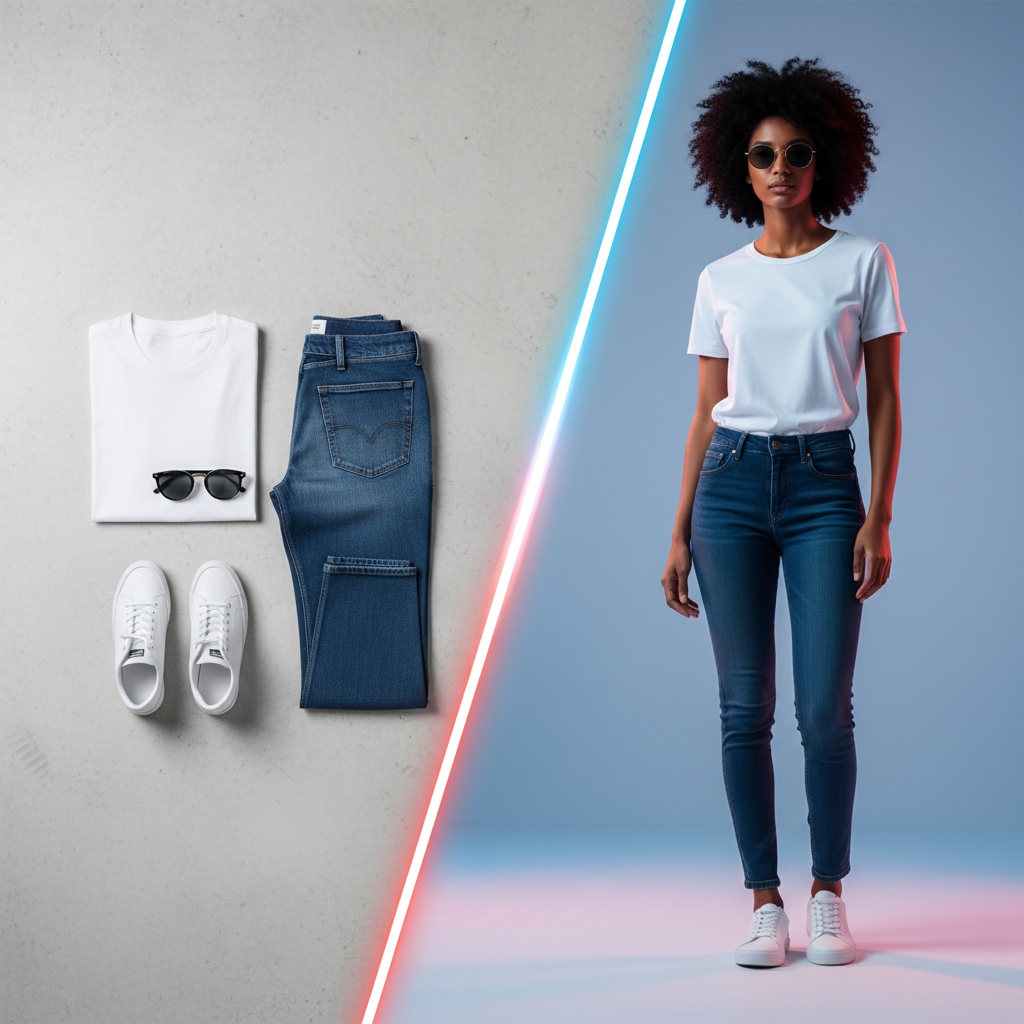
AI Flat Lay Photography Generators for Fashion and Apparel Brands
The visual landscape of fashion e-commerce is undergoing a significant transformation, driven by the relentless demand for fresh, engaging content. Traditional photoshoots, once a cornerstone for showcasing garments, are increasingly being complemented—and sometimes replaced—by innovative technologies. Among these, the AI flat lay photography generator for fashion and apparel brands stands out as a powerful tool, streamlining content creation and enhancing product presentation. It represents a pivotal shift for brands aiming for efficiency, scalability, and visual consistency in a competitive market, allowing them to produce high-quality imagery at a fraction of the cost and time. This technology is not just an incremental improvement; it’s a fundamental change in how fashion products are brought to market visually, offering unprecedented agility and creative freedom.
TL;DR
AI flat lay photography generators revolutionize how fashion and apparel brands create product visuals. These tools transform basic flat lay images into high-quality, often on-model, photographs using artificial intelligence. Brands benefit from drastically reduced costs, faster content production, and consistent visual branding across all platforms, ultimately leading to improved customer engagement and conversion rates. This innovation empowers businesses of all sizes to compete with visually stunning content, democratizing access to premium product photography.
Overview
In the dynamic world of fashion and apparel, compelling visuals are paramount for capturing consumer attention and driving sales. For years, flat lay photography has been a go-to method for showcasing garments, offering a clean and focused view of the product. While effective for highlighting fabric and design details, the static nature of traditional flat lays often falls short in conveying the true fit, drape, and real-world appeal of clothing. Shoppers struggle to visualize how a garment might look on a person, leading to hesitation and potentially higher return rates. This is precisely where the AI flat lay photography generator for fashion and apparel brands steps in, bridging the gap between simplicity and aspirational imagery by bringing products to life.
This innovative technology leverages artificial intelligence to take a basic flat lay image and reimagine it into a professional-grade visual. It can transform a garment laid flat into a fully styled look, complete with realistic virtual models, dynamic poses, and custom backgrounds. The goal is to create visuals that resonate more deeply with shoppers, helping them visualize how a product might look and feel when worn, thereby enhancing the emotional connection and perceived value. This evolution is critical for brands operating in fast-paced e-commerce environments where visual storytelling is key to standing out. Imagine taking a simple photo of a dress on the floor and, within minutes, having it displayed on a diverse range of models in various lifestyle settings – that’s the transformative power of an AI flat lay photography generator for fashion and apparel brands.
The adoption of such advanced AI tools is not just about aesthetics; it’s a strategic move for operational efficiency and market responsiveness. Brands can generate a vast array of high-quality images without the logistical complexities and exorbitant costs associated with traditional photoshoots. In my experience, what most guides miss is the sheer volume and variety that AI enables, allowing for rapid A/B testing and hyper-personalization of product visuals. This capability is becoming a non-negotiable for staying competitive, as it allows brands to quickly adapt to market feedback and optimize their visual content for maximum impact. Many teams now use sophisticated AI tools to automate this entire process, from initial image capture to final deployment, freeing up creative resources for higher-level strategic tasks.
The Rise of Automated Visuals
The demand for fresh, engaging content is relentless, especially in fashion, where trends evolve at lightning speed and consumers expect constant novelty. New collections, seasonal updates, social media campaigns, and personalized marketing efforts all require a constant stream of high-quality imagery. Manually producing these visuals at scale can be a significant bottleneck, draining resources, extending production timelines, and delaying market launches. The traditional photoshoot model, while valuable for editorial content, simply cannot keep pace with the demands of modern e-commerce.
AI flat lay photography generators for fashion and apparel brands offer a compelling solution by automating much of this workflow. They empower brands to quickly adapt to trends, test different styling approaches, and maintain a consistent brand aesthetic across all digital touchpoints. This level of agility was previously unattainable for many small to medium-sized businesses, which often struggled to afford professional photography for every product. Now, a startup can produce visuals that rival those of established industry giants, allowing them to launch products faster and iterate on their visual strategy with unprecedented speed.
Moreover, the technology helps democratize access to premium product photography. Even brands with limited budgets can now produce visuals that rival those of larger competitors, leveling the playing field in online retail. This shift allows creative teams to focus on strategy and storytelling, rather than the repetitive and time-consuming tasks of content production. Instead of spending days coordinating models, photographers, and stylists, teams can dedicate their energy to crafting compelling narratives around their brand and products, knowing that the visual execution can be handled efficiently by an AI flat lay photography generator for fashion and apparel brands. This not only accelerates content creation but also fosters a more innovative and experimental approach to visual marketing.
What is AI flat lay photography generator for fashion and apparel brands?
So, what is AI flat lay photography generator for fashion and apparel brands? At its core, it is a specialized artificial intelligence tool designed to create professional-grade product images from simple flat lay photographs. Essentially, it takes an image of a garment laid flat on a surface – often a basic, unstyled shot – and uses advanced AI algorithms to transform it into a more dynamic, engaging, and often aspirational visual. This transformation can involve a variety of enhancements, such as placing the garment on a virtual model, adding realistic backgrounds, simulating different lighting conditions, or enhancing the flat lay itself with improved shadows, drapes, and styling elements.
This technology addresses a core challenge in e-commerce: accurately representing how clothing looks and fits without the prohibitive expense and logistical complexities of traditional photoshoots. It moves beyond basic product shots to deliver imagery that helps customers visualize the product in context, significantly boosting engagement and reducing uncertainty. For example, tools like Uwear.ai specialize in transforming flat-lay product photos into stunning on-model images, automatically generating realistic models wearing garments with proper fit and draping. Another example is Botika, which uses AI to generate diverse models wearing your apparel, allowing for a wide range of body types and ethnicities to be represented, which is crucial for inclusive branding.
In my experience, the true power of an AI flat lay photography generator for fashion and apparel brands lies in its ability to offer unparalleled scalability and consistency. Traditional photoshoots often result in subtle variations in lighting, model poses, and overall aesthetic across different product lines or even within the same collection, making it difficult to maintain a uniform brand image. AI eliminates these inconsistencies, ensuring every image adheres to strict brand guidelines, from the model’s stance to the background environment. This consistency builds trust with customers and reinforces a professional brand image, making the entire online shopping experience more cohesive and reliable. It’s about creating a unified visual language for your brand that resonates across all digital touchpoints.
How does AI flat lay photography generator for fashion and apparel brands work?
Understanding how to use AI flat lay photography generator for fashion and apparel brands involves grasping its sophisticated, multi-step process that transforms a static image into a vibrant visual. At its core, it leverages advanced machine learning, often including generative adversarial networks (GANs) and deep learning models, to understand and manipulate visual data with remarkable precision. The entire workflow is designed to be user-friendly, even for those without extensive photography or graphic design skills, making it accessible to a wide range of fashion businesses.
First, a user uploads a clear flat lay image of their clothing item. This initial image serves as the raw material for the AI. It’s crucial that the input image is as clean as possible, ideally well-lit, free from excessive wrinkles, and against a neutral background. While some advanced platforms can correct minor imperfections, wrinkles or messy backgrounds can sometimes be misinterpreted by the AI as part of the product design, leading to less accurate or less aesthetically pleasing results. Some platforms, like Uwear.ai, simplify this by allowing users to upload a flat-lay image and then add a text prompt describing the desired style, model type, pose, and background, giving users creative control through natural language.
Next, the AI analyzes the garment, meticulously identifying its shape, fabric properties, texture, and how it drapes. Using this information, the AI can then reconstruct the garment digitally, creating a 3D model or a highly detailed 2D representation. If the goal is an “on-model” shot, the AI projects this reconstructed garment onto a virtual model, adapting its shape to different body types and ensuring a realistic fit and flow. Platforms like WeShop AI enable users to upload a flat lay image, select a model and scene from their library, and then generate an image showing the product on a model in a real-world context. This entire process can deliver professional-quality results in minutes, significantly faster than traditional methods which can take weeks. To truly understand the nuances of generating these visuals, it’s beneficial to explore various AI image platforms and their specific capabilities, as each may offer unique features and stylistic outputs.
The Technical Workflow
The technical workflow behind an AI flat lay photography generator for fashion and apparel brands involves several complex algorithms working in concert. Initially, advanced image segmentation techniques are employed to precisely isolate the garment from its background, creating a clean cut-out. This is a critical step, as any imperfections here can lead to artifacts in the final image. Following segmentation, the AI uses its extensive training data, often comprising millions of diverse fashion images – including flat lays, on-model shots, and lifestyle photography – to understand how different fabrics behave and drape on a human form. This vast dataset allows the AI to learn intricate patterns of folds, shadows, and textures.
Once the garment is digitally understood, sophisticated generative models, such as GANs, come into play. These networks consist of a generator that creates new images and a discriminator that evaluates their realism. Through a continuous feedback loop, the generator learns to produce increasingly photorealistic images. When placing the garment on a virtual model, the AI doesn’t just overlay it; it simulates how the fabric would naturally conform to the model’s body, accounting for gravity, tension, and material properties. This involves complex physics-based rendering combined with learned visual aesthetics. The final step involves rendering the new image, incorporating elements like chosen backgrounds, lighting effects (e.g., soft studio light, natural daylight), and specific model poses. Users can often customize these parameters through intuitive interfaces or text prompts, allowing for a high degree of creative control over the final output.
Some advanced generators even allow for customization of model characteristics, such as ethnicity, age, body type, and even specific facial expressions, promoting inclusivity and diversity in brand imagery. This level of control ensures that brands can create content that is not only visually appealing but also representative of their target audience. The ability to create images that accurately depict how clothes fit on various body types is a major advantage, reducing customer hesitation, improving satisfaction, and potentially lowering return rates by providing more accurate visual expectations. This intricate technical process is what allows an AI flat lay photography generator for fashion and apparel brands to deliver such compelling and realistic results.
The Strategic Advantage of AI Flat Lay Photography
Implementing an AI flat lay photography generator for fashion and apparel brands offers a significant strategic advantage in today’s digital-first market. Beyond mere cost savings, these tools fundamentally change how brands approach visual content, impacting everything from marketing agility to customer confidence and overall brand perception. The traditional content bottleneck, where creating high-quality imagery was slow, expensive, and logistically challenging, is effectively removed, paving the way for a more dynamic and responsive marketing strategy.
One of the most compelling benefits is the dramatic reduction in time-to-market. Fashion brands are under immense pressure to launch new collections rapidly, often needing to respond to fleeting trends. With AI, a product can go from a simple flat lay photo to a full suite of on-model, lifestyle, or catalog images in minutes or hours, rather than weeks. This speed allows brands to react instantly to trends, optimize campaigns on the fly, and always have fresh content available for social media, advertising, and e-commerce platforms. Imagine being able to launch a new product line with complete visual assets the very same day it’s ready, giving you a crucial edge over competitors still relying on traditional methods.
Furthermore, the consistency achieved through AI is unmatched. Maintaining uniform lighting, styling, and model representation across hundreds or thousands of SKUs is a logistical nightmare with traditional photography, often resulting in disparate visuals that can dilute brand identity. AI flat lay photography generators for fashion and apparel brands ensure every image adheres to a precise brand aesthetic, creating a cohesive and professional online storefront. This consistency not only strengthens brand identity but also builds greater trust with consumers, as they perceive a higher level of professionalism and attention to detail. This unified visual language helps solidify brand recognition and makes the entire shopping experience more seamless.
Cost Efficiency and Scalability
The financial benefits of adopting an AI flat lay photography generator for fashion and apparel brands are substantial and often represent a game-changer for businesses of all sizes. Traditional photoshoots involve significant expenses for models, photographers, stylists, hair and makeup artists, studio rentals, equipment, travel, and extensive post-production editing. These costs can range from thousands to tens of thousands of dollars per shoot, making it a major line item in a fashion brand’s budget. AI flat lay generators can slash these expenses by as much as 90-99%, redirecting valuable capital towards product development, marketing, or other growth initiatives. For instance, a traditional photoshoot yielding 100 photos could cost over $10,000, while AI can produce the same volume for as little as $28-$150, depending on the platform and complexity.
Data-Backed Bullet Insights:
* 90-99% cost reduction: Brands using AI photography solutions report an average cost reduction of 87%, with some exceeding 95% savings compared to traditional methods. This implies massive budget reallocations for marketing or product development, allowing brands to invest more strategically.
* 15 seconds vs. 2-4 weeks: AI tools can generate professional model photos in as little as 15 seconds, compared to the 2-4 week turnaround time for traditional photoshoots. This dramatically accelerates product launches and content cycles, enabling brands to be far more agile in a fast-moving market.
* 25-40% higher conversion rates: Professional on-model fashion photography, often achievable with AI, outperforms flat lay images or mannequin photos by 25-40% in conversion metrics. This directly translates to increased revenue from existing traffic, making AI an investment with clear ROI.
* 3x more product variations: AI enables brands to create three times more product variations for A/B testing and personalization. This allows for deep optimization of visual content to specific audience segments, leading to more effective marketing campaigns and higher customer engagement.
* Reduced Return Rates: By providing more realistic on-model imagery and diverse body types, AI can help customers make more informed purchasing decisions, potentially reducing return rates by up to 15-20% due to better fit expectations. This not only saves costs but also improves customer satisfaction.
Comparison: AI vs. Traditional Flat Lay Photography
The shift towards AI in fashion photography is driven by clear advantages in efficiency, cost, and scalability. While traditional methods still hold immense value for high-concept editorial campaigns, brand storytelling, and truly unique artistic expressions, an AI flat lay photography generator for fashion and apparel brands offers a pragmatic, powerful, and increasingly sophisticated solution for everyday e-commerce needs. The choice often comes down to balancing artistic intent with the practical demands of online retail.
| Feature | AI Flat Lay Photography Generator | Traditional Flat Lay Photography |
|---|---|---|
| Cost per Image | Very Low ($0.016 – $3.00) | High ($35 – $1,000+) |
| Time to Generate | Minutes to hours | Days to weeks (including planning, shoot, post-production) |
| Scalability | High (thousands of images rapidly, ideal for large catalogs) | Limited (resource-intensive per image, difficult to scale quickly) |
| Consistency | Excellent (AI maintains uniform style, lighting, model aesthetics) | Challenging (variations due to human factors, equipment, mood) |
| Model Diversity | High (virtual models of various demographics, body types, poses) | Limited (dependent on available human models and budget) |
| Logistical Complexity | Low (upload & generate, minimal human intervention) | High (scheduling, studio, crew, equipment, travel, post-production) |
| Realism (On-Model) | High (photorealistic, continually improving, often indistinguishable) | Highest (authentic human interaction, natural imperfections) |
| Creative Control | High (via prompts, style settings, model selection) | Highest (direct interaction with models, stylists, photographers) |
Expert Analysis: The Overlooked Factor
What most guides often miss when comparing these two approaches is the iterative power and experimentation capability that an AI flat lay photography generator for fashion and apparel brands unlocks. With traditional photography, testing different styling, backgrounds, or models for a single product is prohibitively expensive and time-consuming. Imagine wanting to see how a new dress looks on five different body types, in three different lighting conditions, and with two distinct background aesthetics – this would require multiple reshoots and significant budget.
With an AI flat lay generator, brands can generate dozens of variations of the same garment in minutes, at minimal additional cost. This allows for extensive A/B testing, revealing precisely which visuals perform best with specific audiences, leading to significantly higher conversion rates and improved ROI on marketing spend. This optimization capability is a game-changer for data-driven marketing teams, enabling them to refine their visual strategy with real-time insights rather than relying on intuition or costly trial-and-error. For instance, companies like Zalando reported in 2024 that 70% of their editorial campaigns were AI-generated, cutting production costs by as much as 90%. This shows that even large retailers are embracing AI not just for efficiency, but for its creative flexibility and the ability to rapidly experiment with visual narratives. The overlooked factor here is the ability to rapidly experiment and refine visual content, something that was a luxury, but is now a necessity for staying competitive and responsive in the digital fashion landscape.
Action Framework: Implementing AI Flat Lay Generation
Adopting an AI flat lay photography generator for fashion and apparel brands into your workflow doesn’t have to be daunting. By following a structured approach, brands can smoothly integrate this powerful technology and start seeing tangible benefits almost immediately. This framework focuses on practical steps for effective implementation, ensuring you leverage the full potential of these innovative tools. This section answers the question: how to use AI flat lay photography generator for fashion and apparel brands effectively within your business.
1. Assess Your Current Visual Content Needs: Begin by thoroughly evaluating your existing product photography. Identify bottlenecks in your current content production process, inconsistencies across your product catalog, and specific areas where on-model or lifestyle imagery is lacking but crucial for sales. Consider the sheer volume of SKUs you manage and the frequency of new product launches. This initial audit helps define the scope for AI implementation, pinpointing where AI can offer the most immediate and significant impact. Do you need more diverse models? Faster content for social media? Consistent imagery for a new collection?
2. Select the Right AI Platform: Research and choose an AI flat lay photography generator for fashion and apparel brands that aligns with your brand’s specific requirements, budget, and desired output quality. Look for platforms that offer high garment fidelity (how accurately the AI renders your product), diverse model options (ethnicity, age, body type), batch processing capabilities for efficiency, and intuitive interfaces that your team can easily learn. Tools like Claid.ai, Uwear.ai, Botika, and SnapMyDesign are examples of platforms offering various features, from basic flat-lay enhancements to sophisticated on-model transformations and even virtual try-on functionalities. Consider free trials to test output quality.
3. Prepare Your Input Images: The quality of your AI-generated output is heavily dependent on the quality of your input. Ensure your initial flat lay photos are high-quality, well-lit, evenly exposed, and free from excessive wrinkles, harsh shadows, or clutter in the background. A clean, well-prepared input image will lead to significantly better AI-generated outputs, requiring less post-editing. Some advanced tools even offer AI editing features to automatically clean up existing photos, but starting with good raw material is always best practice.
4. Define Your Brand’s Visual Guidelines: Before generating images at scale, establish clear parameters for your AI-generated images. This includes preferred model aesthetics (e.g., natural, aspirational, edgy), desired backgrounds (e.g., minimalist studio, urban street, natural outdoor), specific lighting styles (e.g., soft, dramatic), and the overall mood or emotional tone you want to convey. Documenting these guidelines ensures consistency and helps the AI produce results that align perfectly with your brand identity and target audience expectations. This step is crucial for maintaining brand cohesion.
5. Experiment and Iterate: Don’t expect perfection on the first try. Start with a small batch of products and experiment extensively with different prompts, model selections, poses, and background settings within your chosen AI tool. Analyze the results critically, comparing them to your brand guidelines and even A/B testing them against traditional images if possible. Refine your approach based on what works best for your specific products and target audience. This iterative process of generating, reviewing, and refining is key to maximizing the AI’s potential and achieving optimal results.
6. Integrate with E-commerce Workflows: Plan how the AI-generated images will be incorporated into your existing product pages, social media schedules, and marketing campaigns. Many platforms offer API access for seamless integration into existing e-commerce systems (like Shopify, Magento, WooCommerce), allowing for automated content updates and efficient asset management. Consider how these new visuals will fit into your content calendar and how they will be tagged and organized for easy retrieval and deployment. This ensures that the generated assets are not just created but actively used to drive business goals.
Future Outlook: The Evolution of Fashion Imagery
The future of the AI flat lay photography generator for fashion and apparel brands is incredibly promising, poised to further redefine visual content creation across the industry. We are already seeing rapid advancements in AI capabilities, and this trajectory is only set to accelerate, pushing the boundaries of what’s possible in digital fashion imagery. My prediction is that these tools will become even more sophisticated, offering hyper-realistic outputs that are virtually indistinguishable from traditional photography, while also addressing current limitations such as nuanced fabric textures or complex garment interactions.
One major trend will be the deeper integration of AI into the entire product lifecycle, from initial design to final marketing and sales. Imagine fashion designers creating a garment in a 3D design software, and simultaneously, an AI flat lay photography generator for fashion and apparel brands generates a full marketing campaign with on-model images, lifestyle shots, and even short promotional videos, all before a physical sample even exists. This will drastically shorten lead times, enable even more rapid response to consumer demand, and allow brands to test market viability with visual assets before committing to production. This “digital twin” approach will revolutionize efficiency.
Another area of significant growth will be in personalization and interactive experiences. AI-generated models will become even more customizable, allowing consumers to “try on” clothes virtually on avatars that closely match their own body types, skin tones, and preferences. This could include real-time virtual try-on features directly on e-commerce sites, where a customer uploads their photo and sees how a garment looks on them, or even interactive 3D models that can be rotated and zoomed. Such features will further enhance the online shopping experience, reduce returns due to fit issues, and create a more immersive and engaging customer journey. The ethical considerations around AI model usage, data transparency, and preventing bias will also become more formalized, with industry standards emerging to ensure responsible and inclusive deployment of these powerful technologies. The evolution of the AI flat lay photography generator for fashion and apparel brands will continue to blur the lines between virtual and reality, offering endless creative possibilities.
Practical Checklist for Fashion Brands
To effectively leverage an AI flat lay photography generator for fashion and apparel brands, consider this actionable checklist to guide your implementation and ongoing strategy:
* Audit Current Visual Assets: Review your existing product photos to identify gaps in on-model imagery, areas needing consistency, and bottlenecks in your current content creation workflow. This helps prioritize where AI can make the biggest impact.
* Research AI Platforms: Compare features, pricing, and output quality of various AI flat lay generators like Claid.ai, Uwear.ai, Botika, or SnapMyDesign. Look for platforms that offer the specific model diversity and stylistic control your brand requires.
* Prepare High-Quality Flat Lays: Ensure all input images are well-lit, wrinkle-free, and on a neutral background for optimal AI results. The better your input, the better the AI-generated output will be.
* Establish Brand Guidelines for AI: Document preferred model diversity, poses, backgrounds, lighting styles, and overall mood to maintain brand consistency across all AI-generated visuals. This ensures your AI content aligns with your brand identity.
* Run Pilot Projects: Start with a small selection of products to test the AI’s capabilities, experiment with different generation prompts, and refine your approach before scaling up. Learn what works best for your specific product categories.
* Measure Performance: Track key metrics such as conversion rates, engagement rates, and time/cost savings for AI-generated images versus traditional ones. Use data to justify your investment and optimize your strategy.
* Integrate with E-commerce: Plan for seamless upload and deployment of AI-generated visuals to your online store and marketing channels. Explore API integrations to automate content updates and streamline workflows.
* Stay Updated on AI Trends: Continuously monitor advancements in AI photography and generative AI to adapt your strategy and leverage new features as they become available. The technology evolves rapidly.
* Consider Ethical Implications: Be transparent with consumers about the use of AI-generated imagery, fostering trust and authenticity. Ensure your AI models represent diverse and inclusive demographics responsibly.
* Train Your Team: Educate your marketing, content, and e-commerce teams on how to effectively use the AI tools, interpret the results, and integrate them into their daily tasks. Empowerment through knowledge is key.