

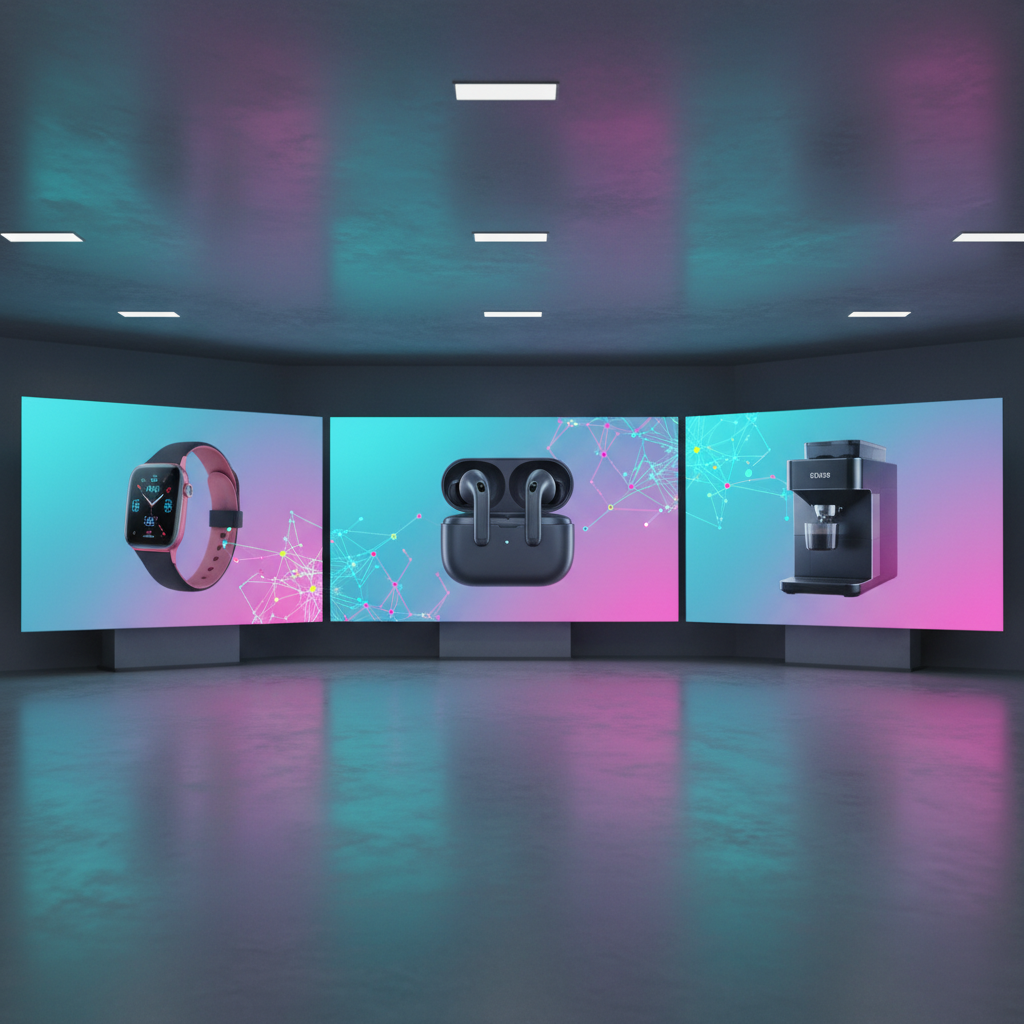
AI for Creating Consistent Product Photo Style Across Entire Catalog
TL;DR: Achieving AI product photo consistency across vast ecommerce catalogs is no longer a distant dream. Modern AI solutions streamline product image styling, ensuring every photo aligns perfectly with your brand aesthetic. These tools automate batch editing, enforce style guides, and dramatically reduce manual effort, leading to superior visual standardization and a cohesive customer experience.
Overview
In the competitive landscape of ecommerce, AI product photo consistency is a critical differentiator. A uniform visual presentation across your entire product catalog isn’t just about aesthetics; it directly impacts brand perception and conversion rates. Shoppers expect a seamless, professional experience, and inconsistent imagery can quickly erode trust.
Historically, maintaining this level of visual consistency was a monumental task. Manual editing, even with dedicated teams, was prone to human error, inconsistencies in lighting, cropping, and background, and was incredibly time-consuming. This challenge only escalates with larger product inventories and frequent updates.
This is precisely where artificial intelligence steps in, offering transformative AI solutions for consistent product imagery across catalogs. By leveraging advanced algorithms, businesses can now automate much of the styling process, ensuring every product photo adheres to a predefined aesthetic. The result is a highly polished, professional catalog that reinforces your brand identity at every touchpoint.
The Imperative of Visual Uniformity
Visual consistency transcends mere aesthetics; it’s a foundational element of strong branding. When every product image shares a cohesive style, it communicates professionalism and attention to detail. This uniformity helps customers navigate your catalog more easily, building subconscious trust and making the shopping experience more enjoyable.
The challenge of how to maintain brand visual consistency with AI product photography lies in scaling quality without sacrificing speed. Traditional methods often force a trade-off between these two crucial factors. However, AI eliminates this compromise, allowing for both rapid processing and unwavering adherence to style guidelines.
In my experience, an inconsistent catalog often signals a lack of organization or professionalism to potential buyers. It can disrupt the visual flow, making products appear disparate even if they belong to the same brand. Ecommerce visual standardization isn’t just a best practice; it’s a strategic imperative for modern online retailers.
Streamlining Product Photo Style with Artificial Intelligence
The advent of AI has revolutionized how businesses approach product photography post-production. Instead of individual manual adjustments, AI offers powerful capabilities for streamlining product photo style with artificial intelligence. This shift moves beyond simple automation to intelligent style application.
These advanced systems can analyze existing brand guidelines and apply them across thousands of images simultaneously. This includes everything from background removal and color correction to shadow creation and alignment. The goal is to achieve an automated product image style that is indistinguishable from expertly hand-edited photos.
One of the overlooked factors here is the sheer volume of assets ecommerce businesses manage. Manually ensuring every new product launch or seasonal update maintains the same visual integrity is a logistical nightmare. AI provides the scalable solution needed to manage this complexity effortlessly.
How AI Ensures Uniform Product Photography
How AI ensures uniform product photography across catalogs involves a multi-step process. First, an AI model is trained on a dataset of perfectly styled images that embody the brand’s desired aesthetic. This training allows the AI to learn the specific parameters, such as lighting angles, background styles, and product positioning.
Once trained, the AI can then process new, raw product images. It intelligently identifies key elements within each photo and applies the learned style transformations. This might include automatically cropping to specific aspect ratios, adjusting white balance, or even generating consistent shadows.
This intelligent application ensures that regardless of the original photo’s conditions, the output consistently matches the brand’s visual guide. It’s about more than just filters; it’s about deep understanding and application of visual rules. This is crucial for achieving a cohesive look in product photos using AI.
Benefits of AI for Consistent Product Image Styling
The benefits of AI for consistent product image styling are extensive, impacting operational efficiency, brand perception, and ultimately, sales. Beyond simply saving time, AI elevates the entire product presentation process.
Firstly, it ensures unparalleled accuracy in style application. Human editors, no matter how skilled, can introduce slight variations over time or across different team members. AI, once configured, applies the exact same rules to every single image, guaranteeing pixel-perfect consistency.
Secondly, the speed at which AI can process images is a game-changer. What would take a team of editors days or weeks can be accomplished by AI in hours. This accelerates time-to-market for new products and allows for more frequent catalog updates, keeping your offerings fresh and competitive.
Enhancing Brand Aesthetic with AI Solutions
Implementing AI for consistent product visual branding directly translates into a stronger, more recognizable brand. When customers encounter a visually uniform catalog, it reinforces the brand’s identity and professionalism. This consistency builds trust and makes the brand more memorable.
Brand aesthetic AI solutions go beyond simple image manipulation. They can analyze visual trends, suggest improvements to existing style guides, and even adapt to subtle shifts in brand identity over time. This proactive approach ensures your visual branding remains cutting-edge and relevant.
In my experience, companies that prioritize visual consistency often see higher engagement rates and lower bounce rates on product pages. A cohesive look creates a more immersive and trustworthy shopping environment, encouraging customers to explore more and ultimately make a purchase.
AI Tools for Batch Editing and Style Guide Automation
The core of achieving widespread product photo consistency lies in advanced AI tools for batch editing product photos to same style and look. These platforms are designed to handle large volumes of images, applying complex edits uniformly and efficiently.
Many of these tools leverage machine learning to understand and replicate specific aesthetic parameters. They can automatically detect product outlines, remove backgrounds, adjust lighting, and even correct perspectives. This capability is essential for AI bulk photo editing for ecommerce catalog consistency.
Furthermore, these platforms often integrate with existing digital asset management (DAM) systems, making the workflow seamless. Teams can upload raw images, apply their custom AI style profile, and receive perfectly consistent, publication-ready images back in a fraction of the time. For those exploring powerful options, a range of AI tools are available that can transform this process.
Automating Style Guide Creation with AI
One of the most innovative applications of this technology is style guide automation with AI for product photography teams. Instead of manually documenting every single visual parameter, AI can learn from a curated set of “golden standard” images and automatically generate a digital style guide.
This AI-powered guide can then be used to train new AI models or to provide clear, objective parameters for human photographers and editors. It ensures that every image, whether created by AI or a human, adheres to the precise specifications. This level of detail is crucial for maintaining product catalog uniformity AI can deliver.
What most guides miss is that AI doesn’t just follow a style guide; it can help create and enforce it. This ensures that the brand’s visual language is consistently applied across all product imagery, from initial photoshoot to final publication.
Integrating AI into Your Product Photography Workflow
Successfully implementing AI for consistent product visual branding requires a thoughtful integration strategy. It’s not about replacing your entire photography team but rather augmenting their capabilities and streamlining repetitive tasks.
The first step is often to audit your current workflow and identify bottlenecks where inconsistencies arise or where manual effort is disproportionately high. This could be background removal, color correction, or resizing. These are prime candidates for AI intervention.
Next, you’ll need to select the appropriate visual consistency software or platform. Many solutions offer varying degrees of automation and customization. It’s crucial to choose one that aligns with your specific brand style and catalog volume.
Action Framework: Implementing AI for Visual Consistency
Here’s a practical framework for integrating AI into your product photography workflow:
1. Define Your Style: Clearly articulate your brand’s visual style. Gather examples of ideal product photos, noting preferred backgrounds, lighting, shadows, and product placement.
2. Pilot Program: Start with a small batch of products or a specific category. Process these images through your chosen AI solution to evaluate its effectiveness and fine-tune settings.
3. Train the AI: If using a customizable AI, feed it your “golden standard” images. This teaches the AI your specific style guide parameters.
4. Integrate with Workflow: Link the AI tool with your existing DAM or photography pipeline. This might involve automated uploads and downloads.
5. Monitor and Refine: Regularly review AI-processed images for quality and consistency. Provide feedback to the AI system to continuously improve its output.
6. Scale Up: Once confident in the AI’s performance, gradually expand its application to larger portions of your catalog.
What the Data Shows: Impact of Visual Consistency
Data consistently highlights the positive impact of visual consistency on ecommerce performance. A study by Statista in 2023 indicated that 87% of online shoppers consider product image quality and consistency “very important” when making a purchase decision. This underscores the direct link between visual presentation and consumer confidence.
Another report from Adobe found that brands with consistent visual presentation across all platforms saw a 23% increase in revenue compared to those with inconsistent branding. This isn’t just about pretty pictures; it’s about tangible business outcomes.
Over 60% of consumers are more likely to trust a brand with a cohesive visual identity, according to a recent marketing survey. Trust directly translates into higher conversion rates and stronger customer loyalty.
FAQ Section
1. What is AI for creating consistent product photo style?
AI for creating consistent product photo style refers to the application of artificial intelligence and machine learning algorithms to automate and standardize the visual appearance of product images across an entire catalog. This technology analyzes existing images and brand guidelines to apply uniform edits, ensuring every photo adheres to a specific aesthetic. It’s a sophisticated form of AI image styling automation that goes beyond simple presets.
These AI systems can perform complex tasks such as background removal, lighting adjustments, color correction, and even shadow generation, all while maintaining precise consistency. The goal is to eliminate manual variations and significantly speed up the post-production process. This ensures product catalog uniformity AI can deliver at scale.
Essentially, it’s about leveraging intelligent software to enforce a brand’s visual identity on every single product image, regardless of its original capture conditions. This leads to a highly professional and cohesive online store presentation.
2. How does AI help maintain brand visual consistency with product photography?
AI helps maintain brand visual consistency by acting as a digital style enforcer. It is trained on a defined set of visual rules and examples, learning the exact parameters for lighting, cropping, backgrounds, and overall mood. When new images are fed into the system, the AI automatically applies these learned rules.
This eliminates human subjectivity and potential errors that can arise from manual editing across different photographers or editors. The AI ensures that every product image, whether it’s for a new collection or an update to an existing item, looks as if it was shot and edited by the same expert, under identical conditions. This addresses the core challenge of how to maintain brand visual consistency with AI product photography.
It acts as a central brain for your visual assets, ensuring that your brand aesthetic AI solutions are consistently applied, reinforcing your identity across all customer touchpoints. This level of uniformity is nearly impossible to achieve manually at scale.
3. Why is a consistent product photo style important for an entire catalog?
A consistent product photo style is paramount for an entire catalog because it directly impacts brand perception, customer trust, and ultimately, sales. When all product images share a uniform look, it conveys professionalism and attention to detail, making your brand appear more reliable and established.
Inconsistency, on the other hand, can make a catalog look disjointed, unprofessional, and even untrustworthy, leading to higher bounce rates. A cohesive visual experience helps customers easily navigate and understand your offerings, reducing cognitive load and enhancing the overall shopping journey. This is fundamental for ecommerce visual standardization.
Moreover, strong visual consistency reinforces brand recognition. When customers see your products, they immediately associate them with your brand, building a stronger emotional connection and fostering loyalty. It’s a key element in creating a memorable and positive brand experience.
4. What are the benefits of using AI for product photo styling?
The benefits of using AI for product photo styling are numerous and impactful. Firstly, it offers unprecedented speed and scalability, allowing businesses to process thousands of images in a fraction of the time compared to manual methods. This accelerates time-to-market for new products.
Secondly, AI ensures flawless consistency and accuracy, eliminating human error and subjective variations. Every image adheres to the exact same style guidelines, leading to a perfectly uniform catalog. This addresses the core benefits of AI for consistent product image styling.
Thirdly, it leads to significant cost savings by reducing the need for extensive manual editing and potentially fewer reshoots due to style discrepancies. Finally, it frees up creative teams to focus on more strategic and creative tasks, rather than repetitive post-production work.
5. How do AI tools for batch editing product photos work?
AI tools for batch editing product photos typically work by first analyzing a set of “reference” images that embody the desired style. The AI learns specific parameters such as lighting, shadows, backgrounds, cropping rules, and color grading. This training phase is crucial.
Once trained, users can upload a large batch of raw product photos. The AI then processes each image individually, intelligently applying the learned style transformations. For instance, it might automatically remove the background, replace it with a uniform white, adjust product lighting to match the reference, and crop the image to a standard aspect ratio.
This entire process is automated, often leveraging powerful cloud computing to handle the computational load efficiently. The output is a collection of perfectly styled images, ready for publication, demonstrating true AI bulk photo editing for ecommerce catalog consistency.
6. Can AI automate style guide creation for product photography teams?
Yes, AI can absolutely automate style guide creation for product photography teams, marking a significant advancement in workflow efficiency. Instead of manually documenting every rule and parameter, AI can analyze a curated set of “perfect” product images that exemplify your brand’s desired style.
From these examples, the AI can extrapolate precise rules for backgrounds, lighting, angles, shadows, and even product placement. It can then generate a comprehensive, objective digital style guide that leaves no room for ambiguity. This capability is at the heart of style guide automation with AI for product photography teams.
This automated style guide can then serve as the definitive standard, both for human photographers and editors, and for further AI processing. It ensures that everyone involved in content creation understands and adheres to the exact visual parameters, fostering consistent output.
7. What are the best AI solutions for bulk photo editing for ecommerce catalog consistency?
The best AI solutions for bulk photo editing for ecommerce catalog consistency often combine advanced image recognition with powerful batch processing capabilities. While specific tools evolve rapidly, leading platforms often include features like automated background removal, intelligent lighting correction, and consistent shadow generation.
Some popular options in the market include specialized services or integrated features within larger platforms. For instance, tools like Pixelz, remove.bg (for background removal, often integrated into larger workflows), and various cloud-based AI image processing APIs offer robust capabilities. When choosing, look for solutions that allow for custom style profile creation and seamless integration with your existing systems. Exploring a range of AI image generators and editors can help identify the perfect fit for your specific needs.
Ultimately, the “best” solution depends on your catalog size, specific style requirements, and budget. It’s crucial to test different platforms to see which one delivers the most accurate and consistent results for your particular product range.
8. How to integrate AI into an existing product photography workflow?
Integrating AI into an existing product photography workflow involves several strategic steps. First, identify the most time-consuming or inconsistent stages of your current process, such as background removal or color grading. These are ideal candidates for AI automation.
Next, choose an AI software or service that offers the specific functionalities you need and can integrate with your current tools (e.g., DAM systems, photo editing software). Many AI solutions provide APIs for seamless connection.
Then, establish your “golden standard” images to train the AI on your brand’s desired style. Begin with a pilot project, processing a small batch of photos to fine-tune the AI’s settings and evaluate its output. Once satisfied, you can gradually scale up the integration, allowing AI to handle the bulk of repetitive styling tasks, thus optimizing product photography workflow with AI consistency.
9. What kind of visual consistency can AI achieve in product photos?
AI can achieve a remarkably comprehensive range of visual consistency in product photos. This includes uniform backgrounds (e.g., pure white, transparent, or studio-style), consistent lighting and shadows that mimic professional studio setups, and standardized cropping and aspect ratios. It’s about creating a unified visual language.
Furthermore, AI can ensure consistent color accuracy, removing color casts and maintaining true-to-life product hues across all images. It can also standardize product positioning and scale, making sure items appear consistently sized and angled. This level of detail is crucial for achieving a cohesive look in product photos using AI.
The result is a catalog where every product image looks like it belongs together, creating a harmonious and professional browsing experience for the customer. This extends to even subtle elements like reflections and depth of field.
10. Is AI product photography cost-effective for large catalogs?
Absolutely, AI product photography is highly cost-effective, especially for large catalogs. The initial investment in AI software or services is quickly offset by significant savings in time and labor. Manual editing for thousands of products requires extensive human resources, which translates to high ongoing operational costs.
AI dramatically reduces the need for large teams of retouchers, speeding up the entire post-production process. This means products can go live faster, accelerating sales cycles. The consistency achieved also reduces the likelihood of reshoots due to style discrepancies, saving further costs.
Moreover, the improved visual quality and consistency that AI provides can lead to higher conversion rates and fewer product returns due to inaccurate visual representation. This makes AI product photography cost-effective for large catalogs not just in terms of direct savings, but also through enhanced revenue generation and brand value.
Comparison: Traditional vs. AI-Powered Product Photo Workflow
| Feature | Traditional Workflow (Manual) | AI-Powered Workflow |
|---|---|---|
| Consistency | Prone to human error, variations across editors/time. | Pixel-perfect, machine-driven uniformity. |
| Speed | Slow, labor-intensive, bottlenecks with large volumes. | Extremely fast, processes thousands of images in hours. |
| Cost | High labor costs, ongoing expenses for retouchers. | Higher upfront software/training, lower long-term operational costs. |
| Scalability | Difficult to scale quickly with growing catalog. | Highly scalable, handles vast catalogs effortlessly. |
| Complexity | Requires skilled editors for each complex task. | Automates complex tasks, simplifies overall process. |
| Style Guide Enforcement | Manual interpretation, potential for deviation. | Automated enforcement, precise application of rules. |
Data-Backed Bullet Insights
* 87% of online shoppers consider product image quality and consistency “very important” when making a purchase decision. This highlights that visual consistency isn’t just a nice-to-have; it’s a fundamental expectation for today’s consumers, directly influencing their buying behavior.
* Brands with consistent visual presentation across all platforms saw a 23% increase in revenue. This statistic unequivocally demonstrates the direct financial impact of a cohesive brand aesthetic, proving that investment in ecommerce visual standardization yields significant returns.
* Over 60% of consumers are more likely to trust a brand with a cohesive visual identity. The implication here is clear: visual consistency builds trust, which is the bedrock of customer loyalty and repeat business. It’s a non-negotiable for building strong brand equity.
* AI-powered image processing can reduce post-production time by up to 80%, according to industry benchmarks. This massive time saving directly translates to faster product launches and more agile marketing campaigns, offering a significant competitive advantage.
* Companies leveraging AI for visual content report a 40% reduction in image-related customer complaints. This indicates that consistent, high-quality imagery minimizes misunderstandings about product appearance, leading to greater customer satisfaction and fewer returns.
Future Outlook: The Evolution of AI in Product Imagery
The trajectory of AI in product imagery points towards even greater sophistication and autonomy. We’re moving beyond mere style application to predictive aesthetics. Imagine AI not just enforcing a style guide, but actively suggesting optimal visual styles based on current market trends and consumer preferences.
The future will likely see more advanced AI image styling automation that can adapt to different sales channels (e.g., social media vs. website vs. print), automatically generating variations of product photos optimized for each platform. We’ll also see deeper integration with 3D models and augmented reality, allowing for dynamic, interactive product visuals that maintain perfect consistency across all representations. The ability to create images that are not only consistent but also hyper-realistic and interactive will be a game-changer.
Furthermore, AI will play a crucial role in creating entirely synthetic product images from scratch, eliminating the need for physical photoshoots for certain product categories. This will offer unparalleled consistency and flexibility, truly transforming the landscape of product visual content.
Practical Checklist: Implementing AI for Visual Consistency
To effectively implement AI for AI product photo consistency, follow this actionable checklist:
* Define Your Brand’s Visual Style: Create a clear, written style guide detailing backgrounds, lighting, cropping, and color palettes.
* Audit Current Workflow: Identify bottlenecks and areas of inconsistency in your existing product photography and editing process.
* Research AI Solutions: Explore various visual consistency software and platforms that offer automated batch editing and style application.
* Pilot Test: Select a small, representative batch of products and process them through your chosen AI tool to evaluate its performance.
* Train the AI: Provide the AI with your “golden standard” images to precisely teach it your brand’s aesthetic.
* Integrate with Existing Systems: Connect the AI solution with your Digital Asset Management (DAM) system or other workflow tools.
* Establish Review Protocols: Implement a system for human review of AI-processed images to ensure quality and make any necessary manual adjustments.
* Monitor and Optimize: Continuously track the performance of your AI workflow, gather feedback, and fine-tune settings for ongoing improvement.
* Educate Your Team: Train your photography and marketing teams on the new AI-enhanced workflow and its benefits.
* Scale Gradually: Once confident, progressively expand the use of AI to cover more product categories and larger volumes.